



DHT11 Sensor: How It Works and Key Applications
Humidity—the amount of water vapour in the air—impacts everything from industrial processes to human comfort. Accurate humidity monitoring is critical in sectors such as semiconductor manufacturing, HVAC systems, and public safety. Digital sensors like the DHT11 provide a cost‑effective solution for real‑time temperature and humidity measurement.
What is a DHT11 Sensor?
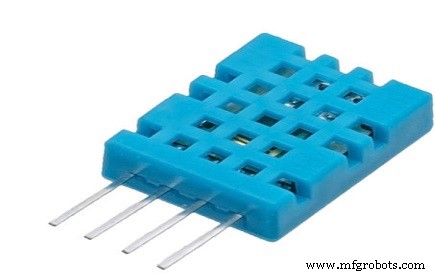
The DHT11 is a low‑cost digital sensor that delivers simultaneous temperature and relative humidity readings. It can be paired with microcontrollers (Arduino, Raspberry Pi, ESP32, etc.) via a single data line, making it ideal for hobbyist projects and industrial prototypes alike.
Two variations exist: the standalone sensor and the ready‑to‑use module. The module includes a pull‑up resistor and an indicator LED, simplifying connections and power management.
How the DHT11 Works
The sensor contains a capacitive humidity element and a Negative Temperature Coefficient (NTC) thermistor. The humidity capacitor has two electrodes separated by a moisture‑absorbing dielectric. As ambient humidity changes, the dielectric’s permittivity varies, altering the capacitance. The integrated circuit converts this change into a digital humidity value.
Temperature is measured by the NTC thermistor: as temperature rises, the thermistor’s resistance decreases. The sensor’s circuitry amplifies this small resistance change, allowing precise digital conversion.
Key Specifications
- Temperature range: 0 °C to 50 °C (±2 °C accuracy)
- Humidity range: 20 % to 80 % RH (±5 % accuracy)
- Sampling rate: 1 Hz (one reading per second)
- Operating voltage: 3 V to 5 V
- Current consumption: ≤2.5 mA
- Pinout: VCC, GND, DATA, NC
- Pull‑up resistor: 5 kΩ–10 kΩ (recommended for data line)
Practical Applications
The DHT11’s compact size, low power, and simple wiring make it popular across a wide range of applications:
- HVAC systems for real‑time climate monitoring
- Portable weather stations and climate research
- Home automation and humidity control in living spaces
- Industrial environments where moisture control is critical (museums, greenhouses, car interiors)
- Educational projects and rapid prototyping
Alternatives and Choosing the Right Sensor
If your project demands higher accuracy, wider range, or faster sampling, consider these alternatives:
- DHT22 / AM2302 – 0 °C to 80 °C, 0 %–100 % RH, ±0.5 °C and ±2 % RH accuracy, 10 Hz sampling
- SHT7x – 0 °C to 125 °C, 0 %–100 % RH, sub‑percent accuracy, up to 20 Hz sampling
Assess your application’s tolerance for temperature range, humidity precision, and response time to select the optimal sensor. The DHT11 remains a reliable choice when budget and simplicity are paramount.
Sensor
- Voltage Sensors: How They Work & Key Applications in Modern Power Systems
- Lambda (Oxygen) Sensor: Function, Operation, and Key Automotive Applications
- Image Sensors: Types, Operation, and Practical Applications
- Gyroscope Sensors: How They Work and Their Key Applications
- Flame Sensors: How They Work and Key Applications in Fire Safety
- Sound Sensors: How They Work & Practical Applications
- Humidity Sensors: How They Work and Key Applications
- Rain Sensors Explained: How They Work & Key Applications
- Laser Sensors Explained: Working Principles & Industrial Applications
- How Tactile Sensors Work: Types, Principles, and Applications