



How Tactile Sensors Work: Types, Principles, and Applications
The WSG‑DSA gripper finger incorporates a high‑resolution tactile transducer, the DSA9205i, directly onto the base jaws of the WSG. Its seamless integration with the gripper controller eliminates the need for external cables, allowing real‑time pressure profile feedback during grasping. This article explains the various tactile sensor types and how they function.
What Is a Tactile Sensor?
A tactile sensor is an electronic device that detects physical interactions with its environment. Human touch is typically modeled as cutaneous (skin) and kinesthetic (muscle and joint) senses. Cutaneous sensors respond to mechanical pressure, pain, and temperature, while kinesthetic sensors capture data from muscles, tendons, and joints.
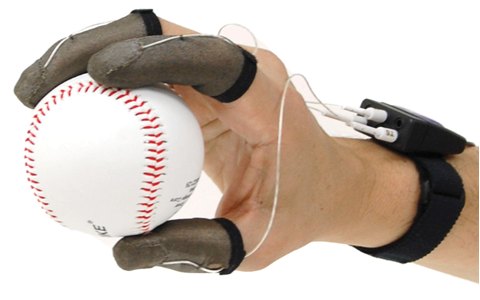
Types of Tactile Sensors
Tactile sensors can be broadly categorized into three main groups:
- Force / Torque Sensors
- Dynamic Sensors
- Thermal Sensors
Force / Torque Sensors
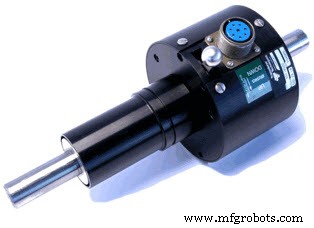
When paired with a tactile array, force/torque sensors provide essential data for precise force control. They can detect load at various points, such as the distal link of a manipulator, and offer high‑bandwidth measurements when used as skin sensors. In an intrinsic tactile sensing setup, the sensor reveals the exact contact location and the associated force or moment.
Dynamic Sensors
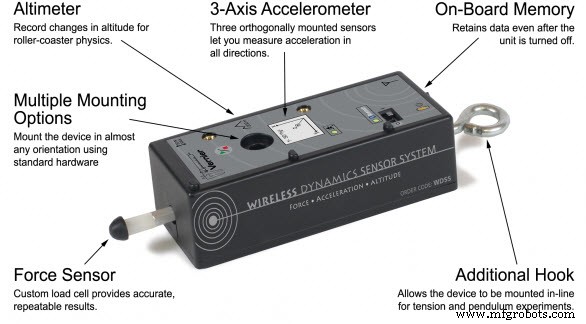
Dynamic sensors are compact accelerometers positioned on finger strips or the skin of a robotic hand. Mimicking Pacinian corpuscles, they detect the onset and release of contact as well as vibrations from sliding over textured surfaces. A secondary type—stress‑rate sensors—captures rapid changes when a fingertip slides over small surface irregularities. These devices often use piezoelectric polymers such as PVDF to convert mechanical strain into a proportional electrical signal.
Thermal Sensors
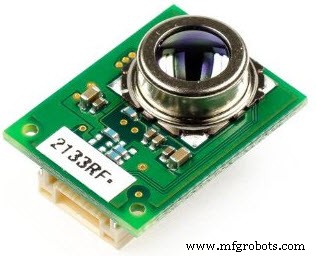
Thermal sensors help robots discern material properties by measuring temperature gradients and thermal conductivity. Common configurations combine Peltier junctions with thermistors, enabling fine‑grained temperature mapping of an object’s surface.
Working Principle and Circuit Diagram
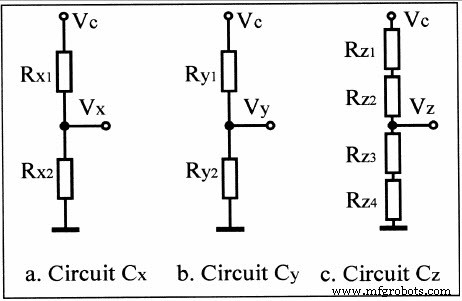
Tactile sensors convert surface contact forces into electrical signals that a robot’s controller can interpret. Three‑dimensional sensors capture normal, shear, and tangential forces, which are essential for force‑controlled manipulation and slip prevention. MEMS‑based technologies frequently underpin these devices, embedding piezoresistive or capacitive elements and pre‑amplification circuits within a compact package.
Tactile Sensors in Robotics
NASA’s robotic missions employ tactile sensors for planetary exploration and maintenance tasks on the International Space Station. These systems have evolved from simple force‑sensing resistors to advanced quantum‑tunneling composites, enabling reliable feedback in harsh environments.
Applications of Tactile Sensors
- Robotics and industrial automation
- Computer hardware and touch interfaces
- Security and surveillance systems
- Consumer electronics (touch screens)
- Medical and prosthetic devices
Benefits of Tactile Sensors
- User‑friendly integration with existing hardware
- Cable‑free, compact design
- Proven reliability in demanding robotic applications
- Scalable for a range of force ranges—from 0.01 N to several newtons
This overview highlights how tactile sensors convert touch into actionable data, empowering robots with human‑like perception. For deeper insights or to discuss specific projects, feel free to leave a comment below.
Photo Credits:
- Tactile Sensor squarespace
- Force/ Torque Sensor transducertechniques
- Dynamic Sensor vernier
- Thermal Sensor images‑amazon
Sensor
- Voltage Sensors: How They Work & Key Applications in Modern Power Systems
- Lambda (Oxygen) Sensor: Function, Operation, and Key Automotive Applications
- Image Sensors: Types, Operation, and Practical Applications
- Gyroscope Sensors: How They Work and Their Key Applications
- Flame Sensors: How They Work and Key Applications in Fire Safety
- Sound Sensors: How They Work & Practical Applications
- Humidity Sensors: How They Work and Key Applications
- DHT11 Sensor: How It Works and Key Applications
- Rain Sensors Explained: How They Work & Key Applications
- Laser Sensors Explained: Working Principles & Industrial Applications