



MQ135 Alcohol Sensor Circuit, Working Principle & Applications
The MQ series gas sensors employ a miniature heater and a tin‑oxide sensing element to detect a wide range of gases at ambient temperature. The MQ‑135, specifically, is a low‑conductivity sensor that registers increased conductivity when exposed to alcohol vapour and other harmful gases. Through a simple electronic interface, the change in conductivity is converted into an analog voltage that reflects gas concentration.
MQ‑135 offers high sensitivity to ammonia, sulfides, benzene, smoke, and other toxic compounds while remaining inexpensive and suitable for diverse projects. Other alcohol sensors in the MQ family include MQ‑2, MQ‑3, MQ‑4, MQ‑5, and MQ‑6.
What Is an Alcohol Sensor?
An alcohol sensor measures the presence of alcohol vapour in the air and outputs an analog voltage proportional to the detected concentration. It operates between –10 °C and +50 °C and requires a power supply of 2.5 V to 5 V. The typical sensing range is 0.04 mg/L to 4 mg/L, making it ideal for breath‑alyzer applications.
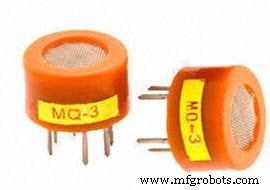
MQ‑135 Gas Sensor Overview
The MQ‑135 detects gases such as ammonia, nitrogen oxides, alcohols, aromatic hydrocarbons, sulfides, and smoke. Its operating voltage ranges from 2.5 V to 5 V, and it features a PT1301 boost converter for the accompanying MQ‑3 sensor. When polluted air enters the sensor, the conductivity of the tin‑oxide layer rises, and the sensor’s output voltage increases accordingly. This makes the MQ‑135 a versatile tool for detecting smoke, benzene, and other hazardous gases.
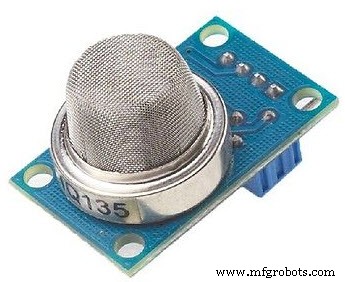
Pin Configuration
The MQ‑135 has six pins: VCC, GND, A0, A1, D0, and D1. For basic analog output, connect VCC to 5 V, GND to ground, and A0 to the microcontroller’s analog input. D0 and D1 provide digital outputs for threshold detection.
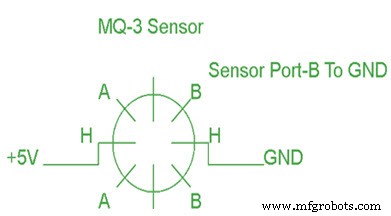
Working Principle & Circuit Diagram
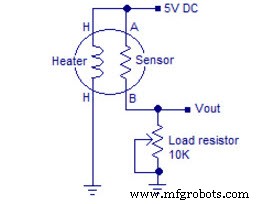
The sensor’s core is a tin‑oxide (SnO₂) layer on ceramic microtubes, heated by an integrated element. Alcohol vapour oxidises to acetic acid over the heated surface, decreasing the resistance of the SnO₂ layer. By placing an external load resistor in series, the resistance change translates into a measurable voltage drop. The following schematic illustrates a typical interface with an Arduino: the sensor’s analog output feeds a voltage divider, while the digital output can trigger an alarm when a set threshold is exceeded.
MQ‑135 as an Air‑Quality Sensor
Beyond alcohol detection, the MQ‑135 excels at monitoring indoor air quality. It senses ammonia, nitrogen oxides, CO₂, and other pollutants. A small potentiometer allows fine‑tuning of the load resistance, improving accuracy across different environments. The sensor provides two outputs: an analog voltage proportional to gas concentration and a TTL digital signal that goes low when the concentration surpasses a configurable threshold.

Applications
- Indoor air‑quality monitoring
- Industrial safety and emission control
- Portable air‑pollution detectors
- Smart home air‑quality dashboards
- Automotive cabin‑air monitoring
Key Features
- Broad‑spectrum sensitivity to toxic gases
- Long service life and low cost
- High responsiveness to ammonia, benzene, and sulfides
- Simple drive circuit compatible with microcontrollers
This article covered the MQ‑135 alcohol sensor’s circuit diagram, operating principle, and practical uses. For further insight, feel free to leave comments or ask how to measure CO₂ and O₂ levels with an MQ‑135 on Arduino.
Photo Credits:
- Alcohol Sensor – alselectro
- MQ‑135 gas sensor – ebayimg
- MQ‑135 Circuit Diagram – circuitstoday
- MQ‑135 air quality sensor – WIKISPACES
Sensor
- Blood Pressure Sensor: How It Works & Key Applications
- MQ2 Gas Sensor: Functionality, Working Mechanism, and Practical Applications
- Fingerprint Sensor Technology: Working Principles, Applications, and Arduino Integration
- Vibration Sensors: Principles, Types, and Industrial Applications
- How Oxygen Sensors Work and Their Key Applications in Automotive and Industrial Systems
- MQ135 Alcohol Sensor Circuit, Working Principle & Applications
- Passive Infrared Sensor Power‑Saver Circuit: Design, Operation, and Applications
- PIR Sensor–Driven Automatic Door Opening System: Circuit, Working & Applications
- Inductive Proximity Sensor: Circuit Design, Functionality, and Practical Applications
- How PIR Sensor Circuits Work: Design, Operation, and Real‑World Applications