



PIR Sensor–Driven Automatic Door Opening System: Circuit, Working & Applications
Automatic doors are common in commercial buildings, malls, and theatres. They open when a person approaches and close when they leave. Several sensor types—radar, PIR, infrared, laser—can trigger the mechanism. This article focuses on a PIR (passive infrared) sensor that detects the heat signature of a human body and sends a signal to a microcontroller to drive the door motor.
How the PIR‑Based Automatic Door Works
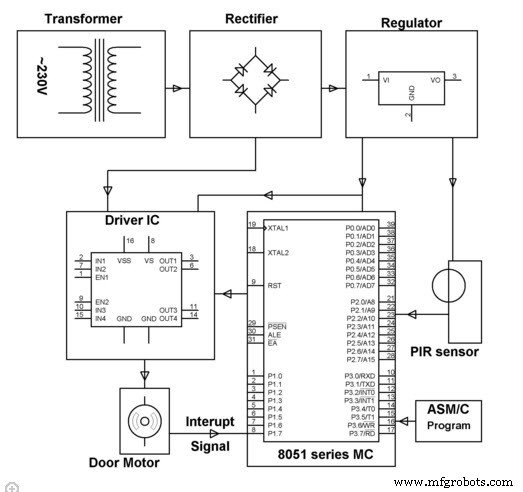
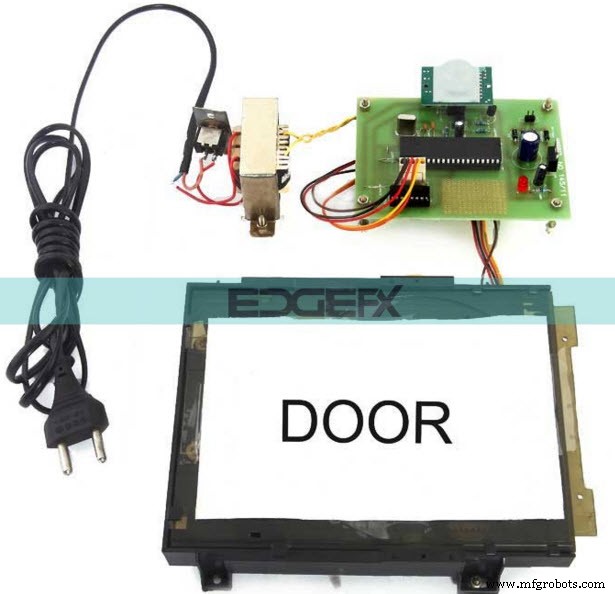
When someone steps within the PIR sensor’s field of view, the sensor registers a change in infrared radiation. The sensor outputs a digital pulse that the microcontroller reads. Once the microcontroller receives the pulse, it activates a motor driver (e.g., L293D) to turn the motor, opening the door. After a preset timeout, the microcontroller sends a command to reverse the motor, closing the door. Limit switches interrupt the motor to prevent over‑travel or stalling.

Circuit Overview
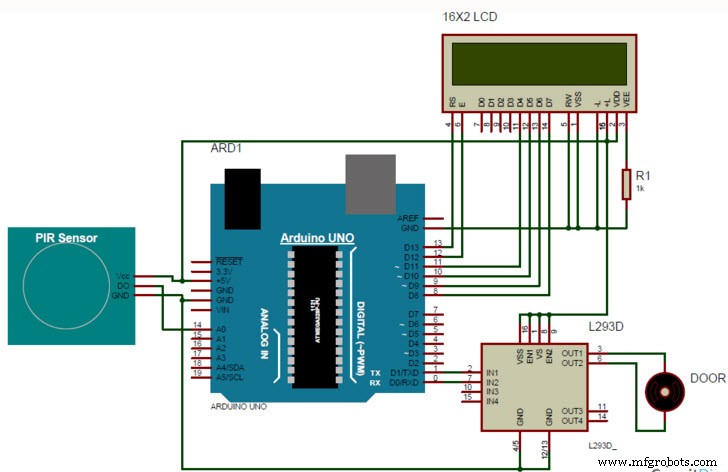
The typical circuit uses an Arduino UNO, a 16×2 LCD for status display, a PIR sensor, a motor driver IC (L293D), a 1 kΩ resistor, and a 12 V motor. The PIR’s Vcc and GND connect to the Arduino’s 5 V and GND, and its OUT pin connects to A0. The LCD’s RS and EN pins tie to pins 12 and 13; data pins D0–D7 link to pins 8–11, while RW goes to GND. The L293D enables bidirectional control of the motor via pins 0 and 1.
Key Components and Software
• 8051 or Arduino microcontroller
• PIR sensor (passive infrared)
• Motor driver IC (L293D or equivalent)
• 12 V DC motor or stepper motor
• Power supply (transformer or battery)
• Diodes, resistors, capacitors, crystal (if using 8051)
• Firmware written in C or Assembly, compiled with Keil or Arduino IDE
The system can be expanded to count entries and exits by adding a simple counter circuit and EEPROM storage for logging when power is lost. This makes it useful for security audits or crowd control in busy venues.
In summary, a PIR‑sensor driven automatic door offers reliable, low‑maintenance operation for high‑traffic areas. If you have questions about implementation or want to adapt the design for specific use cases, feel free to comment below.
Photo Credits:
- Automatic Door Opening System tallahassee
- Automatic Door Opening System Circuitcircuitdigest
Sensor
- Blood Pressure Sensor: How It Works & Key Applications
- Door Sensors: How They Work and Their Role in Home Security
- Fingerprint Sensor Technology: Working Principles, Applications, and Arduino Integration
- Vibration Sensors: Principles, Types, and Industrial Applications
- How Oxygen Sensors Work and Their Key Applications in Automotive and Industrial Systems
- MQ135 Alcohol Sensor Circuit, Working Principle & Applications
- Passive Infrared Sensor Power‑Saver Circuit: Design, Operation, and Applications
- Inductive Proximity Sensor: Circuit Design, Functionality, and Practical Applications
- How PIR Sensor Circuits Work: Design, Operation, and Real‑World Applications
- How Manual and Automatic Transmissions Transfer Power: A Clear Overview