



Inductive Proximity Sensor: Circuit Design, Functionality, and Practical Applications
Proximity sensors are essential components in modern automation, enabling non‑contact detection of objects. Among them, inductive proximity sensors excel at identifying metallic targets with high reliability and a long service life, thanks to their solid‑state construction.
What Is a Proximity Sensor?
A proximity sensor detects the presence of nearby objects without physical contact, using electromagnetic fields or radiation beams. The object sensed is called the target. Different target materials—plastic, metal, magnetic—require specific sensor types such as capacitive, photoelectric, inductive, or magnetic.
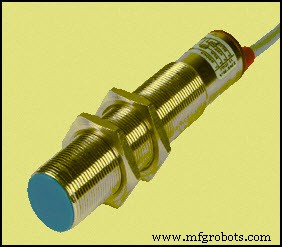
Inductive sensors, unlike many others, have no moving parts, making them highly durable and low‑maintenance. Their nominal range is the maximum distance at which a target can be reliably detected.
Inductive Proximity Sensor Circuit Diagram
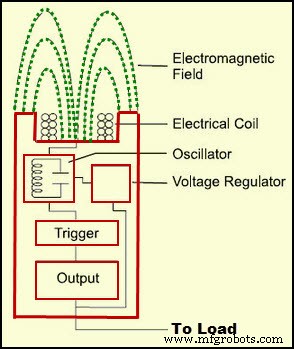
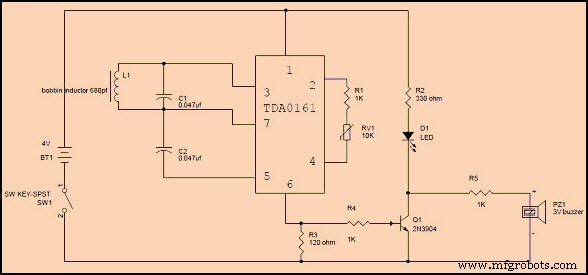
The core of the circuit consists of an oscillator, an induction coil, a power supply, and a voltage regulator. The oscillator generates a high‑frequency magnetic field that drives the coil.
How the Circuit Works
When a metallic target enters the sensor’s field, eddy currents are induced within the target. These currents generate their own magnetic field, which opposes the primary field and reduces its amplitude. The oscillator senses this drop; once the amplitude falls below a predefined threshold, the trigger circuit flips the output state.
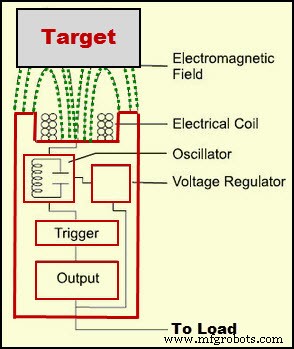
As the target approaches, eddy currents increase, further diminishing the field. Conversely, when the target moves away, the field recovers, and the sensor output returns to its default state.
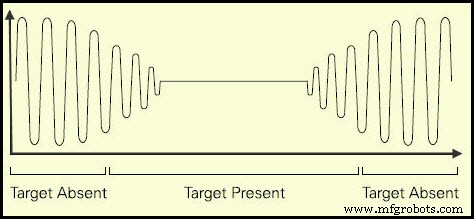
The waveform changes noticeably when a target is present versus absent, as illustrated above.
Operating Voltages
Modern inductive sensors support a wide range of voltages: 10 V to 320 V DC and 20 V to 265 V AC. They are available in AC, DC, and universal (AC/DC) configurations, allowing flexible integration into diverse systems.
Wiring and Output Logic
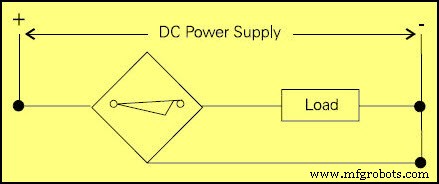
Depending on the sensor’s logic, the output may be Normally Closed (NC) or Normally Open (NO). A PNP output that is low when no target is present indicates an NO configuration; a high output in the same condition indicates NC.
Target Size and Geometry
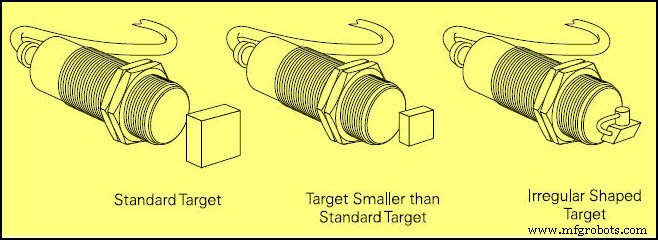
Standard targets are flat, smooth, 1 mm thick mild steel plates. For shielded sensors, the target side length matches the sensor’s sensing face diameter; for unshielded sensors, it should be the larger of the face diameter or three times the rated range. If the target is smaller or irregular, detection distance decreases, requiring the target to be closer.
Applications of Inductive Proximity Sensors
These sensors are ubiquitous in industrial and consumer electronics. Common uses include:
- Metal Detection: Combine the sensor with a buzzer and LC resonant circuit to create a simple metal detector that alerts when metal is nearby.
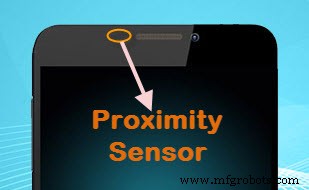
- Mobile Phone Display Control: In smartphones, a proximity sensor turns the display off when the device is held near the ear, preventing accidental touches.
- Automation and Safety: Detect machine parts, verify product presence on conveyor belts, and trigger safety interlocks.
- Robotics: Integrate into robotic grippers or obstacle‑avoidance systems.
Whether you’re designing a prototype or scaling a production line, inductive proximity sensors offer a reliable, contact‑less solution. Share your project ideas and let us help you turn your vision into reality.
Sensor
- Blood Pressure Sensor: How It Works & Key Applications
- Voltage Sensors: How They Work & Key Applications in Modern Power Systems
- RVG Sensor: How It Works and Why It’s Transforming Dental Imaging
- Lambda (Oxygen) Sensor: Function, Operation, and Key Automotive Applications
- Image Sensors: Types, Operation, and Practical Applications
- Color Sensors: How They Work & Key Applications
- Compass Sensors: From Ancient Navigation to Modern Devices
- Fingerprint Sensor Technology: Working Principles, Applications, and Arduino Integration
- Vibration Sensors: Principles, Types, and Industrial Applications
- How Oxygen Sensors Work and Their Key Applications in Automotive and Industrial Systems