



Throttle Position Sensor: How It Works and Why It Matters
In contemporary vehicles, the throttle system regulates engine air intake, enabling precise control over power output by adjusting the throttle valve’s opening. This system is now part of the drive‑by‑wire architecture, where electronic sensors replace many mechanical linkages, and the Engine Control Unit (ECU) uses sensor data to fine‑tune fuel injection and ignition timing.
What Is a Throttle Position Sensor?
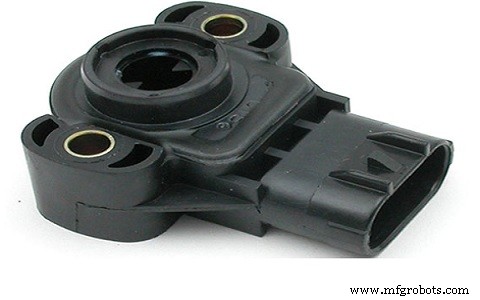
The Throttle Position Sensor (TPS) is a critical electronic component that monitors the position of the throttle valve (butterfly valve) inside the throttle body. It functions essentially as a potentiometer: as the valve opens or closes, the sensor’s output voltage changes proportionally, providing the ECU with a real‑time signal of the driver’s accelerator input.
Working Principle
Mounted on the throttle body, the TPS senses the valve’s angular position and sends a voltage signal to the ECU. The signal is derived from a three‑wire potentiometer: the first wire supplies 5 V to the resistive track, the second wire serves as ground, and the third wire (the wiper) delivers the variable voltage to the ECU. The voltage typically ranges from about 0.5 V (idle) to 4.5 V (wide‑open throttle).
TPS designs vary: the most common are the simple potentiometer type, the closed‑throttle version that includes end‑switches for safety, and hybrid models that combine both features.
Applications
The ECU relies on the TPS to determine engine load and to adjust fuel delivery and ignition timing. Key operating points include:
- Idle: Output voltage < 0.7 V.
- Partial throttle: Voltage between 0.7 V and 4.0 V.
- Wide‑open throttle (WOT): Output voltage ≈ 4.5 V.
A malfunctioning TPS can trigger a Check Engine Light (CEL) and cause symptoms such as engine surging, stalling, or loss of power. Common failure modes include wiring corrosion, internal resistor drift, or mechanical binding of the throttle shaft.
What are the three states of throttle value the sensor can detect?
Answer: Idle, partial throttle, and wide‑open throttle.
Sensor
- Blood Pressure Sensor: How It Works & Key Applications
- Voltage Sensors: How They Work & Key Applications in Modern Power Systems
- Throttle Position Sensor: How It Works and Why It Matters
- RVG Sensor: How It Works and Why It’s Transforming Dental Imaging
- Lambda (Oxygen) Sensor: Function, Operation, and Key Automotive Applications
- Pulse Sensor: How It Works and Key Applications for Makers
- Understanding RTD Sensors: Principles, Accuracy, and Key Applications
- Fingerprint Sensor Technology: Working Principles, Applications, and Arduino Integration
- Vibration Sensors: Principles, Types, and Industrial Applications
- How Oxygen Sensors Work and Their Key Applications in Automotive and Industrial Systems