



Blood Pressure Sensor: How It Works & Key Applications
Blood pressure (BP) is a critical vital sign that reflects the force of circulating blood against arterial walls. It is commonly expressed as the ratio of systolic to diastolic pressure. Traditional measurements rely on a mercury sphygmomanometer, but since 1981, automated oscillometric methods have become standard for non‑invasive BP monitoring. Modern devices employ a pressure sensor instead of a mercury column to capture arterial pressure changes digitally.
What Is a Blood Pressure Sensor?
A blood pressure sensor is a non‑invasive device that records arterial pressure using an electronic pressure transducer. It replaces the mercury column found in traditional cuffs with a solid‑state sensor, allowing for automated, on‑screen readings without manual auscultation.
Working Principle
In conventional cuffs, a clinician inflates the cuff, manually occluding the artery, and listens for Korotkoff sounds with a stethoscope to determine systolic and diastolic values. Automated systems, however, use a pressure sensor embedded in the cuff to detect oscillations in cuff pressure as the cuff deflates. These oscillations correspond to arterial blood flow, and an onboard processor analyzes the waveform to calculate systolic, diastolic, and mean arterial pressures. The results are then displayed on a digital read‑out.
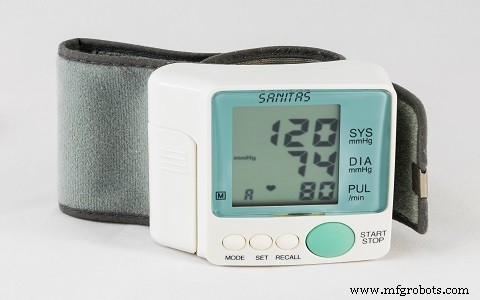
The sensor’s digital output is processed in real time, recorded, and presented on a monitor that may include additional analytics such as pulse rate and trend history.
Advantages
Because the sensor is non‑invasive, it eliminates the risks associated with mercury exposure and needle puncture. Its automated nature reduces user error, offers instant results, and is ideal for home use or clinical environments where quick, repeatable measurements are essential.
Applications of Blood Pressure Sensors
Blood pressure sensors are indispensable for managing hypertension, particularly for patients who require frequent monitoring at home. The compact, battery‑operable design makes them suitable for remote or underserved areas lacking full medical infrastructure.
A critical component of accurate measurement is the selection of the pressure sensor. Honeywell’s 26 PC SMT sensor is a popular choice because it offers high‑pressure capability, fast response, and low cost. Its surface‑mount design simplifies PCB integration and keeps installation expenses minimal.
Using oscillometric techniques, the system can determine systolic, diastolic, and mean arterial pressures, as well as pulse rate. It can be powered from mains electricity or run on rechargeable batteries.
What ratio of systolic pressure over diastolic pressure is considered normal?
Sensor
- Blood Pressure Sensor: How It Works & Key Applications
- Voltage Sensors: How They Work & Key Applications in Modern Power Systems
- RVG Sensor: How It Works and Why It’s Transforming Dental Imaging
- Lambda (Oxygen) Sensor: Function, Operation, and Key Automotive Applications
- Image Sensors: Types, Operation, and Practical Applications
- Color Sensors: How They Work & Key Applications
- Compass Sensors: From Ancient Navigation to Modern Devices
- Fingerprint Sensor Technology: Working Principles, Applications, and Arduino Integration
- Vibration Sensors: Principles, Types, and Industrial Applications
- How Oxygen Sensors Work and Their Key Applications in Automotive and Industrial Systems