



Vibration Sensors: Principles, Types, and Industrial Applications
What Is a Vibration Sensor?
A vibration sensor, commonly known as a piezoelectric sensor, converts mechanical vibrations into electrical signals. By exploiting the piezoelectric effect, it transforms acceleration, pressure, or strain into a measurable voltage, enabling precise monitoring of dynamic systems.
Working Principle
Vibration sensors operate on mechanical or optical principles to detect motion. The most prevalent type is piezoelectric, where a crystal generates voltage proportional to applied stress. Sensitivities typically range from 10 mV/g to 100 mV/g, but custom ranges are available to match specific measurement requirements.
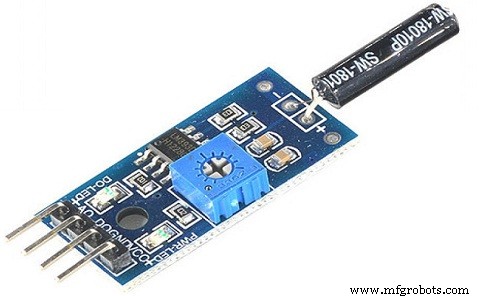
Common Types of Vibration Sensors
- Accelerometers – Ideal for general vibration and shock measurements.
- Strain Gauges – Suitable for curved surfaces and large‑mass structures where strain data is critical.
- Velocity Sensors – Designed for high‑temperature environments (>700 °F) where velocity measurement is preferred.
- Gyroscopes – Provide orientation data, useful in navigation and stabilization.
- Pressure/Microphone Sensors – Used for acoustic vibration analysis and health monitoring.
- Laser Displacement Sensors – Offer non‑contact displacement measurement with high accuracy.
- Capacitive/Eddy‑Current Displacement Sensors – Provide precise displacement readings without mechanical contact.
- Vibration Meters – Portable instruments for on‑site equipment diagnostics.
- Data Loggers – Capture and store vibration data for later analysis, reducing field testing time.
Industrial Applications
Vibration sensors play a pivotal role across a spectrum of industries:
- Wind Power & Mining – Monitor slow‑rotating turbines with sub‑1 Hz response.
- Oil & Gas – Track high‑frequency gear and turbine vibrations from 10 Hz to 10 kHz.
- Food & Beverage, Paper, Metalworking – Ensure process stability and product quality.
- Power Generation – Detect early signs of mechanical failure in generators and turbines.
Accurate vibration measurement is essential for predictive maintenance, equipment safety, and process optimization. Selecting the right sensor—considering sensitivity, frequency range, and environmental conditions—determines measurement success.
Sensor
- Blood Pressure Sensor: How It Works & Key Applications
- Voltage Sensors: How They Work & Key Applications in Modern Power Systems
- RVG Sensor: How It Works and Why It’s Transforming Dental Imaging
- Lambda (Oxygen) Sensor: Function, Operation, and Key Automotive Applications
- Image Sensors: Types, Operation, and Practical Applications
- Color Sensors: How They Work & Key Applications
- Compass Sensors: From Ancient Navigation to Modern Devices
- ACS712 Current Sensor: How It Works and Key Applications
- Fingerprint Sensor Technology: Working Principles, Applications, and Arduino Integration
- How Oxygen Sensors Work and Their Key Applications in Automotive and Industrial Systems