



Ambient Light Sensors: Functionality, Design, and Key Applications
The unit of illuminance, lux, is the internationally accepted measure of ambient light. Typical ambient light sensors can detect levels from below 50 lux—typical of a dim interior—to over 10,000 lux, the brightness of a midday sun. One lux equals one lumen per square meter, allowing photometric measurements to match the human eye’s perception of light intensity.
In the early 2000s, ambient light sensors began to appear in a growing share of mobile phones. By 2004, roughly 30 % of phones sold included an ambient light sensor; by 2016 that figure had risen to 85 %, underscoring the technology’s importance for power management and user comfort.
What Is an Ambient Light Sensor?
An ambient light sensor (ALS) is a photodetector that measures the total light in a device’s surroundings and automatically adjusts screen brightness or backlight levels. By dimming displays in low‑light environments, the sensor conserves battery life and reduces eye strain. ALS units are found in smartphones, tablets, laptops, automotive displays, LCD TVs, and even outdoor lighting controls.
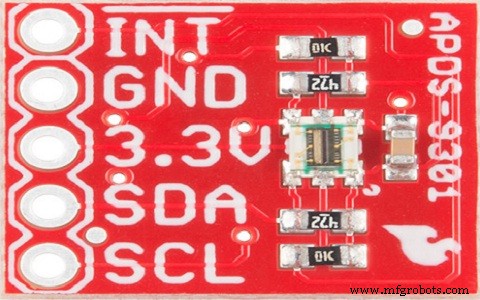
Common ALS architectures include photodiodes, photonic ICs, and phototransistors—devices that integrate a photodetector with an amplifier on a single chip.
Ambient Light Sensor Circuit Design
Many ALS circuits employ a light‑dependent resistor (LDR) as the light‑sensing element. The LDR’s resistance decreases from several megaohms in darkness to a few hundred ohms under direct sunlight, providing a voltage output proportional to light intensity.
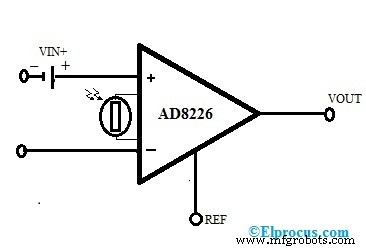
The output voltage can be read by an instrumentation amplifier such as the AD8226, which offers a wide supply range (2.7 V–36 V), rail‑to‑rail output, and low quiescent current. The amplifier’s gain is set by a fixed resistor (49.4 kΩ) in series with the LDR:
VOUT = G (VIN+ – VIN–) + VREF
With VIN– and VREF grounded, the gain becomes:
G = VOUT / VIN+ = 1 + 49.4 kΩ / LDR
Solving for the LDR resistance gives:
LDR = (49.4 kΩ) / (VOUT / VIN+) – 1
By measuring the amplifier’s output, the system can infer ambient light levels and adjust display brightness accordingly.
Applications
Ambient light sensors drive a wide range of products:
- Mobile Devices – Dynamic backlight control saves battery life and protects users’ eyes.
- Automotive – Headlight intensity adjustment, cockpit dimming, and daylight‑sensing for interior lighting.
- Consumer Electronics – LCD TVs, monitors, and portable media players use ALS to adapt brightness.
- Smart Lighting – Streetlights and signage automatically turn on or dim based on ambient conditions.
Examples of commercial sensors include:
- AMI’s AMIS74980x – Designed for automotive and consumer displays, offering low dark current and precise brightness regulation.
- OSRAM’s ALS‑SFH5711 – Mimics human eye sensitivity, enabling accurate backlight tuning in mobile and automotive markets.
- Avago’s APDS‑9004 – Used in DVD players, LCDs, and notebooks, it provides automatic brightness adjustments to extend display lifespan.
In sum, ambient light sensors autonomously gauge environmental lighting, adjusting display or illumination levels to conserve power, extend device life, and enhance user comfort.
Sensor
- Blood Pressure Sensor: How It Works & Key Applications
- Voltage Sensors: How They Work & Key Applications in Modern Power Systems
- RVG Sensor: How It Works and Why It’s Transforming Dental Imaging
- Lambda (Oxygen) Sensor: Function, Operation, and Key Automotive Applications
- Image Sensors: Types, Operation, and Practical Applications
- Color Sensors: How They Work & Key Applications
- Photoresistor (LDR): Function, Types, and Practical Applications
- Fingerprint Sensor Technology: Working Principles, Applications, and Arduino Integration
- Vibration Sensors: Principles, Types, and Industrial Applications
- How Oxygen Sensors Work and Their Key Applications in Automotive and Industrial Systems