



Understanding RTD Sensors: Principles, Accuracy, and Key Applications
In modern instrumentation, sensors are the interface between electronic, electrical, and mechanical systems and the physical world. They convert measurable phenomena—such as voltage, current, pressure, or temperature—into signals that can be processed by digital equipment. Each sensor type relies on a distinct physical principle. For instance, the piezoelectric effect measures voltage and current, the Hall effect gauges magnetic flux density, and the Resistance Temperature Detector (RTD) translates temperature changes into resistance variations.
What is an RTD Sensor?
An RTD, or Resistance Temperature Detector, is a precision temperature sensor that measures temperature by monitoring the resistance of a conductor. Typically, an RTD consists of a thin wire—commonly platinum, nickel, or copper—coiled or wound around a ceramic or glass core. The wire’s resistance changes predictably with temperature, providing a direct, linear relationship that can be calibrated for accurate readings.
Platinum is the preferred material for high‑accuracy applications because of its stable, linear resistance‑temperature curve over a broad range (−200 °C to +660 °C). Nickel, while cheaper, exhibits non‑linear behavior above 300 °C, limiting its use to sub‑300 °C environments. Copper offers lower cost but is typically used in less demanding settings.
Unlike thermocouples, which generate a voltage via the Seebeck effect, RTDs require an external power source to drive current through the sensing element. The resulting voltage drop is proportional to the element’s resistance, and thus to temperature.
Working Principle
The RTD’s operation hinges on the well‑characterized resistance‑temperature relationship of its conductor. As temperature rises, the atomic lattice vibrations increase, raising electrical resistance. By measuring this resistance change, the sensor can infer temperature with high precision. Calibration curves are generated during manufacturing to account for the exact material properties and geometry of each sensor.
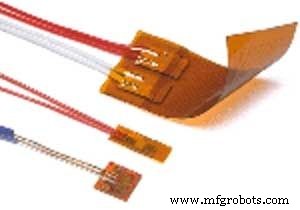
Because the resistive element is delicate, it is insulated and housed in a protective sheath. For temperatures below 250 °C, silicone rubber or PVC provides effective insulation. For higher temperatures, chemically inert metal alloys form the sheath, safeguarding the sensor and maintaining accuracy.
The sensor’s effective temperature range is defined by the linear portion of its resistance‑temperature curve. For platinum RTDs, this is typically 0 °C to 660 °C; nickel RTDs are confined to 0 °C to 300 °C. Within this range, the temperature coefficient of resistance (α) is calculated as:
α = (R100 – R0) / (100 °C × R0)
where R0 and R100 are the resistances at 0 °C and 100 °C, respectively.
Applications of RTD
- Automotive: Engine coolant temperature, oil level monitoring, and intake air temperature sensors.
- Industrial Processes: Precise temperature control in food processing, chemical reactors, and power electronics.
- Consumer Electronics: Temperature management in CPUs, GPUs, and thermal‑control systems.
- Medical Devices: Sterilization units, incubators, and diagnostic equipment requiring stable, repeatable readings.
- Aerospace & Defense: Cryogenic systems, engine monitoring, and high‑altitude instrumentation.
Examples of RTD Sensors in Everyday Use
Common RTD implementations include coolant sensors in vehicles, transmission oil temperature probes, intake air temperature sensors, and fire‑detector circuits. Their high accuracy and long‑term stability make them ideal for applications where even minor temperature deviations can impact performance or safety.
In many industrial settings, RTDs are overtaking thermocouples because they deliver superior accuracy, repeatability, and durability over extended periods. While thermocouples may be adequate for short‑term or low‑precision tasks, RTDs maintain calibration for years, reducing maintenance and calibration costs.
You’ve likely encountered RTDs in devices such as coffee machines, smartphones, or kitchen appliances. What other applications have you seen these sensors employed in?
Sensor
- Voltage Sensors: How They Work & Key Applications in Modern Power Systems
- RVG Sensor: How It Works and Why It’s Transforming Dental Imaging
- Lambda (Oxygen) Sensor: Function, Operation, and Key Automotive Applications
- Image Sensors: Types, Operation, and Practical Applications
- Pulse Sensor: How It Works and Key Applications for Makers
- Gyroscope Sensors: How They Work and Their Key Applications
- Flame Sensors: How They Work and Key Applications in Fire Safety
- Sound Sensors: How They Work & Practical Applications
- Humidity Sensors: How They Work and Key Applications
- Understanding RTD Sensors: Principles, Accuracy, and Key Applications