



How PIR Sensor Circuits Work: Design, Operation, and Real‑World Applications
Sensors detect changes in physical parameters or events and translate them into electrical or optical signals. They are generally classified as analog or digital devices.
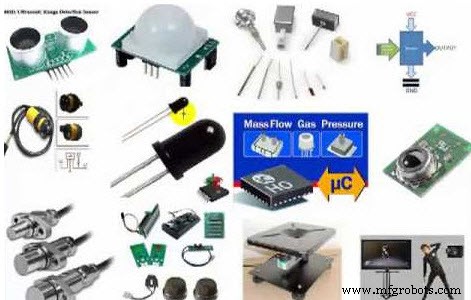
Common sensor categories include temperature, pressure, gas, fire, pyroelectric, piezoelectric, IR, and PIR sensors. This article focuses on PIR sensor circuits, modules, and their operation.
PIR Sensor
A PIR (passive infrared) sensor detects the motion of humans within a range typically around 10 m, with an effective detection span of 5 m to 12 m. PIR sensors are built on pyroelectric elements that sense infrared radiation. In this discussion we examine a PIR module equipped with a dome‑shaped Fresnel lens.
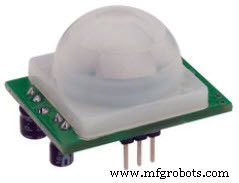
PIR sensor circuits are widely employed in projects that detect human presence—whether entering or exiting a space. Their flat, lens‑based design allows straightforward integration with microcontrollers and other electronic systems.
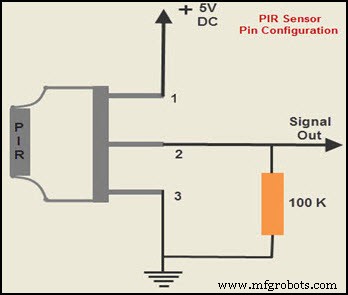
As illustrated, a PIR module has three pins: GND, VCC (typically up to 5 V), and OUT. Some larger modules drive a relay directly instead of providing a digital output, but most yield a simple high/low digital signal that can be read by a microcontroller.
PIR Sensor Circuit
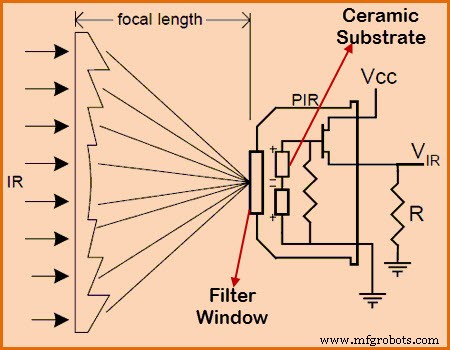
The PIR module’s internal board features a ceramic substrate and a filter window, topped with a Fresnel lens that focuses infrared radiation onto the pyroelectric element.
PIR Sensor Working
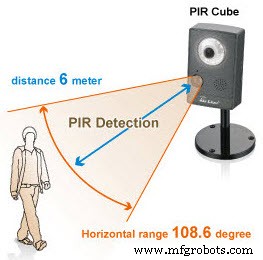
When a warm body traverses the sensor’s field of view, the pyroelectric element registers the change in infrared radiation, converting it into an electrical pulse that can trigger alarms, buzzers, or other outputs.
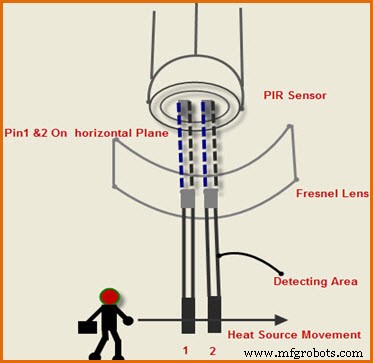
Internally, the sensor comprises two pyroelectric plates—one positive, one negative—each producing a signal as the infrared flux changes. The output is the differential of these signals, amplified and filtered to produce a clean digital pulse. The Fresnel lens splits the field into multiple zones, enabling detection across a broad area or focused region.
After powering on, the sensor undergoes a stabilization period (typically 10–60 s) during which the output stays low. Once motion is detected, the OUT pin rises for a few seconds before returning to low.
Practical Applications of PIR Sensor
PIR sensors power a wide array of automated systems—ranging from outdoor and stairwell lighting to parking‑lot illumination, and from automatic doors to security alarms. Below we outline several practical implementations built around a PIR module.
PIR Sensor based Automatic Door Opening System
An automatic door system uses a PIR sensor to detect a person and sends a high pulse to a microcontroller. The microcontroller then drives a motor driver via input and enable pins, opening the door automatically.
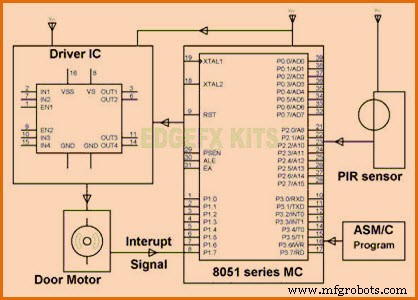
The motor driver powers the hinge motor, allowing the door to swing open when a human is detected within the sensor’s field.
PIR Sensor based Security Alarm System
For high‑security environments, the PIR output can drive a UM3561 alarm IC, which produces multi‑tone sirens (ambulance, fire, police). When motion is detected, the microcontroller’s digital pulse activates the UM3561, sounding the alarm.
What other real‑world uses of PIR sensors can you think of? Share your ideas in the comments to help broaden the community’s knowledge.
Sensor
- Blood Pressure Sensor: How It Works & Key Applications
- Voltage Sensors: How They Work & Key Applications in Modern Power Systems
- RVG Sensor: How It Works and Why It’s Transforming Dental Imaging
- Lambda (Oxygen) Sensor: Function, Operation, and Key Automotive Applications
- Fingerprint Sensor Technology: Working Principles, Applications, and Arduino Integration
- Vibration Sensors: Principles, Types, and Industrial Applications
- How Oxygen Sensors Work and Their Key Applications in Automotive and Industrial Systems
- MQ135 Alcohol Sensor Circuit, Working Principle & Applications
- Passive Infrared Sensor Power‑Saver Circuit: Design, Operation, and Applications
- Inductive Proximity Sensor: Circuit Design, Functionality, and Practical Applications