



Piezoelectric Sensors: How They Work, Key Specs, and Arduino Integration
Sensors convert physical changes—such as light, heat, motion, moisture, pressure, or vibration—into electrical signals that can be calibrated, transmitted, or processed further. While mercury thermometers and car oxygen sensors are classic examples, this article focuses on the versatile piezoelectric sensor.
What Is a Piezoelectric Sensor?
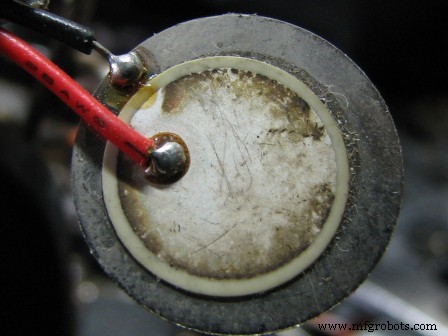
A piezoelectric sensor exploits the piezoelectric effect: certain materials generate an electric charge when mechanically stressed. Not every material exhibits this behavior; common piezoelectric media include natural single‑crystal quartz, bone, and engineered ceramics such as PZT.
Principle of Operation
Piezoelectric devices are commonly used to measure acceleration and pressure. In a pressure sensor, a thin membrane transfers external force to the piezoelectric element, generating a voltage proportional to the applied pressure. In an accelerometer, a seismic mass moves relative to a fixed crystal, and the resulting mechanical load produces a charge that reflects the acceleration.
Because pressure sensors can be sensitive to unwanted vibrations, an acceleration compensation element is often added to maintain accurate readings.
Internal Circuit Representation
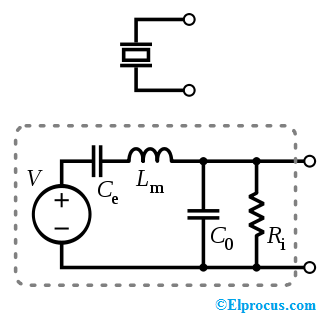
A typical piezoelectric sensor can be modeled with internal resistance (Ri), inductance (inertia), and capacitance (Ce)—the latter inversely related to material elasticity. Adequate load and leakage resistance ensure low‑frequency response and accurate signal transduction. In electrical terms, the sensor behaves as a primary pressure transducer.
Key Specifications
- Measurement range: Determined by the sensor’s design and intended application.
- Sensitivity (S): The ratio of output change (∆y) to input change (∆x): S = ∆y/∆x.
- Reliability: The ability to maintain consistent characteristics under defined operating conditions.
- Impedance ≤ 500 Ω
- Typical operating temperature: –20 °C to +60 °C (recommend –30 °C to +70 °C to avoid degradation)
- Low soldering temperature
- Strain sensitivity: 5 V/µε
- Quartz is preferred for its high flexibility and stable performance.
Using a Piezoelectric Pressure Sensor with Arduino
Below is a straightforward example that toggles an LED when sufficient pressure is detected.
Hardware
- Arduino board (e.g., Uno, Nano)
- Piezoelectric pressure sensor
- LED
- 1 MΩ resistor (for voltage/current limiting)
Circuit Diagram
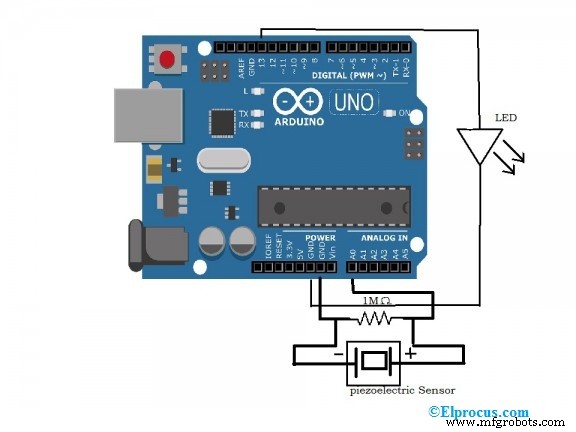
- The sensor’s positive lead connects to analog pin A0; the negative lead goes to ground.
- The 1 MΩ resistor sits in parallel with the sensor to protect the analog input from transient spikes.
- The LED anode connects to digital pin D13; cathode to ground.
How It Works
A threshold of 100 is set to ignore minor vibrations. When the sensor’s output exceeds this threshold, the LED toggles state; otherwise it remains unchanged.
Arduino Sketch
const int ledPin = 13;      // LED pin
const int sensorPin = A0;  // Sensor pin
const int threshold = 100; // Minimum reading to trigger
int ledState = LOW;        // Current LED state
int sensorReading;        // Latest sensor value

void setup() {
  pinMode(ledPin, OUTPUT);
}

void loop() {
  sensorReading = analogRead(sensorPin);
  if (sensorReading >= threshold) {
    ledState = !ledState;      // Toggle LED
    digitalWrite(ledPin, ledState);
    delay(10000);              // Debounce delay
  } else {
    digitalWrite(ledPin, ledState);
  }
}
Applications
- Shock detection in safety systems
- Thickness gauges and flow sensors (active mode)
- Microphone elements, accelerometers, and musical pickups (passive mode)
- Ultrasound imaging
- Optical, micro‑movement, and electroacoustic measurements
Piezoelectric sensors blend simplicity with high sensitivity, making them indispensable in fields ranging from industrial safety to medical diagnostics. Have you integrated these sensors into your projects? Share your experiences and the challenges you encountered.
Sensor
- Blood Pressure Sensor: How It Works & Key Applications
- Arduino Sensors: Types, Applications, and Real‑World Projects
- HDC2080 Digital Humidity & Temperature Sensor: Circuit Diagram, Specs & Applications
- Fingerprint Sensor Technology: Working Principles, Applications, and Arduino Integration
- Vibration Sensors: Principles, Types, and Industrial Applications
- How Oxygen Sensors Work and Their Key Applications in Automotive and Industrial Systems
- Piezoelectric Sensors: How They Work, Key Specs, and Arduino Integration
- Piezoelectric Transducers Explained: Working Principles, Circuit Design, and Practical Applications
- Inductive Proximity Sensor: Circuit Design, Functionality, and Practical Applications
- LM335 Temperature Sensor: Complete Guide to Specs, Setup, and Real-World Uses