



Accelerometer Sensors: How They Work and Where They’re Used
Modern devices rely on sensors to monitor and control physical variables. Among these, accelerometers measure an object’s acceleration and velocity, enabling features from smartphone orientation to aircraft navigation.
What Is an Accelerometer?
Acceleration is the rate of change of velocity over time. In practice, there are two concepts: proper acceleration, which is the physical acceleration felt by an object relative to inertial space, and coordinate acceleration, which depends on the observer’s frame of reference. An accelerometer is an electromechanical instrument that directly measures proper acceleration.
Working Principle
The core principle is analogous to a mass on a spring. When the device accelerates, the mass deflects until the restoring force of the spring balances the inertial force. The resulting displacement is proportional to the sensed acceleration, and this mechanical motion is converted into an electrical signal.
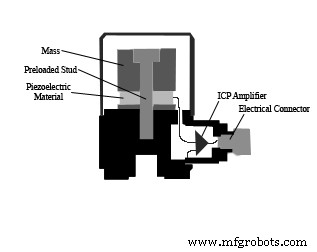
Accelerometers come in analog and digital formats. They are fabricated using piezoelectric, piezoresistive, or capacitive transduction. Each method translates the mechanical motion into a measurable electrical quantity:
- Piezoelectric accelerometers use single-crystal piezoelectric material that generates voltage under stress, ideal for high-frequency and high-temperature applications.
- Capacitive accelerometers employ silicon micro-machined structures where acceleration changes capacitance, which is then converted to voltage.
- MEMS accelerometers feature a tiny cantilever beam with a proof mass, available in two- or three-dimensional configurations for orientation and velocity sensing.
Applications
Accelerometers underpin many technologies across industries:
- Inertial navigation systems for aircraft, ships, and autonomous vehicles.
- Vibration monitoring in rotating machinery to prevent failures.
- Screen orientation and image stabilization in smartphones and digital cameras.
- Flight stabilization and motor control in drones.
- Device orientation, shock detection, and motion tracking in laptops and mobile phones.
- Biological research for high-frequency motion analysis of animals.
- Health monitoring of industrial equipment and fault detection in rotors.
- Structural health monitoring of buildings and bridges under dynamic loads.
- Measurement of CPR chest compression depth in medical devices.
- Navigation and direction sensing for GPS‑augmented systems.
- Remote sensing of seismic activity in volcano monitoring networks.
Real-World Examples
Accelerometers are integral to aircraft, missiles, earthquake monitoring systems, pumps, fans, compressors, medical AEDs, footpods, intelligent compaction rollers, airbag deployment, electronic stability control in cars, tilting trains, gravimeters, camcorders, G‑logger devices, mobile phones, and more.
Every smartphone contains an accelerometer that, alongside a gyroscope, determines screen orientation and supports motion‑based apps. Think about the last time your phone auto‑rotated – that was an accelerometer at work.
Sensor
- Blood Pressure Sensor: How It Works & Key Applications
- Voltage Sensors: How They Work & Key Applications in Modern Power Systems
- RVG Sensor: How It Works and Why It’s Transforming Dental Imaging
- Lambda (Oxygen) Sensor: Function, Operation, and Key Automotive Applications
- Image Sensors: Types, Operation, and Practical Applications
- Color Sensors: How They Work & Key Applications
- Fingerprint Sensor Technology: Working Principles, Applications, and Arduino Integration
- Vibration Sensors: Principles, Types, and Industrial Applications
- How Oxygen Sensors Work and Their Key Applications in Automotive and Industrial Systems
- Accelerometer Sensors: How They Work and Where They’re Used