



LM335 Temperature Sensor: Complete Guide to Specs, Setup, and Real-World Uses
Many different temperature sensors use different measuring principles and technologies to achieve a measurement. Some work best in certain conditions, while others are flexible and can be used over a wide range of conditions. The temperature sensors include thermistors, resistance temperature detectors, temperature probes, and thermocouples. Today’s article will take an in-depth look into the LM335 temperature sensor, its configuration, specification, usage, and application.
What Is the LM335 Temperature Sensor?
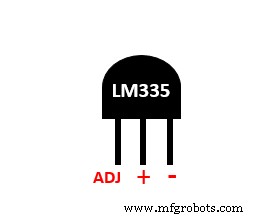
Fig 1: A Schematic Symbol of an LM335 Sensor
The LM335 is an accurate, cheap, and simple-to-use precise temperature sensor.
It has a low impedance of less than 1 ohm, hence it’s suitable for a broad number of temperature measurements. Therefore, the low resistance enables it to operate on a current of 400uA to 5 mA.
At 10mV/K, the sensor’s breakdown voltage is directly proportional to the absolute temperature.
Simply put, the LM335 is a 2-terminal Zener diode whose reverse breakdown voltage directly corresponds to its absolute temperature.
Thus, it doesn’t necessarily need a Zener diode in its circuitry. Its datasheet shows that the sensor has a series of capacitors, resistors, and transistors. The network of components functions pretty much like a Zener diode.
Therefore, you can measure temperature as long as it is between -40 ℃ to 100 ℃.
And when you consider its broad temperature range, reasonable price, and high accuracy, the sensor is one the best.
LM335 Temperature Sensor Configuration
LM335 has three steel pins at the bottom of the sensor.
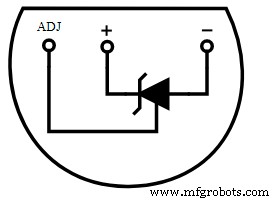
Fig 2: Internal Diagram of an LM335
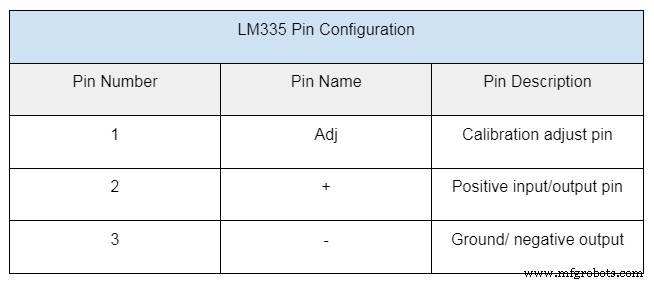
The LM335 pin configuration table below shows the various pins and their purposes.
LM335 Temperature Sensor Features and Specifications
Features
- It’s cheap & Easy to calibrate
- Calibrated to a Kelvin scale & Very accurate
- Its temperature range is 205 °C (from -55 to 150 °C)
- Works on a current range of 400uA minimum current to 5mA optimum current
Technical Specification
- Temperature error at 25 °C is 2 °C
- Forward sensor current: 10mA
- Reverse sensor current: 15mA
- Working output voltage: 2.95V to 3.01V
- Wide operating temperature range: -40 °C to 100 °C
- Temperature range while in store: -60 °C to 150 °C
- Heat resistance: 202 °C/W
How to Use the LM335 Temperature Sensor?
The LM335 temperature sensor is a convenient electrical component that easily interfaces into your circuitry. Its temperature scale calibration is in Kelvins.
Therefore, to use it, connect it to the circuit as shown in the circuit diagram below. You can opt to leave out the ADJ button if you don’t need to calibrate the sensor.
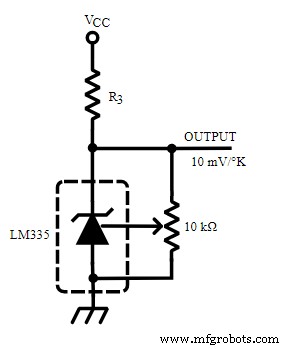
Fig 3: A Calibrated Temperature Sensor
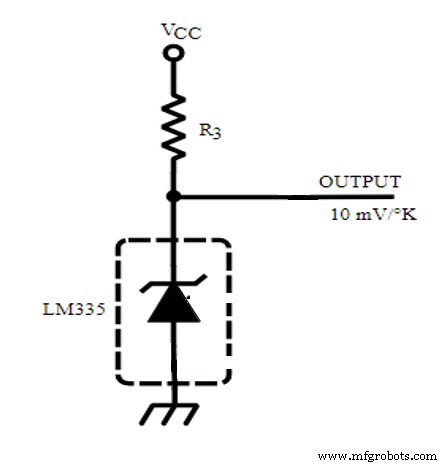
Fig 4: A Basic Temperature Sensor
It’s easier to use than resistive temperature sensors and thermocouples since it doesn’t require external interfacing. It needs no calibration and has a linear response to the input.
Consequently, it’s common in temperature controllers and data loggers.
The second way to use the temperature sensor is to calibrate it. To do so, connect the ADJ pin to a 10 Kilo Ohm potentiometer. Adjust the resistance to give a minimal temperature measurement error.
Usually, a calibration done at 25 ℃ is accurate over 100 ℃ of temperature measurement. It gives an error of less than one ℃.
A forward current of 5mA is preferred for the LM335 sensor, even though 10mA is its forward current limit. Therefore, you can use an impedance of less than 1 Ohm datasheet to enable the current limiting.
It restricts the forward current to less than 10mA to avoid damaging the device or other circuit components.
Furthermore, to get the best results, an operating current for the circuit is 1mA is preferable.
A significant advantage of using the LM335 is that it gives a numerical output. Therefore, you don’t necessarily need to add a comparator switch to your circuit.
The sensor output feeds into the programmables as a code. It means that the reading of an analog pin will result in a meaningful creation without necessitating buffering.
Also, you can opt not to pin your temperature sensor directly to your circuit since a cable connection works well. However, just like any electrical component, there’s a usable range that a cable can function without reaching a 1° loss.
The distance is proportional to the wire gauge, and you can use some connection cables while 100 meters away. Don’t worry about the loss if you use the correct wire gauge. It gets more significant with distance, but you don’t need to worry if the connections are a few meters apart.
The LM335 is a susceptible device to electrical short circuits. Therefore, we recommend a glue-lined heat shrink for the insulation purpose to provide better thermal insulation. Insulate the three terminals and ensure that the course is waterproof.
If you’d prefer to clamp the sensor circuit, a copper bar is good for the setup.
LM335 Temperature Sensor Applications

Fig 5: Air Conditioning System Repair
- They’re used in heating, ventilation, and AC systems
- Used in power supply systems
- Temperature sensing in Battery management systems
- Electrical appliances
Conclusion
The LM335 is a high accuracy, versatile, and simple-circuitry sensor that you’ll find helpful in your temperature measuring tasks. It doesn’t require a lot of interfacing to use and has a linear output.
Contact us if you need further assistance or have questions. We’ll get back to you at the soonest time possible.
Industrial Technology
- Blood Pressure Sensor: How It Works & Key Applications
- Voltage Sensors: How They Work & Key Applications in Modern Power Systems
- Arduino Sensors: Types, Applications, and Real‑World Projects
- Understanding RTD Sensors: Principles, Accuracy, and Key Applications
- Fingerprint Sensor Technology: Working Principles, Applications, and Arduino Integration
- Vibration Sensors: Principles, Types, and Industrial Applications
- How Oxygen Sensors Work and Their Key Applications in Automotive and Industrial Systems
- Piezoelectric Sensors: How They Work, Key Specs, and Arduino Integration
- Build a Multi‑Sensor Temperature & Light Monitoring System with Raspberry Pi & DS18B20
- DS18B20 1-Wire Digital Temperature Sensor: Pinout, Key Features & Practical Applications