



OPT3007 Ultra‑Thin Ambient Light Sensor – Precision Light Measurement for Smart Devices
The OPT3007 is a cutting‑edge, ultra‑thin ambient light sensor that delivers accurate visible‑light intensity readings while consuming minimal power. Ideal for modern wearables, smartphones, and display back‑lighting systems, it offers a 23‑bit dynamic range, 0.01–83,000 lux measurement, and I2C/SMBus digital communication.
Key Features
- Auto full‑scale range selection for optimal accuracy across lighting conditions.
- Infrared rejection and photopic filtering that match the human eye’s spectral response.
- Low operating current of 1.8 µA and a wide supply range of 1.6 V to 3.6 V.
- Operating temperature: –40 °C to +85 °C.
- 5.5 V‑tolerant I/O and a robust 6‑pin Picostar package.
Technical Overview
Block Diagram
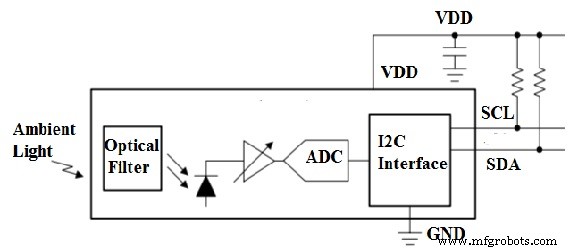
The sensor operates as a slave on the I2C/SMBus bus, using the 7‑bit address 0x45. The master initiates communication with a start condition, followed by the address and read/write bit. The OPT3007 then returns the measured lux value and status information.
Circuit Integration
When integrating the OPT3007, connect the SCL and SDA pins to the microcontroller’s I2C bus, and place pull‑up resistors (typically 4.7 kΩ to 10 kΩ) between each line and VDD. For high‑speed or noise‑prone environments, shield the communication lines and consider adding decoupling capacitors close to the device’s power pins.
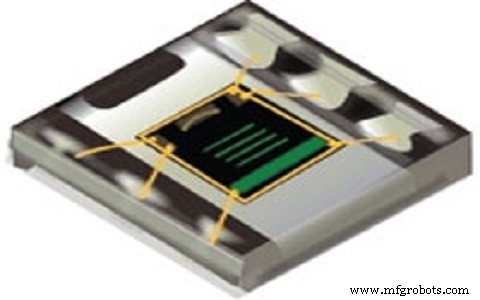
Pin Configuration (6‑Pin Picostar)
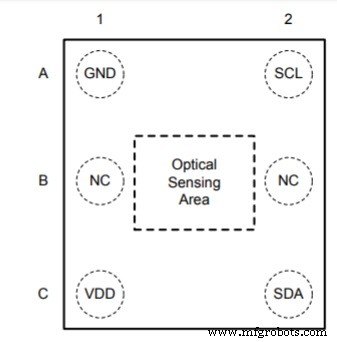
- A1 – GND
- B1 – NC
- C1 – VDD (1.6 V–3.6 V)
- A2 – SCL (I2C clock, 1.6 V–5.5 V via 10 kΩ)
- B2 – NC
- C2 – SDA (I2C data, 1.6 V–5.5 V via 10 kΩ)
Specifications Summary
- Lux range: 0.01–83,000 lux
- Dynamic range: 23 bits (auto‑gain)
- Current consumption: 1.8 µA (typical)
- Power supply: 1.6 V–3.6 V (±5 % tolerance)
- Temperature: –40 °C to +85 °C
- Package: 6‑pin Picostar, ultra‑small footprint
- Data interface: I2C / SMBus, 7‑bit address 0x45
- Optical filtering: Photopic response, IR rejection
- Input/output: 5.5 V tolerant
Typical Applications
- Smartwatches and wearable electronics (compact form factor)
- Smartphones and tablets for adaptive back‑light control
- Camera exposure and auto‑white‑balance modules
- LED lighting control systems
- Health and fitness bands
- Replacement for legacy photodiodes and photoresistors in industrial sensors
Alternatives
Other Texas Instruments photonic ICs such as the OPT3004, OPT3006, OPT3002, and OPT301 offer similar functionality, but the OPT3007 stands out for its ultra‑thin design and superior dynamic range.
For detailed electrical characteristics, pin‑to‑pin wiring, and application notes, consult the Texas Instruments datasheet. Handle the sensor with care: keep the optical surface clean and avoid mechanical stress due to its thin silicon wafer.
Sensor
- Color Sensors: How They Work & Key Applications
- Ambient Light Sensors: Functionality, Design, and Key Applications
- Optical Sensors: Fundamentals, Types, and Practical Applications
- Heartbeat Sensor: How It Works & Practical Applications
- Build a Multi‑Sensor Temperature & Light Monitoring System with Raspberry Pi & DS18B20
- Raspberry Pi Light Sensor Tutorial – Wire an LDR and Read Light Levels with Python
- Digital Light Sensor – Power an LED with Ambient Light Using Windows 10 IoT Core
- Capacitive Touch LED Switch with Arduino UNO – Easy DIY Project
- Zerynth Lamp: Smart IoT Ambient Light Control with NeoPixel LEDs
- Build an Ambient Light Sensor with Photoresistor and LED: Step‑by‑Step Guide