



Optical Sensors: Fundamentals, Types, and Practical Applications
Optical sensors convert light into an electronic signal, enabling precise, contact‑less measurement of a wide range of physical properties. They play a pivotal role in modern automation, safety systems, and consumer electronics.
What Can Optical Sensors Measure?
Depending on the design, optical sensors can quantify temperature, velocity, liquid level, pressure, displacement, vibrations, chemical species, force, radiation, pH, strain, acoustic fields, and electric fields.
Common Types of Optical Sensors
- Photoconductive devices – Change resistance in response to light intensity.
- Photovoltaic cells (solar cells) – Generate a voltage proportional to incident light.
- Photodiodes – Produce a current that rises with light power.
- Phototransistors – Similar to photodiodes but provide internal current gain.
All these sensors rely on a transmitter (usually a LED or laser) and a receiver. An object either reflects or interrupts the light beam, and the sensor interprets the change as a signal.
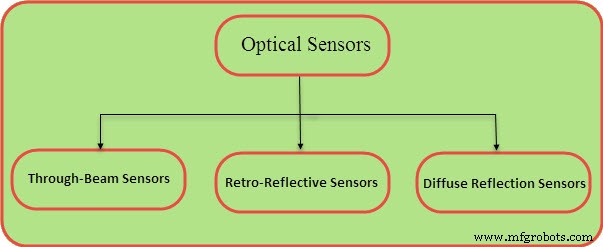
Through‑Beam Sensors
These consist of separate transmitter and receiver modules positioned opposite each other. When an object fully blocks the beam, the receiver registers a switch‑off signal.
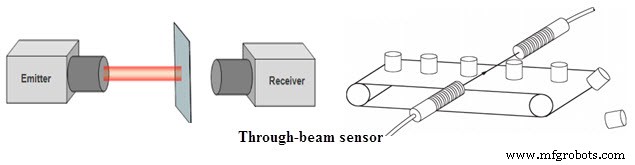
Advantages: Long operating distances; detection independent of surface color or texture. Requires the object to be large enough to interrupt the beam completely.
Retro‑Reflective Sensors
The transmitter and receiver share a single housing and a built‑in reflector directs the emitted light back to the sensor. Any obstruction of the beam triggers a switch.
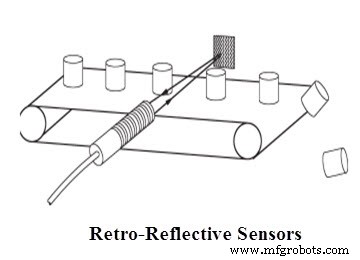
Advantages: Simple mounting; precise switching points; effective across a range of distances; robust to surface variations.
Diffuse Reflection Sensors
Both components are housed together. Light reflected from the target is detected directly by the receiver.
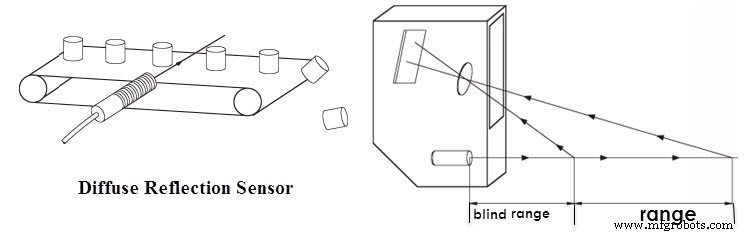
Advantages: Suitable for varying target surfaces; however, rear‑side reflections may lead to false triggers if sensitivity is not properly set.
Light Sources in Optical Sensors
Choosing the right light source is critical for sensor performance. The two most common types are:
1. Light‑Emitting Diode (LED)
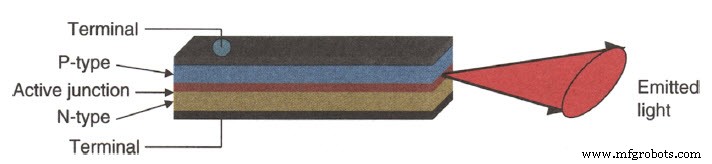
LEDs generate light when electrons recombine with holes across a p‑n junction. They are compact, energy‑efficient, and emit a broad spectrum suitable for many sensors.
2. Laser (Light Amplification by Stimulated Emission of Radiation)
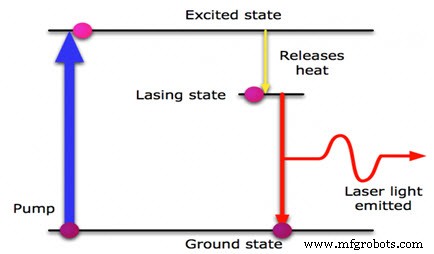
Lasers produce highly coherent, monochromatic light by stimulating excited electrons to emit photons of identical wavelength. Their precision makes them ideal for long‑range and high‑resolution sensing.
Practical Applications of Optical Sensors
Optical sensors are integral to many everyday devices and industrial systems:
Ambient Light Sensors
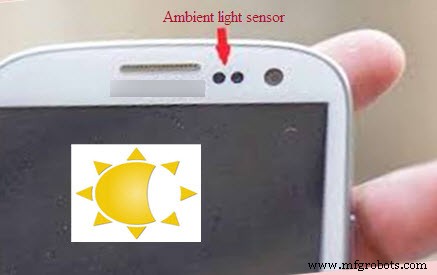
Found in smartphones and smart lighting, they adjust display brightness or lighting levels to match ambient conditions, saving energy and improving usability.
Biomedical Applications
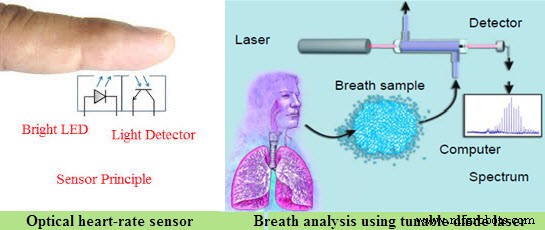
Optical heart‑rate monitors use photoplethysmography: a LED shines through skin and the reflected light is analyzed to extract pulse data. Breath analysis can be performed with tunable diode lasers to detect trace gases.
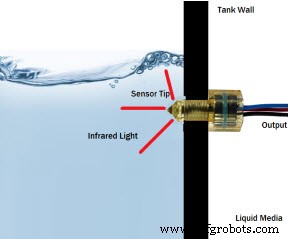
Optical Liquid Level Indicator
Consists of an infrared LED, a light‑sensitive transistor, and a transparent prism tip. When the tip is in air, light reflects back strongly; immersion in liquid scatters the beam, reducing reflected intensity and allowing precise level detection.
Whether you're designing a safety interlock, a smart thermostat, or a medical diagnostic device, understanding the fundamentals of optical sensors and selecting the right type and light source is essential for reliable performance.
Sensor
- Virtual Sensors: How They Work and Key Applications
- Occupancy Sensors Explained: How They Work and Why They’re Essential for Energy Savings
- Door Sensors: How They Work and Their Role in Home Security
- Inductive Sensors: How They Work and Key Industrial Applications
- Color Sensors: How They Work & Key Applications
- IoT Sensors: Functionality, Types, and Real‑World Applications
- MEMS Sensors: How They Work and Their Key Applications
- How Parking Sensors Work & Their Key Applications
- Magnetic Sensors: Principles, Types, and Applications
- Ambient Light Sensors: Functionality, Design, and Key Applications