



How Flex Sensors Work and Their Key Applications
In today’s sensor‑rich landscape, flex sensors—also known as bend sensors—are essential for measuring deflection in a wide array of devices. By tracking changes in resistance as the sensor’s flexible strip is bent, they provide real‑time feedback for applications ranging from robotics to interactive gaming.
What Is a Flex Sensor?
A flex sensor is a variable‑resistance device that measures how much a material has been bent or deflected. It typically consists of a thin plastic strip coated with a conductive carbon layer. When the strip flexes, the carbon pathways are stretched or compressed, altering the electrical resistance proportionally. This property allows the sensor to act like a digital goniometer, translating mechanical angle into measurable voltage changes.
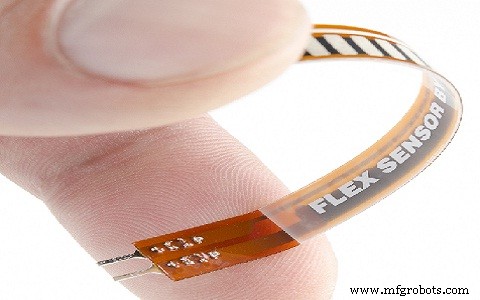
Types of Flex Sensors
Flex sensors are primarily sold in two common sizes: 2.2‑inch and 4.5‑inch. While their operating principles are identical, the larger variant offers a greater resistance range, making it suitable for high‑precision or high‑force applications.
In this article we focus on the 2.2‑inch model, which is widely used in computer interfaces, rehabilitation devices, servo‑motor control, security systems, musical interfaces, and any context where adjustable resistance via bending is required.
Pin Configuration
Flex sensors are simple two‑terminal devices with no polarity. They operate on a supply voltage of 3.3 V to 5 V DC, making them compatible with most microcontrollers.
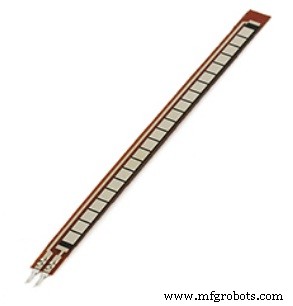
- Pin P1: Connect to the positive rail (+V).
- Pin P2: Connect to ground (GND).
Typical Use Cases
1. **Door/Window Status** – Mount the sensor on a door frame; as the door opens, the strip flexes, triggering an alert or automation.
2. **Angle Measurement** – Attach the sensor to a limb, joint, or mechanical arm to read bend angle directly from resistance changes, enabling precise motion control or rehabilitation monitoring.
How It Works
The core principle is that the sensor’s resistance increases linearly with bending. For example:
- 0° (straight) – baseline resistance.
- 45° – resistance roughly doubles.
- 90° – resistance roughly quadruples.
These proportional changes can be read by a simple voltage divider or an analog‑to‑digital converter, converting mechanical motion into digital signals.
Specifications & Features
- Supply voltage: 0 V–5 V (peak)
- Power rating: 1 W peak, 0.5 W continuous
- Operating temperature: –45 °C to +80 °C
- Flat (unbent) resistance: 25 kΩ
- Resistance tolerance: ±30%
- Bend resistance range: 45 kΩ–125 kΩ
Applications
- Medical instruments and prosthetics
- Computer peripherals (joysticks, touch panels)
- Robotics (joint monitoring, soft‑robot actuators)
- Physical therapy devices
- Virtual motion and gaming controllers
- Musical instruments (dynamic controllers)
In summary, a flex sensor converts bending into measurable electrical changes, making it a versatile component for any system that requires real‑time angle or pressure feedback. Its ease of integration and low cost make it a staple in modern sensor suites.
Sensor
- How Distance Sensors Work and Their Key Applications
- Voltage Sensors: How They Work & Key Applications in Modern Power Systems
- Lambda (Oxygen) Sensor: Function, Operation, and Key Automotive Applications
- Image Sensors: Types, Operation, and Practical Applications
- Gyroscope Sensors: How They Work and Their Key Applications
- Flame Sensors: How They Work and Key Applications in Fire Safety
- Sound Sensors: How They Work & Practical Applications
- Humidity Sensors: How They Work and Key Applications
- Rain Sensors Explained: How They Work & Key Applications
- Laser Sensors Explained: Working Principles & Industrial Applications