



Understanding the AD8232 ECG Sensor: Functionality and Applications
The electrocardiography (ECG) technique captures electrical signals generated by the heart, enabling clinicians and researchers to assess cardiac function and physiological states. The AD8232 sensor is a compact integrated circuit designed to measure these biopotential signals, converting them into a clear analog ECG trace suitable for diagnostics and monitoring.
What Is the AD8232 ECG Sensor?
The AD8232 is a commercial board that conditions and amplifies the minute electrical activity of the human heart. By acting as a low‑noise operational amplifier, it isolates the true cardiac signal from ambient interference, producing a clean analog output that can be displayed as a traditional ECG waveform.
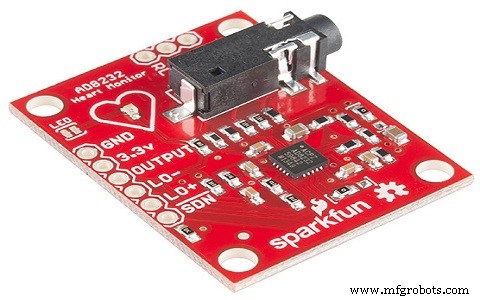
The chip excels at signal conditioning for biopotential applications, offering amplification, extraction, and filtering of low‑amplitude signals even in the presence of motion or electrode drift.
Pin Configuration
Typical AD8232 modules expose pins such as SDN, LO+, LO-, OUTPUT, 3.3V, and GND, which can be soldered to development boards like Arduino. Additional pins for Right Arm (RA), Left Arm (LA), and Right Leg (RL) allow custom electrode placement. An integrated LED provides real‑time heartbeat visualization.
Key mechanical and electrical attributes include a 4 mm × 4 mm footprint, 20‑lead LFCSP package, operating temperature range −40 °C to +85 °C (performance verified 0 °C to 70 °C), and a low 170 µA supply current.
Features & Specifications
- Single‑supply operation from 2 V to 3.5 V
- Fully integrated front‑end for single‑lead ECG
- On‑chip virtual ground via integrated reference
- Internal RFI filter
- Rail‑to‑rail output
- Shutdown (SDN) pin for power‑save mode
- CMRR of 80 dB
- Right‑leg drive (RLD) amplifier
- Supports 2‑ or 3‑lead electrode configurations
- Uncommitted op‑amp architecture
- Half‑cell potential tolerance up to ±300 mV
- Three‑pole adjustable low‑pass filter with variable gain
- High DC‑blocking gain for signal isolation
- Quick‑restore feature for faster high‑pass filter settling
- Two‑pole adjustable high‑pass filter
- Compact 4 mm × 4 mm, 20‑lead LFCSP package
Applications
The versatility of the AD8232 enables a wide range of use cases:
- Personal heart‑rate and fitness monitoring
- Portable ECG systems
- Remote patient telemetry
- Interactive gaming peripherals
- Biopotential acquisition for research
- Biometric authentication devices
- Physiological studies and psychophysiology
- Rapid prototyping of biomedical instruments
- Heart‑rate variability analysis
- Human‑computer interaction research
- Stress and mood monitoring
In summary, the AD8232 is a precise, low‑power, and compact solution for measuring the heart’s electrical activity, making it invaluable for clinical diagnostics, consumer wearables, and research applications.
Sensor
- How Distance Sensors Work and Their Key Applications
- Voltage Sensors: How They Work & Key Applications in Modern Power Systems
- Lambda (Oxygen) Sensor: Function, Operation, and Key Automotive Applications
- Image Sensors: Types, Operation, and Practical Applications
- Gyroscope Sensors: How They Work and Their Key Applications
- Flame Sensors: How They Work and Key Applications in Fire Safety
- Sound Sensors: How They Work & Practical Applications
- Humidity Sensors: How They Work and Key Applications
- Rain Sensors Explained: How They Work & Key Applications
- Laser Sensors Explained: Working Principles & Industrial Applications