



How Water Flow Sensors Work and Their Key Applications
Sensors are indispensable in modern automation, offering low cost, high reliability, and seamless integration with complex electronic systems. Over the decades, sensor technology has evolved from bulky centimeter‑sized units to nanometer‑scale devices, enabling precise monitoring of environmental parameters such as light intensity, furnace temperature, and ambient humidity. Among these, water flow sensors provide a reliable solution for measuring liquid flow rates in a variety of settings.
What Is a Water Flow Sensor?
Industrial plants, commercial complexes, and residential buildings all rely on a steady water supply. To ensure efficient usage and detect anomalies, the rate of water flow must be quantified. Water flow sensors accomplish this by being installed directly at the source or within the pipe network, converting the velocity of water into measurable electrical signals. The flow rate is typically expressed in liters per hour (L/h) or cubic meters per hour (m³/h).
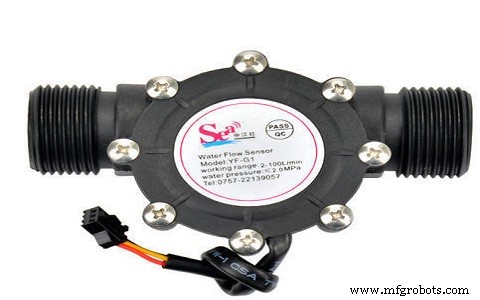
These sensors are versatile enough to handle hot, cold, warm, clean, or even turbid water. They are available in multiple diameters and flow‑rate ranges to suit different pipe sizes and applications.
Working Principle
A typical water flow sensor consists of a plastic valve and a rotating rotor. As water passes through the valve, it turns the rotor. Embedded within the rotor is a Hall‑effect sensor that detects the rotor’s rotation by generating a voltage pulse for each revolution. This pulse frequency is directly proportional to the flow velocity, allowing the sensor to calculate the flow rate accurately.
The underlying physics is the Hall effect, first documented by Edwin Hall in 1879. When a magnetic field intersects a conductor moving through it, an induced voltage appears perpendicular to both the field and the current. In the sensor, the rotor’s motion within the magnetic field induces this voltage, which the Hall sensor captures and converts into digital pulses.
These pulses can be displayed on an integrated LCD or transmitted to a microcontroller (e.g., Arduino) for further processing. The sensor typically requires a DC supply between 5 V and 18 V, with a three‑wire configuration: red for power, black for ground, and yellow for the signal output.
Applications of Water Flow Sensors
Water flow sensors find use in any scenario where liquid throughput must be monitored or regulated. Common applications include:
- Residential and commercial water meters
- Industrial process control (e.g., chemical reactors, cooling systems)
- Agricultural irrigation systems
- Wastewater treatment and monitoring
- Dairy and food processing (measuring milk or other fluids)
Different sensor technologies are chosen based on the medium and operating conditions:
- Paddle‑wheel (rotary) sensors: Ideal for clean water and moderate flow rates; cost‑effective and widely available.
- Positive displacement meters: Provide accurate measurements in non‑straight or restricted pipes and for viscous liquids.
- Magnetic flow meters: Suitable for conductive, dirty, or high‑temperature fluids such as sewage or slurry.
- Ultrasonic flow meters: Non‑intrusive and effective for large‑diameter pipes carrying contaminated water.
The sensor’s Hall‑effect output produces a pulse for every revolution of the rotor, which can be calibrated to generate a specific number of pulses per liter of fluid. The pulses are then displayed on an LCD or sent to a data logger.
Example: YFS201 Hall‑Effect Flow Sensor
The YFS201 is a popular model that outputs 4–5 pulses per liter per minute, with a measurable range of 1–30 L/min. It operates on 5 V to 18 V DC, features a waterproof housing, and is straightforward to interface with microcontrollers, making it a favorite for hobbyists and professionals alike.
Have you integrated a water flow sensor into your projects? Share your experience in the comments below.
Sensor
- How Distance Sensors Work and Their Key Applications
- Voltage Sensors: How They Work & Key Applications in Modern Power Systems
- Lambda (Oxygen) Sensor: Function, Operation, and Key Automotive Applications
- Image Sensors: Types, Operation, and Practical Applications
- Gyroscope Sensors: How They Work and Their Key Applications
- Flame Sensors: How They Work and Key Applications in Fire Safety
- Sound Sensors: How They Work & Practical Applications
- Humidity Sensors: How They Work and Key Applications
- Rain Sensors Explained: How They Work & Key Applications
- Laser Sensors Explained: Working Principles & Industrial Applications