



Understanding Load Cells: How Weight Sensors Work and Their Key Specifications
In modern electronic systems, load cells—commonly known as weight sensors—are the backbone of accurate mass measurement. These transducers convert mechanical load into an electrical signal, delivering precise, repeatable values essential for scales, industrial automation, and many other applications.
What Is a Load Cell?
Definition: A load cell is a transducer that transforms a force, pressure, or weight into a measurable electrical signal. The signal can be a voltage, current, or frequency shift, depending on the load and the chosen interface circuit.
When a load is applied, the cell’s internal elements change resistance or capacitance in proportion to the applied force, producing an output that directly correlates with the magnitude of the weight.
SEN0160 Example Module
The SEN0160 weight sensor module incorporates the HX711 24‑bit ADC. This chip is widely used in industrial control and weighing applications because it offers high integration, fast response, and robust noise immunity—all at a low cost.
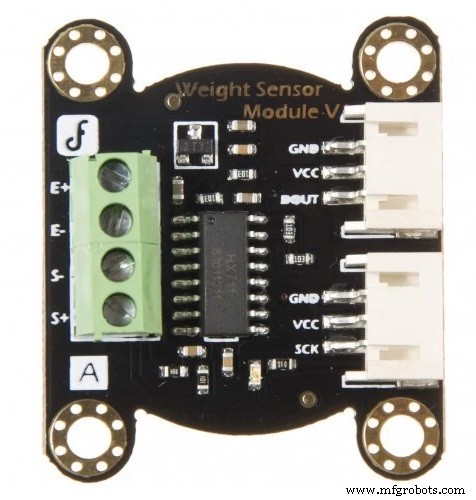
Module Specifications
- Capacity: 1 kg
- Excitation voltage: 5 V – 15 V
- Output sensitivity: 1.0 ± 0.15 mV/V
- Systematic error: 1 ‰ of full scale
- Zero shift: 0.05 % or 0.03 %
- Zero output: ±0.1 mV/V
- Input impedance: 1 055 ± 15 Ω
- Output impedance: 1 000 ± 5 Ω
- Overload capacity: 200 % of full scale
- Output type: Analog
- Dimensions: 33 mm × 38 mm
Common Load‑Cell Types
Load cells come in several varieties, each suited to particular environments:
- Strain‑gauge cells – The most widely used type, employing electrical resistance changes in a bonded foil.
- Capacitive cells – Measure changes in capacitance between plates under load.
- Hydraulic cells – Convert load into fluid pressure.
- Pneumatic cells – Use air pressure variations to sense force.
How to Choose the Right Load Cell
Selecting a load cell requires balancing several factors:
- Measurement range and capacity
- Application environment (temperature, vibration, humidity)
- Size and mounting constraints
- Required accuracy and repeatability
- Overload tolerance
HX711 ADC Specifications
- 24‑bit resolution
- Two selectable input channels
- Serial digital interface
- Data rates: 10 SPS or 80 SPS
- High common‑mode rejection (50 Hz & 60 Hz)
- Supply voltage: 2.6 V – 5.5 V
- Current draw: < 1.6 mA
- Operating temperature: –40 °C – 85 °C
- 16‑pin SOP package
Performance in real‑world systems depends on factors like vibration, temperature drift, and mechanical stability, so careful selection and proper calibration are essential.
Sensor
- How Distance Sensors Work and Their Key Applications
- Sony IMX586 Camera Sensor: How It Works & Key Features
- Understanding the AD8232 ECG Sensor: Functionality and Applications
- HC‑SR04 Ultrasonic Sensor: How It Works and Key Applications
- Voltage Sensors: How They Work & Key Applications in Modern Power Systems
- Lambda (Oxygen) Sensor: Function, Operation, and Key Automotive Applications
- Image Sensors: Types, Operation, and Practical Applications
- Gyroscope Sensors: How They Work and Their Key Applications
- Flame Sensors: How They Work and Key Applications in Fire Safety
- Sound Sensors: How They Work & Practical Applications