



Nanostructured Electron Cloak: MIT Breakthrough for Invisible Electron Transport
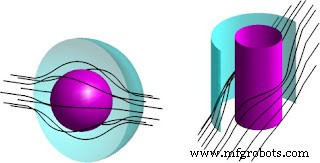 Invisibility Cloaks
Invisibility cloaks conceal objects from electromagnetic waves by guiding light around them. They rely on metamaterials—engineered composites with negative refractive indices—that redirect incoming light so the waves rejoin on the far side as if the cloak were absent.
Electron Cloak
Electrons behave as waves over a coherence length before scattering disrupts their phase, producing interference effects. MIT researchers have adapted the cloak concept for electrons using core–shell nanoparticles embedded in a semiconductor host. These nanostructures, about 10 nm in diameter—the typical electron wavelength at room temperature—create multiple interfaces that reflect electron waves. By precisely tuning each interface, the reflected waves interfere destructively, canceling the net reflection. Electrons with the right energy thus pass through the structure unimpeded, effectively rendering the nanoparticle invisible to electron transport.
Applications
Electron cloaks could enhance devices requiring high electron mobility, such as next‑generation semiconductor switches and thermoelectric materials for efficient energy conversion. The technology opens pathways to electronically controllable “visible‑to‑invisible” states and could dramatically improve device performance by minimizing scattering losses.
Nanomaterials
- Demonstrating Sound Cancellation with Speaker Phase Reversal
- Understanding Electron Tubes: Components and Functionality
- A Primer on Vacuum (Electron) Tubes: Foundations of Modern Electronics
- Conventional vs. Electron Flow: What Engineers Use and Why
- Understanding Standing Waves and Resonance in Transmission Lines
- Optimized Al₂O₃/MgO Emission Layers for Ultra‑High Gain Electron Multipliers
- Investigating Spin‑Split Peaks in Transverse Electron Focusing Across Temperatures
- Review of Nanostructured Black Silicon Applications
- High-Resolution 3D Imaging of Pencil-Shaped GaN/(In,Ga)N Core‑Shell Nanowires via Electron Tomography
- Graphene Metasurface for Dual-Function Generation and Steering of Vortex Waves