



Electrical Isolation with Transformers: SPICE Analysis & Practical Applications
SPICE Analysis of Electrical Isolation
Transformers not only enable voltage and current conversion in AC and DC circuits but also deliver a critical feature known as electrical isolation. This capability allows two circuits to be magnetically coupled without any direct wire connections, safeguarding sensitive components and enhancing safety.
To illustrate this effect, we run a SPICE simulation that imposes a high DC voltage on the secondary side while grounding the two circuits:
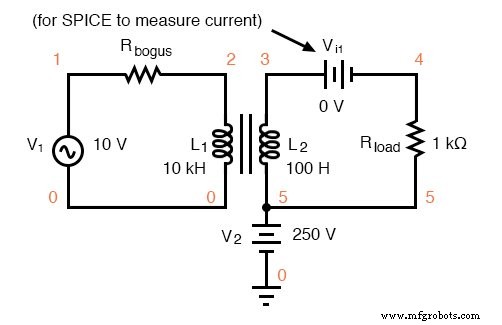
Transformer isolates 10 Vac at V1 from 250 VDC at V2.
v1 1 0 ac 10 sin
 rbogus1 1 2 1e-12
 v2 5 0 dc 250
 l1 2 0 10000
 l2 3 5 100
 k l1 l2 0.999
 vi1 3 4 ac 0
 rload 4 5 1k
 .ac lin 1 60 60
 .print ac v(2,0) i(v1)
 .print ac v(3,5) i(vi1)
 .end
DC voltages referenced to ground (node 0):
(1)    0.0000    (2)    0.0000    (3)  250.0000
(4)  250.0000    (5)  250.0000

AC voltages:
freq          v(2)        i(v1)
 6.000E+01     1.000E+01   9.975E-05    Primary winding

freq          v(3,5)      i(vi1)
6.000E+01     9.962E-01   9.962E-04    Secondary winding
SPICE shows that the 250 VDC is present on the secondary circuit relative to ground, yet the primary circuit registers zero DC voltage at nodes 1 and 2. The AC transformation remains unchanged, confirming that the transformer effectively blocks the common‑mode voltage from the primary side.
The voltage applied to the secondary is often called a common‑mode voltage because it is referenced to a common point (ground) and appears at multiple nodes. The transformer’s isolation prevents this voltage from influencing the primary circuit.
This isolation property holds regardless of whether the common‑mode voltage is DC or AC, even at a different frequency.
In applications that require identical voltage and current levels on both sides, 1:1 isolation transformers are used. These devices maintain the same voltage and current while providing electrical isolation. A typical benchtop isolation transformer is shown below.
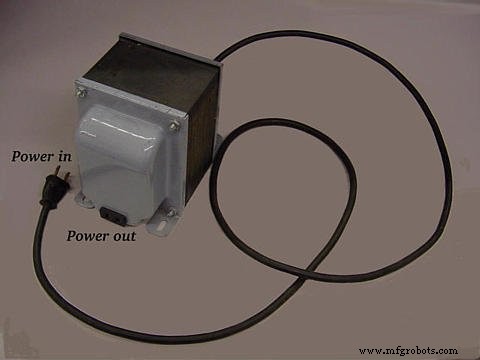
Isolation transformer isolates power from the mains.
REVIEW:
- Transformers enable power transfer between circuits without direct conductors, offering electrical isolation.
- Isolation transformers are specifically designed to provide this isolation without changing voltage or current ratios.
- Step‑up, Step‑down, and Isolation Transformers Worksheet
Industrial Technology
- Exploring Voltage Addition with Series Battery Connections
- Voltage Divider Lab: Design, Measurement, and Kirchhoff’s Voltage Law Verification
- Thermoelectricity: Understanding Thermocouples and the Seebeck Effect
- Potentiometric Voltmeter: Precise Voltage Measurement with Minimal Loading
- Build a Potato Battery: A Step‑by‑Step Guide to DIY Electrochemical Power
- Tachogenerators: Precision Speed Measurement for Industrial Motors and Equipment
- Understanding Capacitor and Inductor Transient Response in Series RC Circuits
- Understanding AC Waveforms: Sine Waves, Frequency, and Oscilloscope Basics
- Electrical Safety: How to Prepare for Absence‑of‑Voltage Testing
- Electrical Testing Safety: Spotting Backfed vs. Induced Voltages