



Electrical Safety: How to Prepare for Absence‑of‑Voltage Testing
According to OSHA and the NFPA 70E Standard for Electrical Safety in the Workplace, workers must de‑energize all live parts unless live conditions are required for troubleshooting. Achieving an electrically safe work condition, however, is not as simple as it sounds. Proper planning, tool selection, and PPE usage are essential.
- Effective preparation simplifies testing and reduces accident risk.
- Stopping work to fetch missing tools interrupts focus and can lead to errors.
Before you take a single measurement, determine:
- Is the test a troubleshooting or a voltage‑absence verification?
- Which instruments will confirm the energized or de‑energized state?
- What PPE is required? Consider circuit voltage, flash protection boundary, and incident energy at working distance.
- Is lockout/tagout complete?
- Is the test tool functioning correctly?
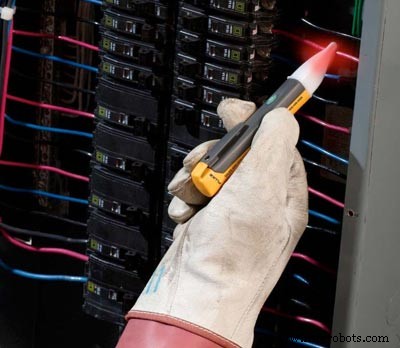
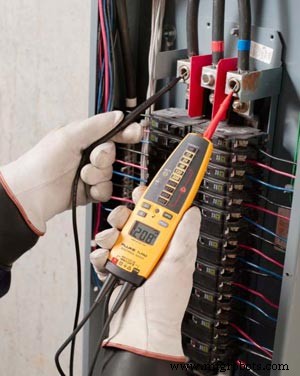
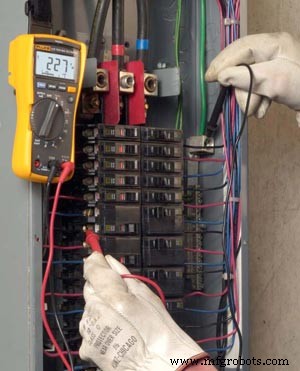
When verifying the absence of voltage, consider using a non‑contact proximity tester (Figure 1), a digital electrical tester (Figure 2), or a multimeter with a low‑impedance option (Figure 3).
Tools to Use
A) Low‑Voltage Proximity or Non‑Contact Voltage Testers
These compact devices are ideal for an initial scan but must always be followed by a direct‑contact meter. At Shermco Industries, every technician carries a proximity tester in an easily accessible pocket to quickly confirm the presence or absence of voltage.
Proximity testers can give misleading results when:
- The insulated probe touches grounded metal.
- The cable is partially buried.
- The user is isolated from ground.
- The tester is used inside a metal enclosure.
- The cable is shielded.
For a deeper understanding, read the Fluke application note “Understanding Capacitive Voltage Sensors.” The key word is “proximity” – the test’s sensitivity depends on distance and field strength, which can be altered by insulation, breaker material, and other barriers.
B) Electrical Testers (formerly solenoid)
Solenoid testers were once the standard due to cost, but they have significant limitations:
- They cease to indicate voltage below ~70–90 V, depending on the model, which can be hazardous.
- Indicator lights often stop at ~30 V, insufficient for many work conditions.
- Wear and tear can distort the voltage scale, compromising reliability.
- They are not fused and lack CAT safety ratings, leaving operators vulnerable to transients.
Fluke recommends the newer generation of fused, electronic testers. These devices still vibrate and illuminate but offer accurate measurement down to 10 V and provide transient protection.
C) Digital Multimeter
Multimeters are the gold standard for contact measurements. However, incorrect setting selection is a common mistake—choosing the wrong range or unit can mask true voltage levels. Modern auto‑ranging meters eliminate this risk and often include safety features such as low‑impedance testing.
The Fluke 117, for instance, provides a low‑impedance mode and an integrated non‑contact voltage function, allowing a single instrument to perform both proximity and contact tests.
Any direct‑contact meter must be rated for the circuit it will measure. OSHA and NFPA 70E both mandate that test equipment match the circuit voltage. Failure to do so has resulted in fatalities when technicians unknowingly contact high‑voltage lines while testing lower‑voltage circuits.
Personal Protective Equipment
Requiring PPE for a non‑energized test may seem unnecessary, but until a circuit is verified as de‑energized, it should be treated as energized. Appropriate PPE should be worn until the absence of voltage is confirmed.
As the former field services manager and compliance manager for SUNOHIO, I once faced an unexpected live circuit during a seemingly routine transformer test. The unrecorded installation of an alternate circuit meant the transformer was still energized, and the voltage detector lit up, nearly causing a collapse. The lesson was clear: never assume a circuit is dead.
The Fluke Safety Program offers a free poster (https://shop.csepromo.com/Fluke/) that clarifies test tool ratings and the corresponding PPE categories.
Lockout/Tagout
OSHA’s 1910.333(b) and NFPA 70E Article 120 require workers to place equipment in an electrically safe work condition. This includes lockout/tagout, test operating, testing at the point of contact, and grounding when feasible.
Capacitors, UPS systems, and long cable runs can retain charge. Grounding neutralizes stored energy and eliminates induced voltages from adjacent conductors. Always ensure a positive ground connection to prevent fault conditions.
Verifying the Operation of the Voltage Tester
Before performing an absence‑of‑voltage test, confirm your instrument is functioning:
- With PPE on, measure a known voltage similar to the equipment’s operating voltage (AC or DC).
- Test the circuit that is supposed to be de‑energized.
- Re‑verify the meter by measuring the known source again.
This “live‑dead‑live” verification is required by OSHA for circuits above 600 V and by NFPA 70E Article 110.9(A)(4) for circuits operating at 50 V or more.
About the Author
Jim White is the training director at Shermco Industries in Irving, Texas, and a Level IV NETA technician. He serves on NETA’s NFPA 70E and B committees, the Arc Flash Hazard Work Group, and was chairman of the 2008 IEEE Electrical Safety Workshop.
Equipment Maintenance and Repair
- Why Electrical Safety Matters: Protecting Your Life and Work
- Understanding Capacitor and Inductor Transient Response in Series RC Circuits
- Electrical Isolation with Transformers: SPICE Analysis & Practical Applications
- Ensuring Safety: Precise Pressure Valve Testing with Crystal XP2i
- Samtec’s Severe Environment Testing (SET): Elevating COTS Product Safety
- Electrical Testing Safety: Spotting Backfed vs. Induced Voltages
- Reliability Excellence: The Key to Safer, More Profitable Operations
- Why Ground Testing Is Essential for Electrical Safety and Reliability
- 5 Essential Safety Tips for Transporting Heavy Equipment
- How to Prepare for a Successful Asphalt Paving Season