



Samtec’s Severe Environment Testing (SET): Elevating COTS Product Safety
This article introduces Severe Environment Testing (SET), a safety testing standard that bridges the gap between a full MIL‑STD product and a COTS product to provide additional confidence in the safety of a COTS product.
Electrical interconnects are critical components across many industries, operating in diverse storage and environmental conditions. End‑users demand rigorous testing to ensure reliable performance in their specific applications. Severe Environment Testing (SET) was created to give designers the assurance needed to confidently integrate COTS interconnects into their systems.
Origin of the SET Initiative
While commercial‑off‑the‑shelf (COTS) products have long been used in commercial sectors, their adoption in military, aerospace, automotive, industrial, and medical fields has grown only recently. These sectors typically require additional verification beyond what standard COTS testing offers. SET was conceived to bridge the gap between a fully MIL‑STD‑qualified product and a standard COTS item, providing system designers and engineers with the extra confidence that a COTS component will perform reliably in demanding environments.
Figure 1. The SET approval badge.
Severe Environment Testing
SET builds on the VITA 47.0–47.3 framework, incorporating common qualification tests—low‑level circuit resistance (LLCR), humidity, temperature cycling, dielectric withstanding voltage (DWV), mechanical shock, and vibration—and extending their parameters to demonstrate connector performance under severe conditions. For a detailed view, see the SET report example (PDF).
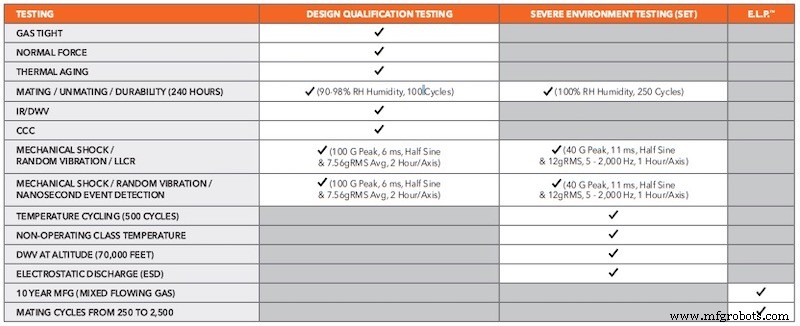
Table 1. Areas of Samtec’s Design Qualification Testing
Mating/Unmating/Durability in Standard Qualification Testing
These tests assess a connector set’s ability to maintain performance when subjected to non‑ideal conditions. In a standard protocol, the relative humidity (RH) ranges from 90 % to 98 % for 10 days, with 25 mating/unmating cycles. SET amplifies these demands: RH is set to 100 %, and the cycle count rises to 250, ensuring resilience under extreme humidity.
Temperature Cycling (Thermal Shock Testing)
Temperature shock testing verifies that a connector can endure rapid thermal transitions. The conventional test exposes a connector set to a range of –55 °C to +85 °C for 100 cycles, with a 30‑minute dwell at each temperature. SET expands the range to –65 °C to +125 °C, increases the cycle count to 500, and still retains the 30‑minute dwell. Throughout, LLCR is measured to detect any rise in resistance.
Mechanical Shock / Random Vibration / LLCR and Event Detection
Mechanical shock and random vibration testing evaluate a connector’s robustness against physical disturbances. The standard test uses a 100 G peak shock (6 ms, half‑sine). SET employs a 40 G peak shock for 11 ms, half‑sine, and monitors LLCR before and after to capture contact resistance changes. Random vibration follows a 7.56 gRMS profile over 2 hours per axis; SET raises the intensity to 12 gRMS across 5–2000 Hz for 1 hour per axis, with continuous event detection to capture any contact discontinuities.
Electrostatic Discharge (ESD)
While ESD is rarely tested for connectors, it becomes critical in harsh environments. The SET ESD test follows EN 61000‑4‑2 from VITA 47, subjecting the connector to 0 kV–15 kV discharges via a 150 pF capacitor and 330 Ω resistor. Each level (5 kV, 10 kV, 15 kV) is applied ten times, followed by a visual inspection to confirm no plating damage.
Dielectric Withstanding Voltage (DWV) at Altitude
DWV is a standard reliability assessment, but testing at 70,000 ft altitude adds complexity. In a typical DWV test, a 60‑second application of .75 × breakdown voltage is used. SET places the connector in a 70,000‑ft altitude chamber and applies 300 VAC; a successful test requires no electrical arcs.
SET Expands to Additional Product Series
Developed by Samtec for engineers and designers who need deeper qualification data for COTS products operating in severe environments, SET delivers results beyond standard COTS testing. Samtec continually broadens its line of Severe Environment Tested (SET) products. Check here for the most recent list of approved series.
Industry Articles are a form of content that allows industry partners to share useful news, messages, and technology with All About Circuits readers in a way editorial content is not well suited to. All Industry Articles are subject to strict editorial guidelines with the intention of offering readers useful news, technical expertise, or stories. The viewpoints and opinions expressed in Industry Articles are those of the partner and not necessarily those of All About Circuits or its writers.
Industrial Technology
- Doug Gaus: Saving Thousands on Design & Testing to Launch Innovative Products
- Master E3.series for Industrial Equipment Design: Unified Electrical & Mechanical Engineering
- Essential RF & Microwave Design Principles for Reliable PCB Performance
- High‑Voltage PCB Design: Materials, Safety, and Best Practices
- Design for Assembly: Enhancing Product Manufacturing Efficiency
- Design for Manufacturing: Key Principles for Product Success
- Develop Comprehensive Safety Protocols for Workers and Technicians
- Essential Safety Guidelines for Metal Fabrication Work
- Top 5 Proven Safety Practices for Operating Industrial Machinery
- Cut Costs and Boost Safety: Expert Design Strategies for Gas Distribution Systems