



Understanding AC Waveforms: Sine Waves, Frequency, and Oscilloscope Basics
When an alternator generates AC voltage, the polarity changes smoothly over time, forming a distinctive sine wave when plotted on a graph.
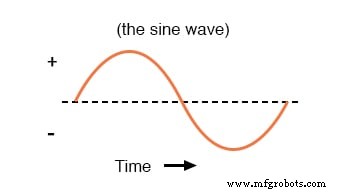
Graph of AC voltage over time (the sine wave).
In the alternator’s voltage trace, the transition from positive to negative polarity is continuous; the rate of change peaks at the zero-crossing and is slowest at the peaks. This mirrors the mathematical sine function over a 0–360° range, as shown in the table below.
Trigonometric Sine Function
| Angle (°) | Sin (angle) | Wave | Angle (°) | Sin (angle) | Wave |
|---|---|---|---|---|---|
| 0 | 0.0000 | zero | 180 | 0.0000 | zero |
| 15 | 0.2588 | + | 195 | -0.2588 | - |
| 30 | 0.5000 | + | 210 | -0.5000 | - |
| 45 | 0.7071 | + | 225 | -0.7071 | - |
| 60 | 0.8660 | + | 240 | -0.8660 | - |
| 75 | 0.9659 | + | 255 | -0.9659 | - |
| 90 | 1.0000 | +peak | 270 | -1.0000 | -peak |
| 105 | 0.9659 | + | 285 | -0.9659 | - |
| 120 | 0.8660 | + | 300 | -0.8660 | - |
| 135 | 0.7071 | + | 315 | -0.7071 | - |
| 150 | 0.5000 | + | 330 | -0.5000 | - |
| 165 | 0.2588 | + | 345 | -0.2588 | - |
| 180 | 0.0000 | zero | 360 | 0.0000 | zero |
The electromechanical alternator produces a sine‑wave AC signal because the voltage induced in stationary coils is proportional to the rate of change of magnetic flux, which follows a sine function as the rotor turns (Faraday’s Law of Electromagnetic Induction). When the magnetic poles are nearest the coils, the flux changes fastest; when they are farthest, the change is slowest, yielding the familiar smooth sinusoid.
Period vs Frequency
A full cycle of the waveform is the distance between identical points on the graph—most commonly between successive peaks. The horizontal axis can be read in degrees (0–360°) or in time, depending on context. The time span of one cycle is called the period, usually expressed in seconds.
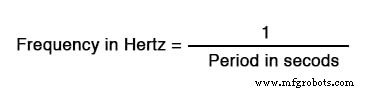
Because one complete cycle spans 360°, the period in degrees is always 360°, but the time it takes for a cycle depends on how quickly the voltage oscillates. The reciprocal of the period is the frequency, measured in Hertz (Hz) as cycles per second. In the U.S., utility power runs at 60 Hz, while European grids operate at 50 Hz.
Historically, frequency was denoted as “cycles per second” (CPS). The shift to Hertz, named after Heinrich Hertz, is widely accepted in modern engineering.
Period and frequency are mathematically inverses:
Using an Oscilloscope
An oscilloscope displays voltage as a function of time on a screen, much like an ECG machine does for heart activity. By measuring the horizontal distance between identical points on the displayed waveform, you can determine the period and then compute the frequency.
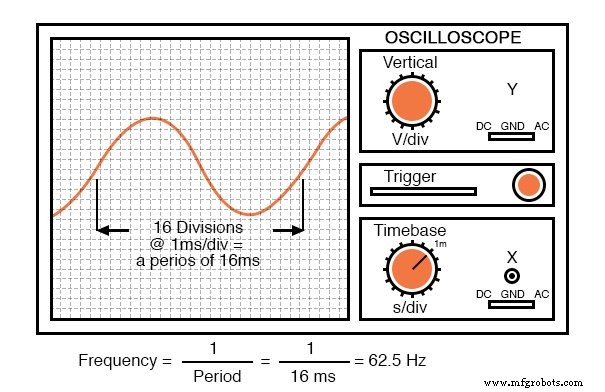
Time period of sine wave is shown on oscilloscope.
AC and Sound: A Helpful Analogy
Electrical waves and sound waves share fundamental properties: both vary over time and can be characterized by frequency. In music, frequency corresponds to pitch. For example, the note A4 is tuned to 440 Hz; an octave above is 880 Hz, exactly double the frequency.
Below is a table of common musical notes and their frequencies:
| Note | Musical Designation | Frequency (Hz) |
|---|---|---|
| A | A₃ | 220.00 |
| A♯/B♭ | A#₃ / B♭₃ | 233.08 |
| B | B₃ | 246.94 |
| C | C₄ (Middle C) | 261.63 |
| C♯/D♭ | C#₄ / D♭₄ | 277.18 |
| D | D₄ | 293.66 |
| D♯/E♭ | D#₄ / E♭₄ | 311.13 |
| E | E₄ | 329.63 |
| F | F₄ | 349.23 |
| F♯/G♭ | F#₄ / G♭₄ | 369.99 |
| G | G₄ | 392.00 |
| G♯/A♭ | G#₄ / A♭₄ | 412.30 |
| A | A₄ | 440.00 |
| A♯/B♭ | A#₄ / B♭₄ | 466.16 |
| B | B₄ | 493.88 |
| C | C₅ | 523.25 |
Notes sharing the same letter differ by a 2:1 frequency ratio, which explains why two tones an octave apart sound so similar. The piano keyboard illustrates this spacing: one octave spans seven white keys.
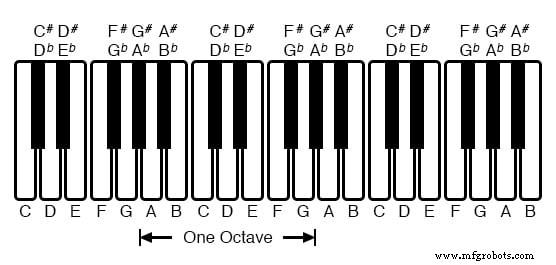
An octave is shown on a musical keyboard.
Other Forms of Alternating Waves
While alternators naturally produce sine waves, many electronic circuits intentionally generate other waveforms. Common shapes include square, triangle, and sawtooth, each with distinct harmonic content. Even when a circuit is designed to output a pure sine wave, real-world factors often introduce distortion.
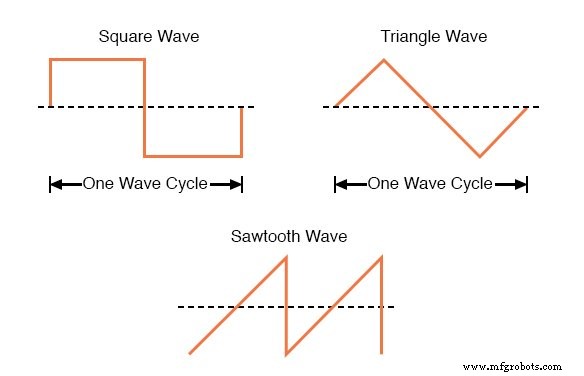
Some common waveshapes (waveforms).
Waveforms that closely resemble a perfect sine are called sinusoidal; any deviation is termed non‑sinusoidal. Understanding the shape of an AC waveform is crucial because it influences how the wave interacts with electrical circuits.
Review
- Alternators produce a sine‑wave AC signal.
- A cycle is one complete evolution of the waveform.
- The period is the time for one cycle.
- Frequency is the number of cycles per second (Hz). 1 Hz = one cycle per second.
- Frequency = 1 / (period in seconds).
Related Worksheets
- AC Waveforms Worksheet
- Basic Oscilloscope Operation Worksheet
Industrial Technology
- Exploring Voltage Addition with Series Battery Connections
- Voltage Divider Lab: Design, Measurement, and Kirchhoff’s Voltage Law Verification
- Thermoelectricity: Understanding Thermocouples and the Seebeck Effect
- Potentiometric Voltmeter: Precise Voltage Measurement with Minimal Loading
- Build a Potato Battery: A Step‑by‑Step Guide to DIY Electrochemical Power
- Low‑Voltage AC Power Supply: Phase‑Shift Circuit Components & Best Practices
- Voltage Regulator Experiment with a 12‑Volt Zener Diode
- Voltage Follower Amplifier: Design, Build, and Measurement Guide
- Designing a High‑Gain Multi‑Stage Common‑Emitter Amplifier with Negative Feedback
- Tachogenerators: Precision Speed Measurement for Industrial Motors and Equipment