



Understanding Alternating Current (AC): Why It Powers the World
When students first explore electricity, they encounter direct current (DC) – a steady flow of electrons that maintains a fixed polarity. DC is produced by batteries and triboelectric phenomena, where rubbing certain materials creates a unidirectional charge.
Alternating Current vs Direct Current
While DC is straightforward, most electrical systems rely on alternating current (AC). Rotary generators naturally produce voltages that change polarity, reversing positive and negative over time. This alternating pattern is the hallmark of AC, whether the polarity flips or the current direction oscillates.
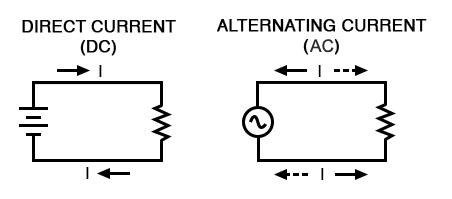
Direct vs alternating current
Where a battery symbol represents any DC source, the circle with a wavy line inside denotes an AC voltage source.
Although AC offers no advantage for heating applications – where only the magnitude of power matters – it unlocks efficiencies in generators, motors, and power distribution that DC cannot match.
Below is a brief technical backdrop that explains why AC dominates high‑power systems.
AC Alternators
When a magnetic field rotates around stationary wire coils, Faraday’s law induces an AC voltage across those coils. This principle forms the core of an AC generator, commonly called an alternator:
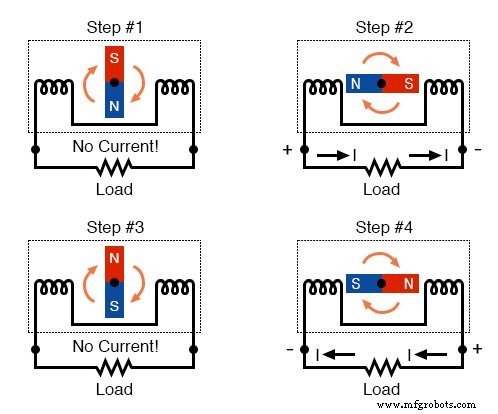
Alternator operation
As the magnet’s poles pass each coil, the induced voltage’s polarity reverses, driving current in the opposite direction. The faster the shaft turns, the higher the frequency of the resulting AC waveform.
DC generators follow a similar induction principle but require a rotating coil and stationary brushes to convert the changing polarity into a constant voltage. This adds mechanical complexity, sparks, and wear, especially at high speeds.
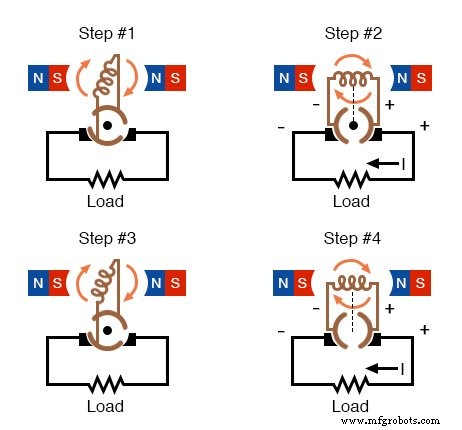
DC generator operation
Because AC generators do not need brushes or commutators, they are simpler, more reliable, and cheaper to manufacture.
AC Motors
The same simplicity applies to motors. AC motors rely on the rotating magnetic field produced by AC in stationary coils, eliminating the need for brushes. DC motors, in contrast, must use brushes to reverse current in the rotating armature, mirroring the complexity seen in DC generators.
Transformers
AC’s most powerful advantage lies in its compatibility with transformers, devices that exploit mutual induction between two coils. Energizing one coil with AC induces a proportional AC voltage in the second coil:
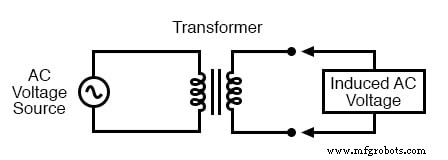
Transformer “transforms” AC voltage and current.
The secondary voltage equals the primary voltage multiplied by the turns ratio:
- V_secondary = V_primary × (N_secondary ÷ N_primary)
- I_secondary = I_primary × (N_primary ÷ N_secondary)
This relationship is analogous to a gear train: stepping down voltage while stepping up current is like reducing speed while increasing torque.
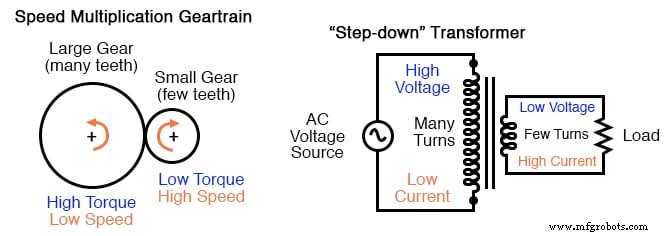
Speed multiplication gear train steps torque down and speed up. Step-down transformer steps voltage down and current up.
Reversing the turns ratio allows a transformer to step up voltage, reducing current and line losses during long‑distance transmission. This capability is essential for modern power grids, enabling the efficient delivery of electricity from distant power plants to local consumers.
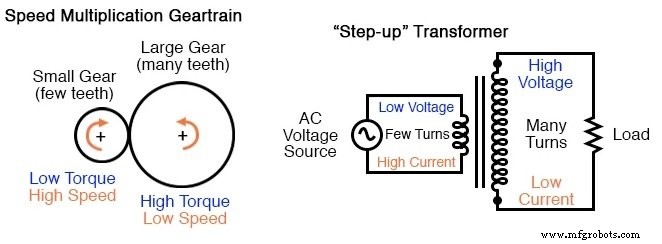
Speed reduction gear train steps torque up and speed down. Step-up transformer steps voltage up and current down.
Without AC transformers, high‑voltage transmission would be prohibitively expensive, limiting power systems to short distances. AC’s compatibility with transformers is therefore a cornerstone of modern electrical infrastructure.
Because transformers rely on changing magnetic fields, they cannot operate with pure DC. Although pulsed DC can create a varying field, it is effectively a form of AC.
In summary, AC offers:
- Simple, brush‑free generator and motor designs
- Efficient voltage stepping for long‑distance transmission
- Reliability and lower manufacturing costs
These advantages explain why AC dominates global power distribution.
Key Takeaways
- DC = constant polarity; AC = polarity that alternates over time.
- Alternators and AC motors are mechanically simpler than their DC counterparts.
- Transformers can only work with AC, making high‑voltage transmission feasible.
- Voltage and current in a transformer follow the turns ratio: V₂ = V₁(N₂/N₁), I₂ = I₁(N₁/N₂).
Additional Resources
- Basic AC‑DC Power Supplies Worksheet
- Step‑up, Step‑down, and Isolation Transformers Worksheet
Industrial Technology
- Hands‑On Guide to Current Dividers: Build, Measure, and Simulate with a 6 V Battery
- Understanding Meter Design: From Classic Galvanometers to Modern Digital Displays
- Understanding Metal Casting: Process, Benefits, and Applications
- What Is a Current Meter? A Guide to Measuring Electrical Current
- Understanding Current Regulators: How They Protect Your Devices
- Understanding Wattmeters: Types, Functions, and How They Measure Electrical Power
- Understanding Pulsed DC: A Hybrid Current for Modern Electronics
- Understanding Breaking Capacity: Key Facts for Safe Electrical Protection
- Understanding Bias Voltage: Definition and Impact on Electronic Devices
- Understanding Overcurrent Relays: Protecting Circuits from Overload