



Understanding Voltage Regulation in Power Transformers
In earlier SPICE simulations we observed that a transformer’s output voltage can vary with changes in load resistance, even when the input voltage remains constant.
Several factors influence this variance, including the inductances of the primary and secondary windings, winding resistance, and the degree of magnetic coupling between the windings.
For power transformers, the goal is to present the load with a virtually constant voltage. Therefore, the secondary voltage should fluctuate as little as possible across a wide range of load currents.
Voltage Regulation Formula
Voltage regulation measures how effectively a transformer maintains a steady secondary voltage over varying load currents. It is calculated with the following formula:

What Is “Full Load”?
“Full load” refers to the point at which the transformer operates at its maximum permissible secondary current. This operating point is largely dictated by the wire gauge of the windings (ampacity) and the cooling method employed.
Using our first SPICE transformer simulation as an example, let’s compare the output voltage with a 1 kΩ load versus a 200 Ω load (with the 200 Ω load representing full‑load). Recall that the primary voltage is a constant 10.00 V AC:
freq          v(3,5)      i(vi1)
6.000E+01     9.962E+00   9.962E-03    Output with 1kΩ load

freq          v(3,5)      i(vi1)
6.000E+01     9.348E+00   4.674E-02    Output with 200Ω load
Notice the output voltage drops as the load becomes heavier (i.e., as current increases). To illustrate a near‑no‑load condition, we can replace the secondary load with an extremely high resistance:
transformer
v1 1 0 ac 10 sin
rbogus1 1 2 1e-12
rbogus2 5 0 9e12
l1 2 0 100
l2 3 5 100
k l1 l2 0.999
vi1 3 4 ac 0
rload 4 5 9e12
.ac lin 1 60 60
.print ac v(2,0) i(v1)
.print ac v(3,5) i(vi1)
.end
freq          v(2)        i(v1)
6.000E+01     1.000E+01   2.653E-04

freq          v(3,5)      i(vi1)
6.000E+01     9.990E+00   1.110E-12   Output with (almost) no load
The secondary voltage ranges from approximately 9.990 V under no load to 9.348 V at full load. Applying these values to the regulation formula gives:
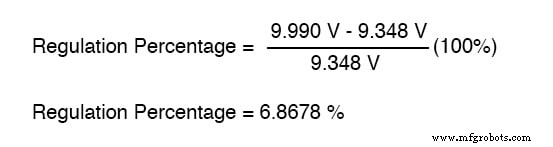
In this example, the regulation exceeds 3 %, which is considered poor for a power transformer. A good power transformer should exhibit a regulation percentage of less than 3 % when driving a purely resistive load. Inductive loads typically worsen regulation, so this analysis represents a best‑case scenario.
Applications That Benefit From Poor Regulation
Some devices intentionally use transformers with poor regulation. For example, discharge lamps require a high initial voltage to ignite the arc, after which the lamp draws less voltage. A step‑up transformer that naturally drops voltage under load is ideal here.
AC arc welders similarly use step‑down transformers that supply high voltage to strike the arc but rely on lower voltage once the arc is established. Designers often adjust arc current by moving an iron core in or out of the transformer, which reduces magnetic coupling, lowers no‑load voltage, and degrades regulation—exactly the desired effect.
Ferroresonant Transformers
Ferroresonant transformers are a special class of power transformers that operate with the core in a state of persistent magnetic saturation. In this regime, variations in primary voltage produce minimal changes in core flux density, resulting in a nearly constant secondary voltage despite supply fluctuations.
Resonant Circuits in Ferroresonant Transformers
Core saturation can distort the output waveform, but ferroresonant transformers mitigate this by incorporating an auxiliary secondary winding paired with one or more capacitors to form a resonant tank tuned to the supply frequency. This tank filters harmonics generated by core saturation and by nonlinear loads, while also storing energy to maintain output voltage during brief input disturbances.
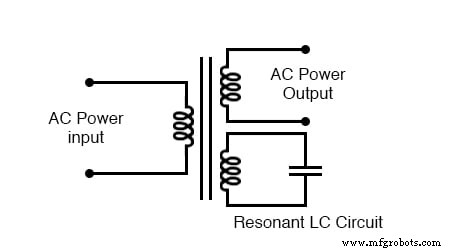
Ferroresonant transformer provides voltage regulation of the output.
Key benefits include robust output voltage amid input variations, harmonic filtering, and the ability to ride through short power interruptions. Some designs even tolerate parallel operation with unsynchronized AC sources, enabling seamless power source switchover.
Known Disadvantages of Ferroresonant Transformers
These transformers consume considerable power due to hysteresis losses in the saturated core, generating significant heat. They are also sensitive to frequency variations, limiting their use with generators that lack stable speed regulation. Additionally, the resonant circuit can produce high voltages, requiring costly capacitors and posing safety hazards to service personnel.
While semiconductor‑based power conditioning solutions exist, they cannot match the simplicity and cost‑effectiveness of ferroresonant transformers for many applications.
Review
- Voltage regulation quantifies a transformer’s ability to keep secondary voltage steady under varying load. Lower percentages indicate better performance.
- Ferroresonant transformer is engineered to maintain stable output voltage even with large input variations.
Related Worksheets
- Regulated Power Sources Worksheet
- Basic AC‑DC Power Supplies Worksheet
Industrial Technology
- Exploring Voltage Addition with Series Battery Connections
- Voltage Divider Lab: Design, Measurement, and Kirchhoff’s Voltage Law Verification
- Thermoelectricity: Understanding Thermocouples and the Seebeck Effect
- Potentiometric Voltmeter: Precise Voltage Measurement with Minimal Loading
- Build a Potato Battery: A Step‑by‑Step Guide to DIY Electrochemical Power
- Low‑Voltage AC Power Supply: Phase‑Shift Circuit Components & Best Practices
- Tachogenerators: Precision Speed Measurement for Industrial Motors and Equipment
- Understanding AC Waveforms: Sine Waves, Frequency, and Oscilloscope Basics
- LM317 Voltage Regulator Datasheet – Your Complete Guide to Precise Voltage Control
- LM350 Voltage Regulator: Complete Guide & Pin Configuration