



LM350 Voltage Regulator: Complete Guide & Pin Configuration
A voltage regulator keeps the output voltage constant regardless of the input or load conditions or changes. And one easy-to-use but very effective voltage regulator is the LM350 positive voltage regulator. You can use it as a programmable voltage output regulator or a precision current regulator, depending on your circuit requirements.
If you’re not sure how to use it, you’re in the right place. Today’s article looks into the voltage regulator, its pin configuration, features, alternatives, and uses.
What is an LM350?
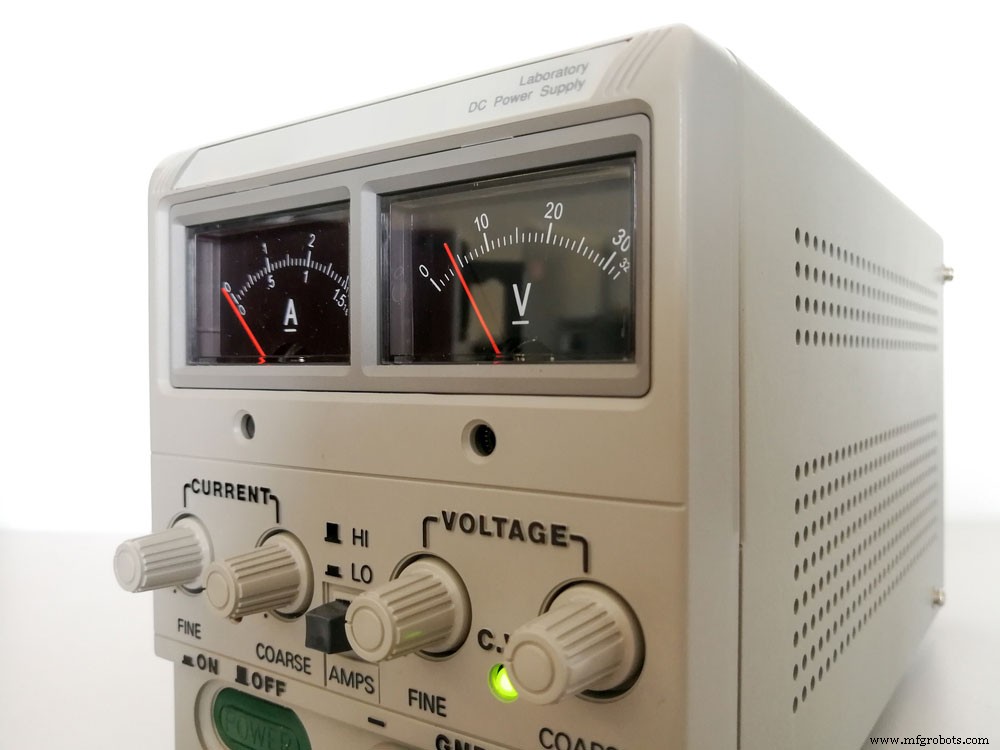
Fig 1: Precise Variable Power Supply
The LM350 is a three-terminal adaptable.
Setting up the LM350 IC is very simple as it only needs two external resistors to set an output voltage.
Furthermore, it’s a sturdy IC that uses safe area compensation, internal current limiting, and thermal shutdown to be blow-out proof. As a result, we can use the regulator to design an adjustable switching or a precision current regulator.
LM350 Pin Configuration
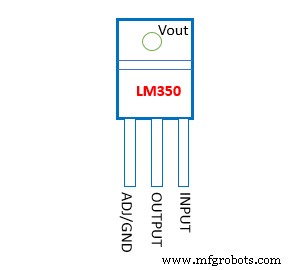
Fig 2: LM350 Voltage Regulator Pin Configuration Diagram
Pin 1/ Adjust Pin (Adj); Sets the output voltage and gives a fixed voltage when the regulator is grounded.
Pin 2/ Output Voltage Pin (Vout); Is the output pin for the regulated voltage.
Pin 3/ Input Voltage Pin (Vin); Serves as the input pin for the voltage under regulation.
LM350 Features
Here are the features and specifications of the LM350 regulator
- The regulator has an output current of 3 Amps and a high dissipation of close to 85 Watts
- Secondly, it has a floating operation in high voltage applications
- Additionally, it gives a line regulation of 0.005%/V and provides a load regulation of 0.1%
- Fourthly, the chip can also withstand a peak input to an output voltage range of 35V. We’d recommend that you keep it close to 15V for normal operation.
- Fifth, the chip has an overload thermal protection feature that shields the circuit components from the effects of overloads. The overload protection keeps the chip in a good working condition even when the adjusted pin is not connected.
- Additionally, you can adjust its output voltage precisely from 1.25V to 33V with a 1% tolerance.
- Finally, it has a built-in safety feature that trips the device when it exceeds the chip’s rated current.
How to use LM350?
To use the LM350 voltage regulator, adjust the values of the resistors under the connection between the output and adjustable pins.
The LM350 has a similar mode of operation to most of the other voltage regulators. A majority of which use input and output capacitors in their circuitry.
The output capacitor improves its transient response and regulation properties making it suitable for electronic regulation and control systems.
Additionally, maximize its performance and regulation by connecting the resistor R1 directly to the output of the voltage regulator.
LM350 Circuit
Below is a three-terminal integrated circuit diagram for the LM350 IC.
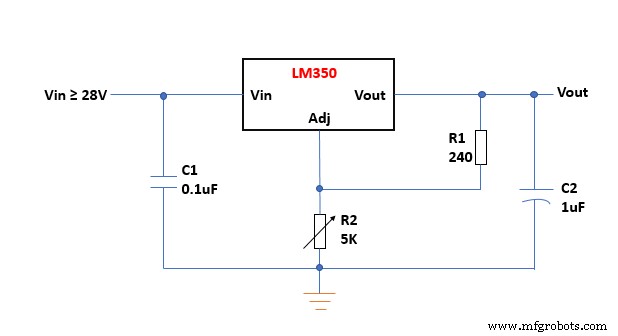
Fig 3: An LM350 Voltage Regulator Circuit Diagram
You’ll use a potential divider network to fix the voltage at the adj pin from the above figure. Additionally, form a voltage divider circuit by using a pair of resistors, as we’ve shown in the circuit diagram above.
You’ll then connect the resistor network to the output voltage pin, Vout.
Also, use a potentiometer instead of a fixed resistor at pin 1 (the potential divider network). It enables the IC to work as a variable voltage regulator.
Finally, you can create a potential difference by connecting the resistor R1 and the potentiometer at the adjusting pin. Doing so controls the Vout according to the following formula.

Clamp the adj pin to the ground to design a voltage supply system with an electric shutdown feature.
LM350 Alternatives
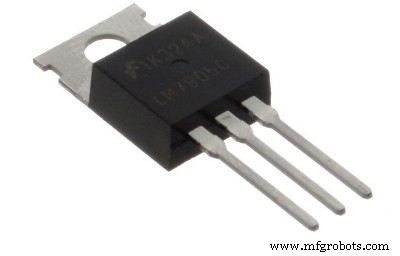
Fig 4: LM7805 5V Voltage Regulator
Listed below are the LM350 voltage regulator alternatives and equivalents.

LM350 Applications
LM350 Applications

Fig 5: A car battery charger
The LM350 is commonly used in the following applications
- Currently limited chargers
- Light controllers
- Temperature controllers
- Switching regulators
- Tracking pre-regulator
- Battery chargers
- Variable power supply systems
- Motor control circuits
- Positive voltage regulations
Conclusion
Contact us if you still have any gray areas or need more information on the LM350. We’ll reach back as soon as we can.
Industrial Technology
- Voltage Regulator Experiment with a 12‑Volt Zener Diode
- Understanding Voltage Regulation in Power Transformers
- Mastering Stainless Steel Welding: A Comprehensive Guide
- Varistor Symbols Explained: Protecting Circuits and Their Practical Applications
- High-Current Voltage Regulator: The Complete Expert Guide
- Comprehensive Guide to Voltage Sensors: Accuracy, Reliability, and Eco-Friendly Solutions
- The Ultimate 9V Voltage Regulator Guide: How to Use and Maximize Performance
- Comprehensive Guide to the LM7815 Voltage Regulator: Usage, Features & Applications
- LM317 Voltage Regulator Datasheet – Your Complete Guide to Precise Voltage Control
- CD4027 Dual JK Flip‑Flop: Comprehensive User Guide