



Accurate Power Measurement in AC Circuits: From Electrodynamometers to Hall‑Effect Sensors
Measuring power in AC circuits is inherently more complex than in DC because phase shifts mean that simply multiplying voltage and current readings does not reflect true power.
What is required is an instrument that can determine the product of instantaneous voltage and current. The classic electrodynamometer, with its stationary and moving coils, excels at this task.
For three‑phase power, two dynamometer movements can be coupled on a common shaft, allowing a single pointer to display the aggregate power on a meter scale. Though this configuration is costly and intricate, it remains a reliable solution.
Hall Effect
One innovative approach to electronic power metering—producing an electrical signal proportional to real power instead of a mechanical pointer—is based on the Hall effect.
The Hall effect, discovered by E. H. Hall in 1879, produces a voltage across a current‑carrying conductor when a perpendicular magnetic field is applied:
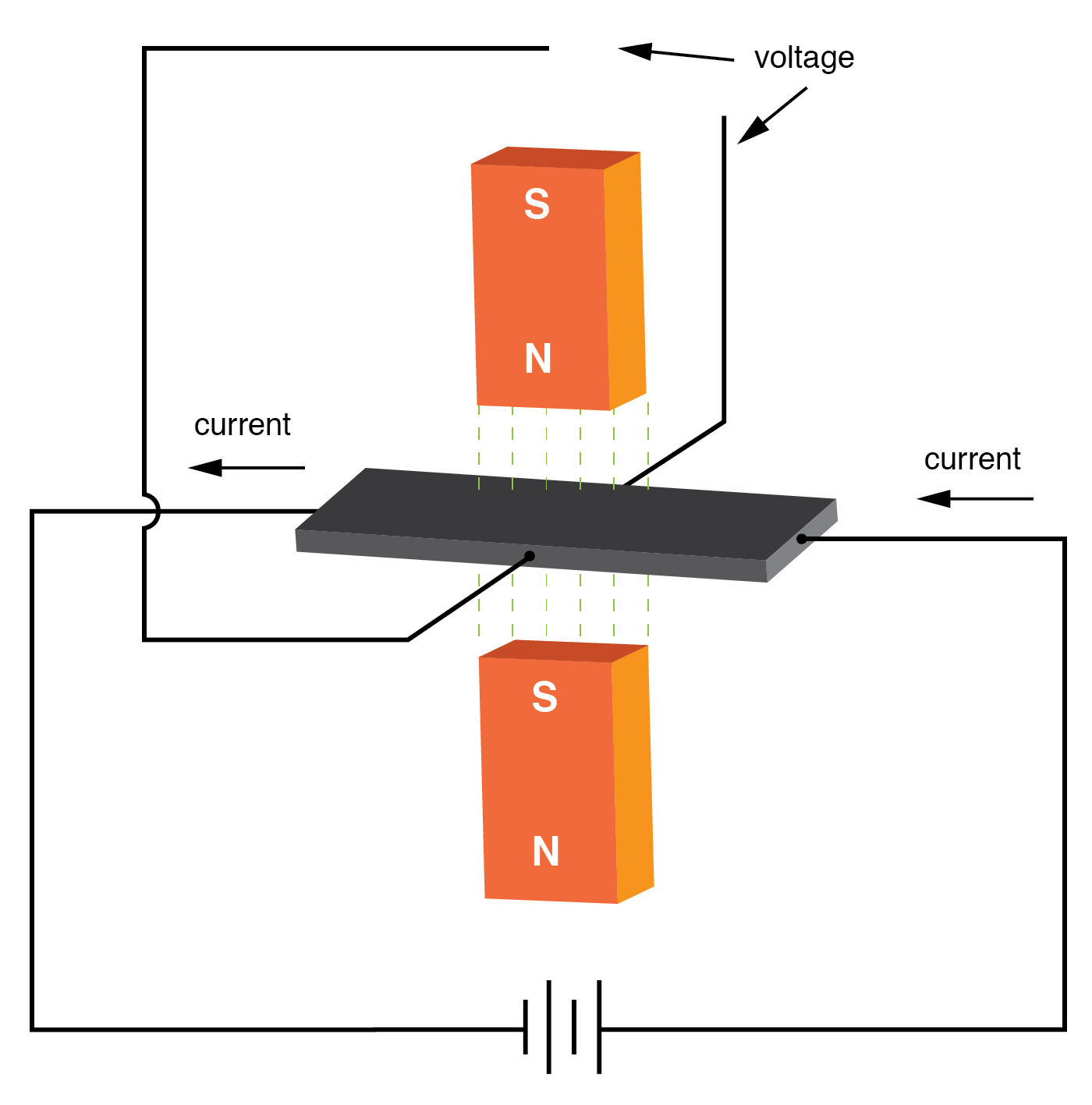
Hall voltage is proportional to current and magnetic‑field strength.
The voltage generated across the flat, rectangular conductor is directly proportional to both the magnitude of the current and the strength of the magnetic field. In other words, it is the product of these two variables. The magnitude of the Hall voltage also depends on the material of the conductor.
Specially engineered semiconductor materials produce a stronger Hall voltage than metals, so modern Hall‑effect devices are built from these materials.
By running AC current through the conductor and generating the magnetic field with coils energized by the same AC power circuit, the Hall voltage becomes proportional to the instantaneous product of current and voltage—i.e., the real power.
Because a Hall‑effect sensor has no moving parts, it can provide instantaneous power measurements with high accuracy.
Moreover, the Hall voltage is a DC signal. The polarity of the Hall voltage depends on both the magnetic‑field polarity and the current direction. When both reverse during an AC half‑cycle, the output polarity remains unchanged.
When voltage and current are 90° out of phase (zero power factor), the peaks of current and magnetic field never coincide; the Hall output becomes zero at those times, reflecting the fact that no real power is delivered to a purely reactive load.
Between these points, the Hall voltage oscillates between positive and negative values, representing the instantaneous exchange of energy with a reactive load. The net DC output over a full cycle is zero, indicating no real power.
If the phase shift is less than 90°, the Hall voltage oscillates asymmetrically—longer positive than negative—so the average (DC) component is non‑zero. A low‑pass filter extracts this DC component, which can then be displayed on a sensitive DC meter movement.
Many users prefer to accumulate power over time rather than measure instantaneously. The filtered DC signal can be integrated to provide total energy consumption, typically expressed in joules or, more commonly, watt‑hours.
RELATED WORKSHEETS:
- DC Transducers Worksheet
Industrial Technology
- PWM Power Controller: Build a Pulse‑Width Modulated Lamp Driver
- Power Sources: AC and DC Explained
- Power Supply Circuits: Types, Design Principles, and Performance
- Understanding Power in Electric Circuits: Measurement & Significance
- Tachogenerators: Precision Speed Measurement for Industrial Motors and Equipment
- Three‑Phase Power Systems: Fundamentals and Benefits
- Measuring Power Quality: Understanding Harmonics and Their Impact on AC Systems
- Efficient 230 VAC Power‑Outage Sensor for Raspberry Pi – Low‑Cost, Compact, and Safe
- Understanding Flicker: Impact on Power Quality and How Variable Speed Drives Help
- Overvoltage Explained: Causes, Risks, and Prevention