



Measuring Frequency and Phase in AC Power Systems
Frequency is a uniquely AC property, crucial for systems that must operate at a precise rate—typically 50 Hz in Europe or 60 Hz in North America. While a generator’s shaft speed can directly give frequency in a local setting, remote measurement demands more sophisticated techniques.
Mechanical Resonance Approach
A simple yet illustrative method uses the principle of mechanical resonance. Every elastic object has a natural frequency; a tuning fork vibrates at a tone defined by its length. Arranging a series of reeds or tuning‑fork‑shaped metal strips on a common base, and exciting them with an electromagnet at the unknown AC frequency, the reed that vibrates most strongly indicates the closest match. This is the principle behind the vibrating‑reed frequency meter, which, while not highly precise, offers ruggedness and ease of construction—often found on small engine‑driven generators to keep output close to the target frequency.
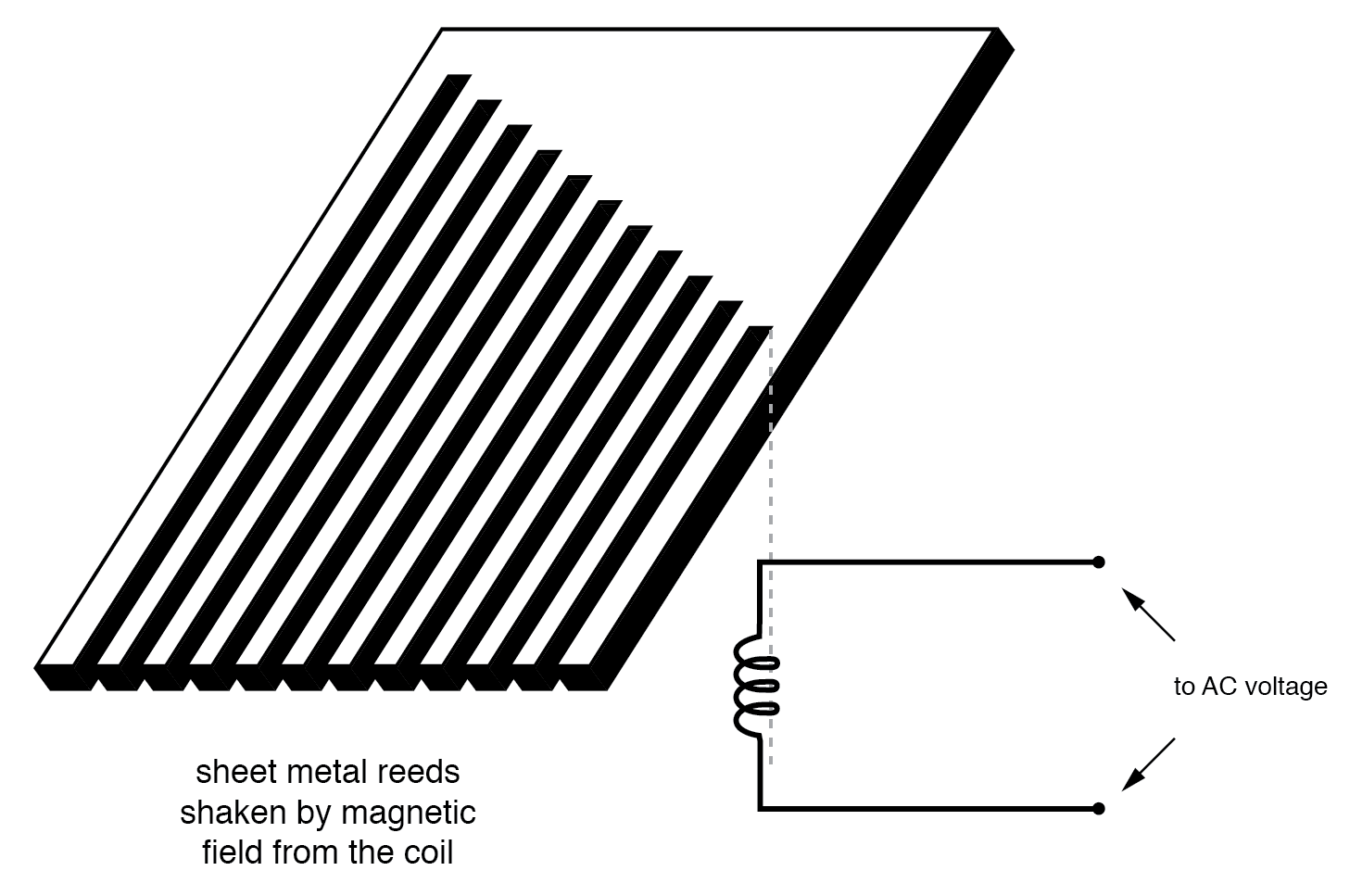
Vibrating reed frequency meter diagram.
Electrical Resonance (LC Tank Circuit)
Replacing the mechanical resonator with an electrical one yields a tunable LC tank circuit. By adjusting an inductor or capacitor until the voltage across the circuit peaks, the resonant frequency is read directly from the calibrated adjustment knob. This technique, akin to a bridge balance, has long been favored by amateur radio operators and can be employed without direct electrical contact with the test circuit.
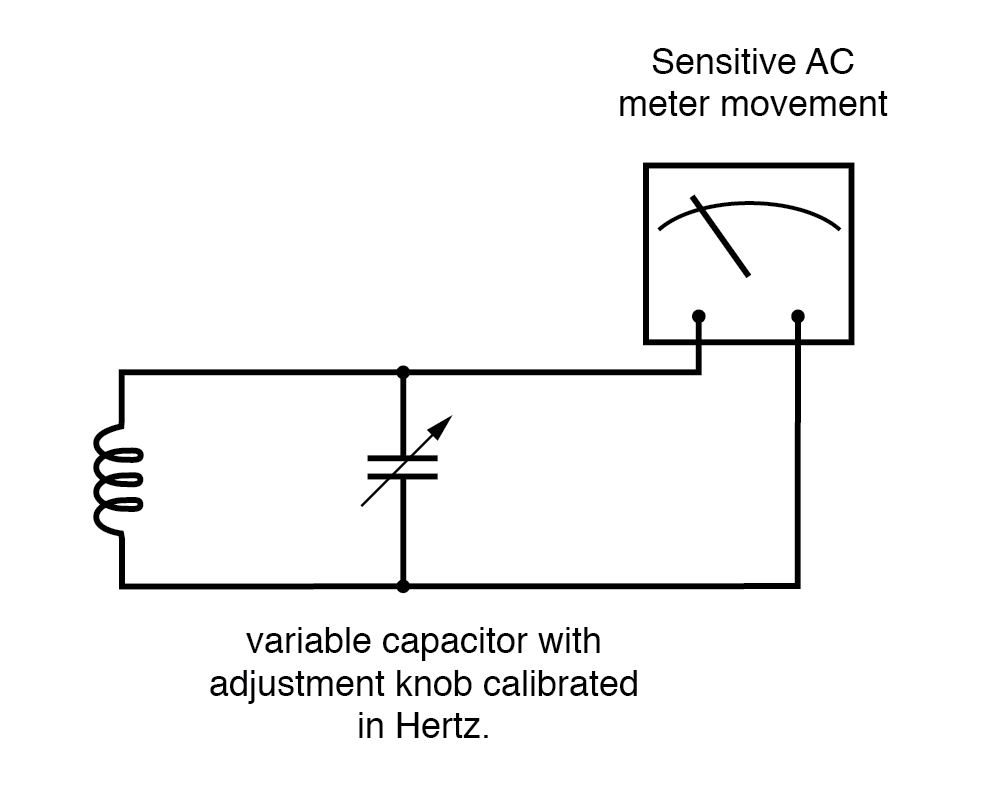
Resonant frequency meter peaks as L‑C resonant frequency is tuned.
Quartz Crystal Standards
Quartz crystals provide the most stable mechanical resonance for electronic use. Their piezoelectric nature turns a small mechanical vibration into a measurable voltage, and vice versa. A crystal behaves as a series LC circuit with a parallel shunt capacitance, offering a high Q factor that translates into excellent frequency stability. In precision devices—oscillators, clocks, and frequency references—crystals are standard. For laboratory accuracy, crystals can be temperature‑controlled in an oven to eliminate thermal drift.
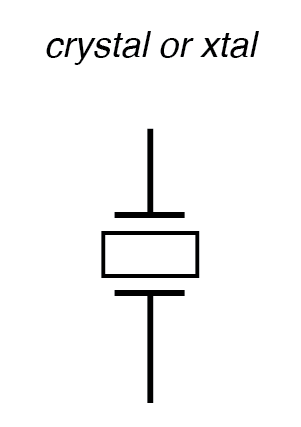
Crystal (frequency determining element) schematic symbol.
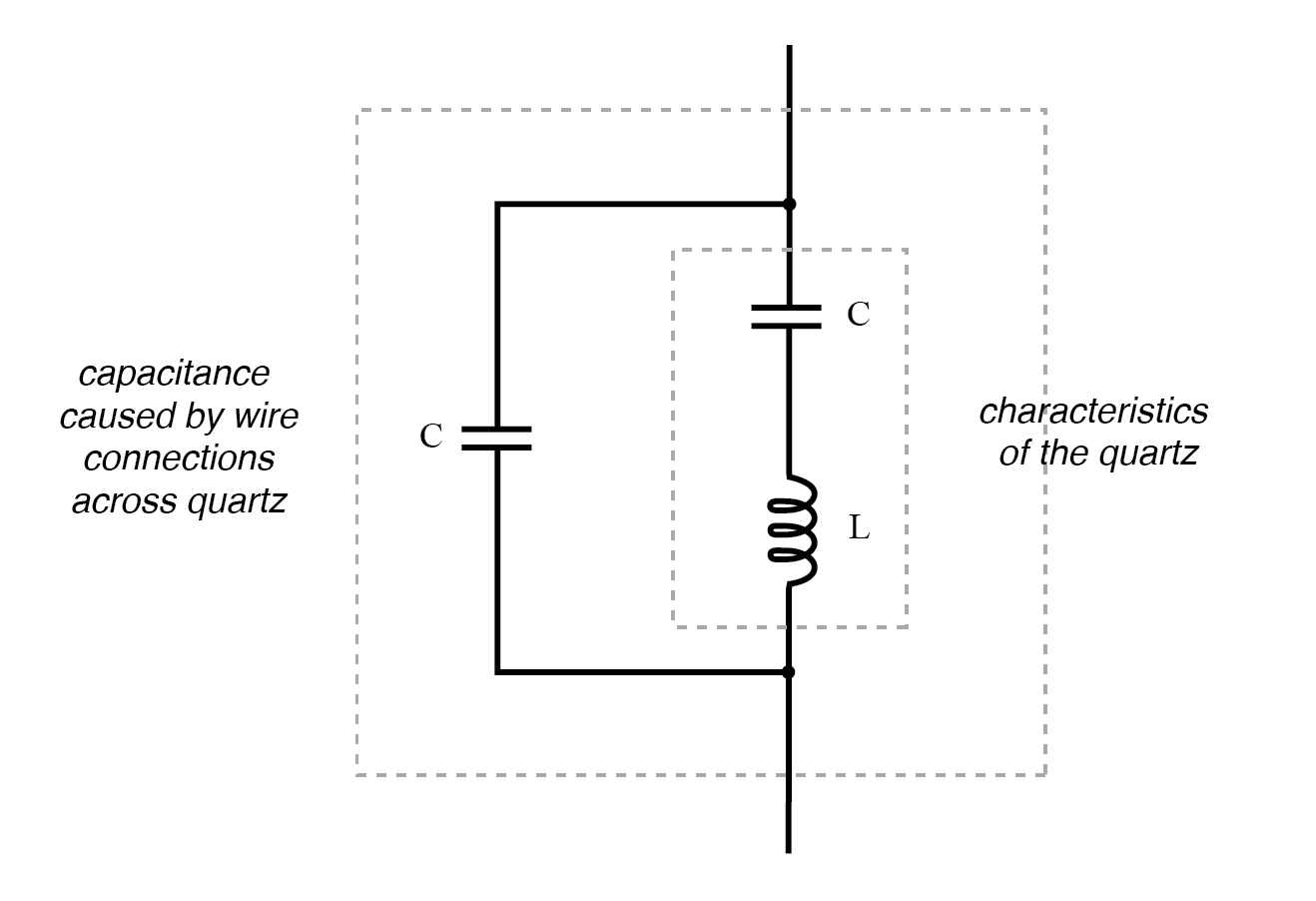
Quartz crystal equivalent circuit.
Atomic Frequency Standards
At the pinnacle of precision, atomic clocks use the resonant frequency of individual atoms—such as cesium or mercury—suspended in vacuum. These standards underpin national timekeeping services and provide reference signals for calibrating other instruments.
Comparative Measurement: Lissajous Figures
When a known reference signal is available, the ratio of an unknown frequency to that reference can be visualized on a cathode‑ray tube (CRT) using Lissajous figures. By driving the horizontal and vertical deflection plates with two AC sources, the resulting pattern reveals the frequency ratio and phase relationship. Integer ratios produce stable figures, while non‑integer ratios cause the figure to drift.
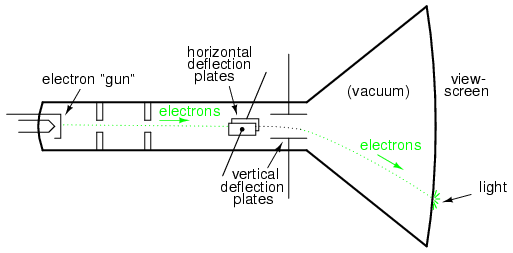
Cathode ray tube with deflection plates.
Examples:
- Same frequency, 0° phase shift – straight line.
- Same frequency, 90° phase shift – circle.
- Horizontal frequency twice the vertical – figure with two lobes.
- 3:1 ratio – figure with three lobes.
- 3:2 ratio – figure with a characteristic “heart” shape.
Key Takeaways
- Mechanical resonators (reed or tuning‑fork) provide a simple visual indication of frequency.
- LC tank circuits offer adjustable, more precise measurements.
- Quartz crystals deliver high‑Q, stable frequency references for oscillators.
- Atomic clocks provide the ultimate standard for time and frequency.
- Lissajous figures enable comparative frequency measurement when a reference signal is present.
Industrial Technology
- pH Measurement: Fundamentals, Electrodes, and Best Practices
- Understanding AC Phase Shift: How Waveforms Lead and Lag
- Representing AC Voltages and Currents as Vectors
- AC Voltage and Current Meter Design: From Rectification to True‑RMS Measurement
- Accurate Frequency & Duty Cycle Measurement with Arduino UNO
- Accurate kVA Transformer Sizing for Single-Phase & Three-Phase Systems
- Precise Ultrasonic Distance Sensing with Arduino – Step‑by‑Step Guide
- Measuring AC and DC Current with Digital and Analog Multimeters: A Practical Guide
- Beat Frequency Oscillator: Principles, Design, and Applications
- Understanding Phase Meters: Accurate Measurement of Electrical Power