



Representing AC Voltages and Currents as Vectors
In AC circuit analysis, every sinusoidal voltage or current can be depicted as a vector. The vector’s length equals the waveform’s amplitude (or RMS value), while its direction encodes the phase angle relative to a reference waveform.
Below is a diagram illustrating how the amplitude of a sinusoid is translated into the length of its corresponding vector.
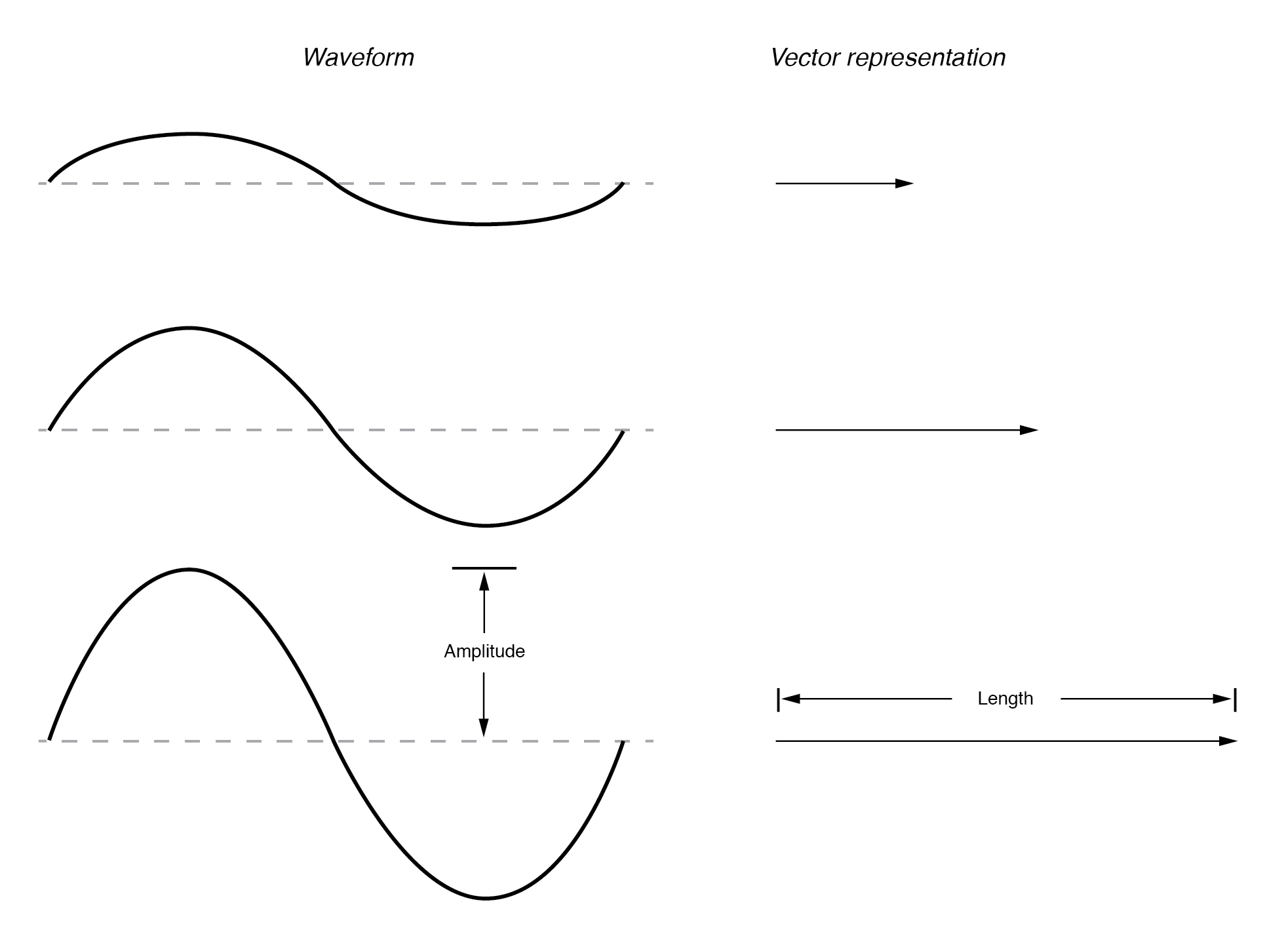
Increasing the waveform’s amplitude stretches the vector; the angle, measured in degrees, represents the phase shift between the waveform of interest and a chosen reference. In most cases, the reference is the main AC supply voltage, which is arbitrarily set to 0°.
Because phase is inherently a relative measure, it only gains meaning when compared against another waveform. For instance, if the supply voltage leads a load current by 45°, the current vector will be rotated 45° clockwise from the voltage vector.
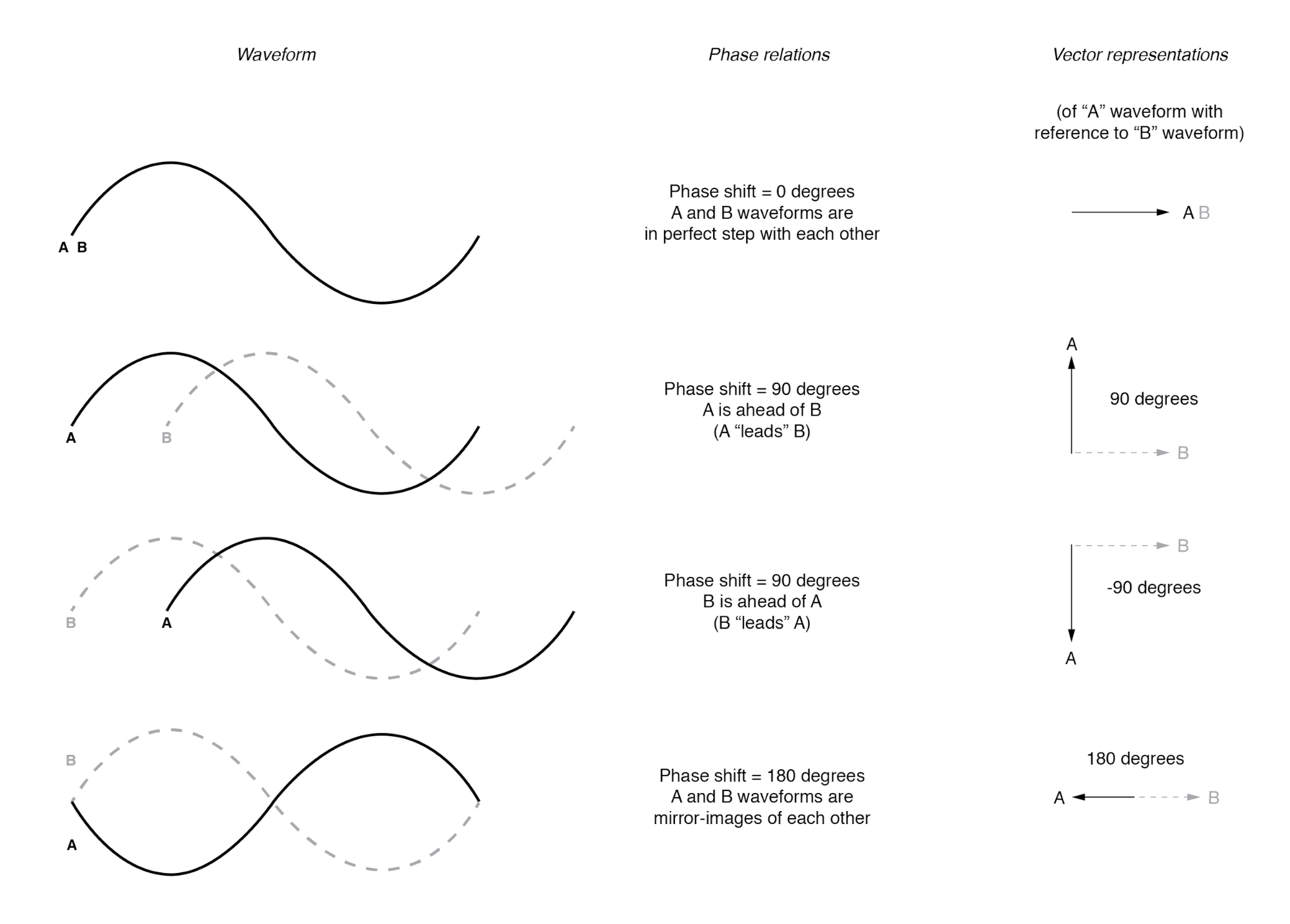
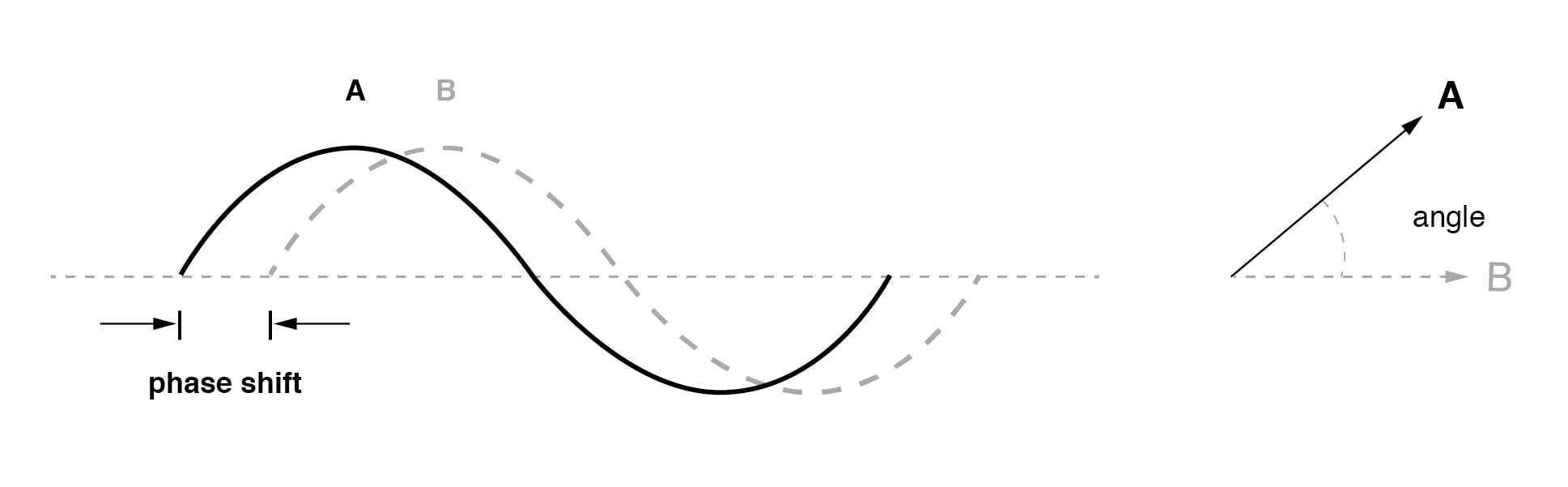
Just as a grounded node provides a common voltage reference in a circuit, an arbitrarily chosen waveform serves as the phase reference. This convention allows us to state, for example, that a current of 24.3 mA lags the reference by 64°, written as “24.3 mA at –64°”.
Review
- When describing an AC quantity, the vector’s length represents its amplitude, and its angle represents the phase relative to a reference waveform.
Related Worksheet
Industrial Technology
- Low‑Voltage AC Power Supply: Phase‑Shift Circuit Components & Best Practices
- Decoding Numbers and Symbols in Electronics
- Understanding AC Waveforms: Sine Waves, Frequency, and Oscilloscope Basics
- Understanding AC Voltage and Current Magnitudes: Peak, RMS, and More
- Understanding AC Phase Shift: How Waveforms Lead and Lag
- Analyzing a Parallel R‑L‑C Circuit: Impedance, Current, and SPICE Simulation
- Analyzing Series-Parallel RC and RL Circuits with Complex Impedance
- Comprehensive Summary of Resistors, Inductors, and Capacitors in AC Circuits
- Measuring Frequency and Phase in AC Power Systems
- Accurate kVA Transformer Sizing for Single-Phase & Three-Phase Systems