



Designing Polyphase AC Motors: Fundamentals and Practical Startup Techniques
AC Motors
Polyphase AC power provides a clear advantage in motor design over single‑phase: the ability to generate a naturally rotating magnetic field. Many AC motors—both induction and synchronous—mirror the construction of their alternator counterparts, featuring stationary windings that energize a rotating magnetic assembly. While more complex topologies exist, the core principle remains the same.
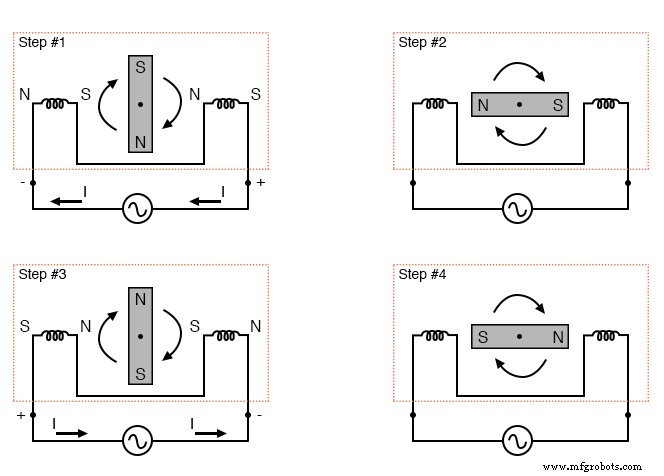
Clockwise AC motor operation.
If the rotating magnet can keep pace with the frequency of the alternating current driving the stator coils, the shaft continues to turn clockwise (see figure). However, the same AC waveform can also drive the motor counter‑clockwise if the magnetic field sequence is reversed.
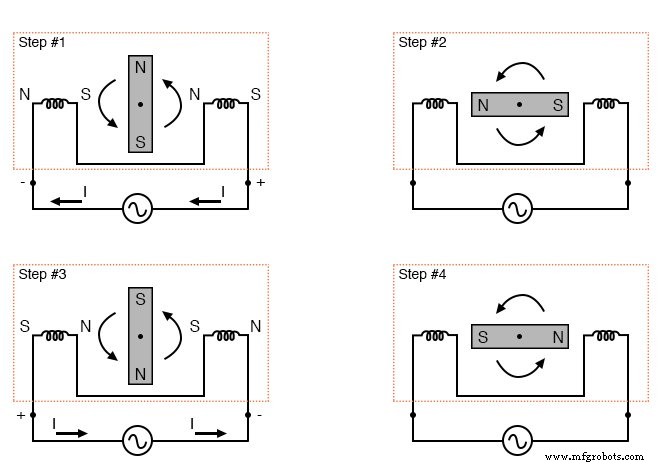
Counter‑clockwise AC motor operation.
Starting AC Motors
Single‑phase induction and synchronous motors lack a predefined rotation direction; they will spin either way with the same voltage waveform. To initiate motion in a specific direction, they require a small assist.
Typical solutions involve an auxiliary winding positioned to produce a phase‑shifted magnetic field. When energized through a capacitor, this winding introduces a current phase lag of less than 180°, creating a magnetic field that rotates in a set direction.
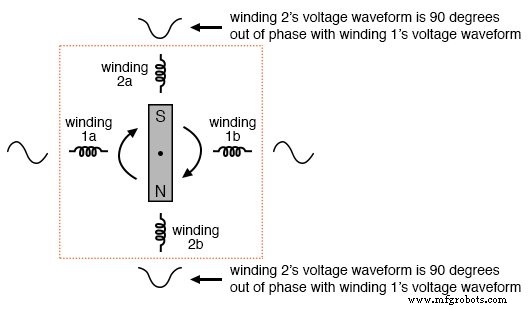
Unidirectional‑starting AC two‑phase motor.
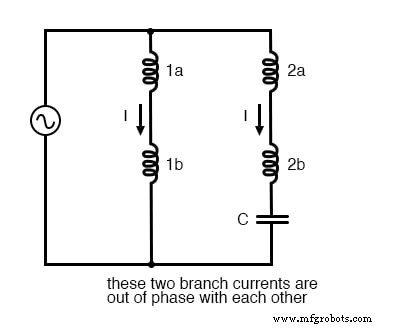
Capacitor phase shift adds the second phase.
The resulting magnetic fields from the main and auxiliary windings rotate in a fixed sequence, ensuring the rotor turns in the desired direction once the motor is started.
Starting Polyphase AC Motors
Polyphase motors sidestep this complication. Their supply voltage already contains a defined phase sequence (e.g., 1‑2‑3), which translates directly into a rotating magnetic field generated by the stator windings. This concept, credited to Nikola Tesla’s 1887 work on polyphase systems, enables simple, efficient motor operation.
Because the phase sequence is inherent in the supply, the motor’s direction of rotation is fixed. Reversing the rotation is as straightforward as swapping any two of the hot leads.
Linear String Lights Analogy
To visualize the importance of phase shift, consider a row of blinking lamps. If lamps of type 1 light up while type 2 remains off, and vice versa, there is no perceived motion— the sequences are 180° out of phase.
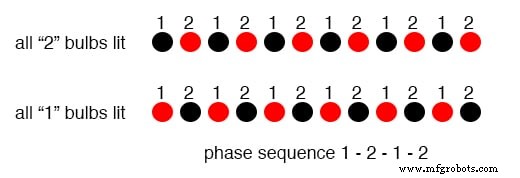
Phase sequence 1‑2‑1‑2: lamps appear to move.
Contrast this with a three‑set sequence (1‑2‑3). Here, the lamps sequentially light in a pattern that gives the illusion of motion along the string.
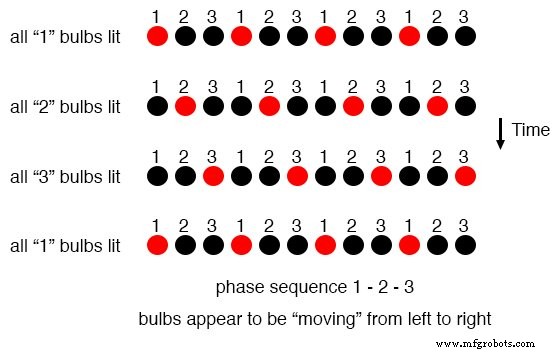
Phase sequence: 1‑2‑3: bulbs appear to move left to right.
Circular String Lights Analogy
Arranging the same sequence around a circle creates a visual rotation. Reversing the phase order flips the perceived direction of motion.
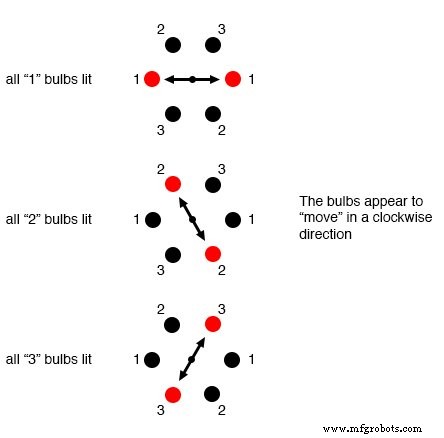
Circular arrangement; bulbs appear to rotate clockwise.
Similarly, a three‑phase AC motor powered with a 1‑2‑3 sequence spins clockwise; swapping the phase order to 3‑2‑1 reverses the rotation.
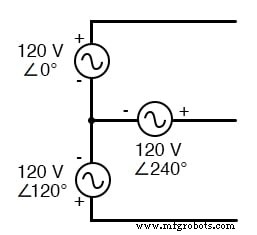
Three‑phase AC motor: A phase sequence of 1‑2‑3 spins the magnet clockwise, 3‑2‑1 spins the magnet counterclockwise.
Review
- Induction and synchronous AC motors rely on a rotating magnetic field produced by stationary windings.
- Single‑phase motors lack a fixed rotation direction and need a phase shift to start reliably.
- Capacitive phase shift in auxiliary windings creates the necessary directionality.
- Polyphase motors naturally generate a rotating field; their rotation is set by the supply phase sequence.
- Reversing any two hot leads on a polyphase motor swaps its direction of rotation.
Related Worksheets
- AC Motor Theory Worksheet
- Polyphase Power Systems Worksheet
Industrial Technology
- Using a Potentiometer as a Rheostat for Simple Motor Speed Control
- Low‑Voltage AC Power Supply: Phase‑Shift Circuit Components & Best Practices
- Half‑Wave Rectifier Experiment: Build, Measure, and Simulate a Simple AC‑to‑DC Motor Circuit
- Understanding Contactors: Types, Functions, and Overload Protection
- Understanding AC Phase Shift: How Waveforms Lead and Lag
- Phase Rotation in Three‑Phase Alternators: Mechanics, Detection, and Wire Reversal
- Variable Reluctance Motors: Types, Operation, and Applications
- Tesla Polyphase Induction Motors: Design, Operation, and Applications
- Integrated Drivers Simplify High‑Power Stepper Motor Design
- How Wide‑Bandgap Semiconductors Revolutionize Motor Control Design