



Phase Shift Oscillator & Varactor Multipliers: Design Principles & Applications
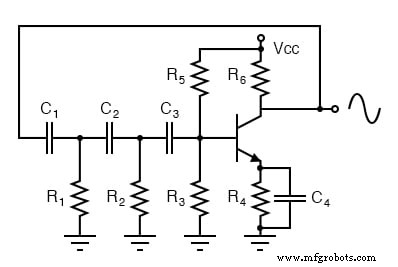
Phase shift oscillator. Each RC stage (R1C1, R2C2, R3C3) contributes a 60° phase shift.
The oscillator depicted above produces a pure sine wave in the audio band. While the collector provides a 180° phase inversion, the three cascaded RC phase shifters add another 180°, yielding a total 360° shift. This constructive feedback enables oscillation once the transistor’s gain surpasses the losses of the feedback network. The design principles are outlined in classic references such as Sedra & Smith’s “Microelectronic Circuits” (7th ed.).
Varactor Multiplier
A varactor diode—whose capacitance varies nonlinearly with reverse bias—distorts the input sine wave f₁, generating higher‑order harmonics (e.g., f₃). The following diagram illustrates the core components:
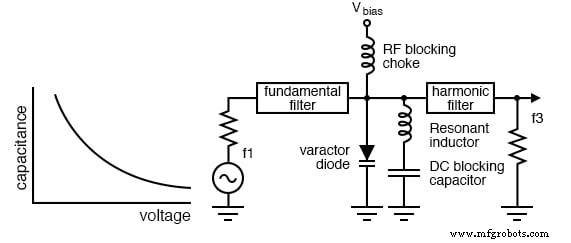
Varactor diode, exhibiting a nonlinear C‑V characteristic, functions as a frequency multiplier.
The architecture includes: a low‑pass filter that passes f₁ while rejecting its harmonics; a choke that supplies DC bias while blocking RF back‑flow; a harmonic filter that selects the desired harmonic (often the third); and a large‑value capacitor that provides a low‑reactance path to ground for RF while blocking DC. The varactor in parallel with the inductor forms a parallel resonant tank tuned to the target harmonic. Because the reverse bias V_bias is fixed, the multiplier can produce stable, high‑frequency outputs that are otherwise inaccessible to standard oscillators. Practical implementations often employ stripline or waveguide sections to achieve frequencies up to several hundred gigahertz.
RELATED WORKSHEET:
- Oscillator Circuits Worksheet
Industrial Technology
- Foundations of DC Circuits: Understanding Direct Current and Core Electrical Concepts
- Understanding AC Circuits: A Beginner's Guide
- Low‑Voltage AC Power Supply: Phase‑Shift Circuit Components & Best Practices
- Rectifier Circuits: From Half‑Wave to Polyphase Full‑Wave Designs
- Understanding Clipper Circuits: Theory, Simulation, and Practical Applications
- Understanding Amplifier Feedback: Positive vs Negative, and Practical Applications
- Phase Shift Oscillator & Varactor Multipliers: Design Principles & Applications
- Crystal and Transistor Radio Circuits: From Basic Detectors to Integrated AM/FM Receivers
- Control Circuits: Fundamentals, Applications, and Best Practices
- Understanding AC Phase Shift: How Waveforms Lead and Lag