



Understanding Contactors: Types, Functions, and Overload Protection
All About Contactors
A contactor is a specialized relay designed to switch high‑current loads, typically electric motors. Unlike standard relays, contactors feature multiple contacts that are normally open (NO). When the coil is energized, the armature pulls the contacts closed, allowing power to flow to the load; when the coil is de‑energized, the contacts return to the NO state, cutting power.
In industrial settings, contactors are most commonly employed to control large electric motors, ensuring that the motor receives the correct voltage and that the circuit is protected from overcurrent conditions.
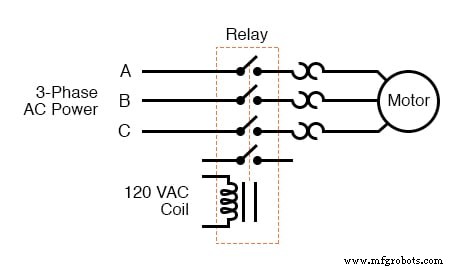
For a 3‑phase motor rated at 1 hp or more, the top three contacts are wired to the incoming 3‑phase AC supply (typically 480 V). The lowest contact is an auxiliary contact, which has a much lower current rating but is driven by the same armature. Auxiliary contacts are often used in relay logic or to switch 120 V AC control circuits.
A single contactor may contain several auxiliary contacts, configured as normally open (NO) or normally closed (NC) as required by the control scheme.
Overload Heaters
Each phase of a motor is equipped with a low‑resistance metal strip known as an overload heater. The heater dissipates heat proportionally to the current drawn by the motor. If the temperature of any heater reaches a critical point—indicating a moderate overload—a normally closed overload contact opens, breaking the series circuit that energizes the coil and immediately shutting the motor.
Unlike circuit breakers or fuses, which protect conductors, overload heaters provide overcurrent protection for the motor itself. They are designed to thermally emulate the motor’s own heating characteristics, so that the heater’s temperature rise matches the motor’s critical temperature profile.
When the overload contact trips, the heater must cool at the same rate the motor would recover, preventing premature restarts until the motor is truly ready.
Three‑Phase Electric Motor Contactor
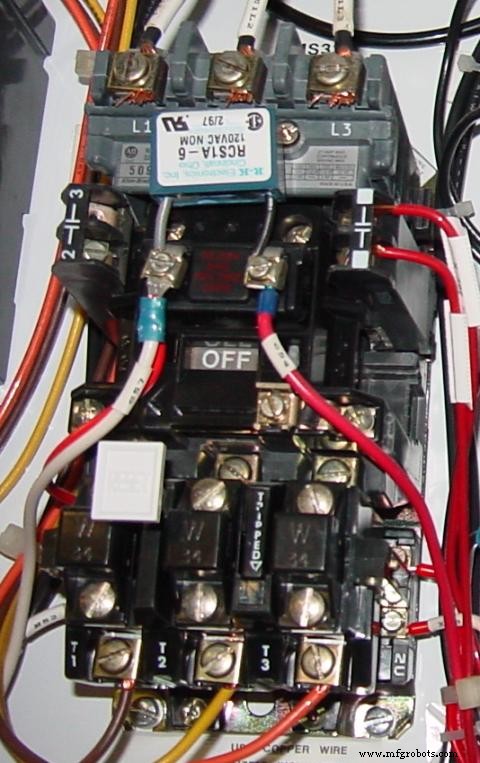
Below is an example of a contactor installed in a municipal water treatment plant’s control panel:
Key Features
- Three normally‑open contacts at the top (L1, L2, L3) handle 480 V AC input. The L2 terminal is hidden behind a snubber circuit that protects the coil.
- The heater assembly at the bottom (T1, T2, T3) delivers power to the motor.
- Black square heater blocks labeled W34 indicate a specific thermal response for the motor’s horsepower and temperature rating.
- A white push button between T1 and T2 allows manual reset of the normally‑closed overload contact after a trip.
- Near the NC contact wiring, a small window marked Tripped displays the trip status via a colored flag.
Using Heater Elements as a Current Shunt
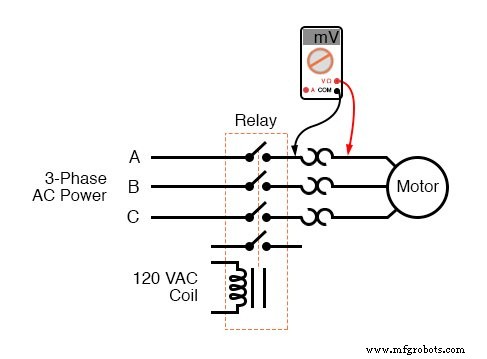
In some troubleshooting scenarios, the heater element can serve as a simple shunt resistor to verify motor operation when the contactor is energized. By measuring millivoltage across each heater with a multimeter, you can determine whether current is flowing through that phase:
- Zero voltage across a heater indicates no current (e.g., a burnt‑out winding).
- A small voltage drop confirms current flow.
This technique is especially useful for detecting single‑phasing conditions, which can cause rapid motor damage.
Review
- A contactor is a high‑current relay used to power electric motors or other large loads.
- Overload heaters protect motors by thermally mimicking motor heating and tripping a normally‑closed contact when necessary.
Related Worksheets
- Basic Electromagnetic Relays Worksheet
- AC Motor Control Circuits Worksheet
Industrial Technology
- Using a Potentiometer as a Rheostat for Simple Motor Speed Control
- Build a Permanent Capacitor Split-Phase Induction Motor – Step‑by‑Step Guide
- Build a Large-Scale AC Permanent Split‑Capacitor Induction Motor
- Signal Coupling: Understanding AC Noise in Telephone Cables
- Half‑Wave Rectifier Experiment: Build, Measure, and Simulate a Simple AC‑to‑DC Motor Circuit
- Advanced Motor Control Circuits: Latching, Stop, and Time‑Delay Techniques
- Designing Polyphase AC Motors: Fundamentals and Practical Startup Techniques
- Variable Reluctance Motors: Types, Operation, and Applications
- Stepper Motors: Types, Characteristics, and Practical Applications
- Understanding AC Commutator Motors: Design, Types, and Applications