



Understanding AC Commutator Motors: Design, Types, and Applications
After arriving in America, Charles Proteus Steinmetz tackled the perplexing challenges of designing brushed AC commutator motors, which previously could not be reliably engineered before construction.
His breakthrough came by formalizing magnetic hysteresis, revealing how the magnetic flux lags behind the magnetizing force and creates losses absent in DC machines.
Using low‑hysteresis alloys and slicing the iron core into thin insulated laminations, engineers could now accurately predict the behavior of AC commutator motors before building them.
Like their DC counterparts, AC commutator motors deliver higher starting torque and higher speed than AC induction motors. The series type, in particular, can operate well above the synchronous speed of a conventional AC motor.
AC commutator motors come in single‑phase and poly‑phase variants. Single‑phase motors experience a double‑line‑frequency torque pulsation that is absent in the smoother poly‑phase design.
While a commutator motor can run at a much higher speed than an induction motor and thus output more power for a given size, it is not maintenance‑free. Brush and commutator wear demand periodic servicing.
Single Phase Series Motor
When a DC series motor equipped with a laminated field is powered from AC, the field coil’s lagging reactance markedly reduces the field current. The motor will run, but its performance is marginal.
During start‑up, the armature windings shorted by the brushes resemble shorted transformer turns in the field, producing substantial arcing and sparking as the armature begins to rotate.
As speed rises, the arcing and sparking are distributed across more commutator segments, making the condition more tolerable. Small uncompensated series AC motors—those below the size of a hand‑drill or kitchen mixer—can still operate under these constraints.
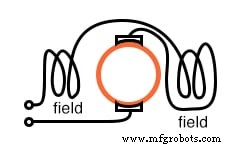
Uncompensated series AC motor
Compensated Series Motor
The arcing issue is mitigated by adding a compensating winding on the stator. This winding is placed in series with the armature and is positioned so that its magnetomotive force cancels the armature’s AC mmf.
Reducing the air gap and the number of field turns lowers the lagging reactance in series with the armature, improving the power factor. All but the smallest AC commutator motors employ compensating windings; even kitchen‑mixer‑sized motors do so.
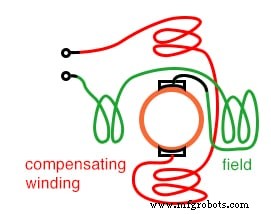
Compensated series AC motor
Universal Motor
Small universal motors—typically under 300 watts—can run on either DC or AC. Very small units may be uncompensated; larger, high‑speed units almost always use a compensating winding.
On AC, the motor runs slightly slower than on DC due to reactance. However, the peaks of the sine waves saturate the magnetic path, reducing the total flux and increasing the speed of the “series” section. These opposing effects keep the speed nearly constant between DC and 60 Hz.
Universal motors power common appliances that demand 3,000 to 10,000 rpm, such as drills, vacuum cleaners, and mixers.
Advances in solid‑state rectifiers and low‑cost permanent magnets are making DC permanent‑magnet motors an increasingly attractive alternative.
Repulsion Motor
A repulsion motor connects the field directly to the AC line voltage and places a pair of shorted brushes offset 15° to 25° from the field axis. The field induces a current in the shorted armature, producing a magnetic field that opposes the field coils.
Speed is controlled by rotating the brushes relative to the field axis. The motor exhibits excellent commutation below synchronous speed and poor commutation above it. The low starting current delivers high starting torque.
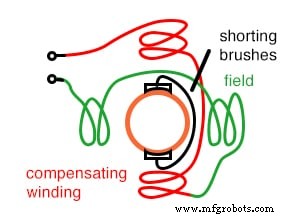
Repulsion AC motor
Repulsion Start Induction Motor
When an induction motor must start a hard‑load, such as a compressor, the high starting torque of a repulsion motor is invaluable. The induction rotor windings are temporarily connected to commutator segments via shorted brushes.
Once the motor nears running speed, a centrifugal switch shorts all commutator segments, converting the rotor into a squirrel‑cage configuration. The brushes may also be lifted to prolong their life.
Starting torque can reach 300% to 600% of the full‑speed value—compared to less than 200% for a pure induction motor.
Summary: AC commutator motors
- The single‑phase series motor is an attempt to emulate a DC commutator motor; it is only practical in very small sizes.
- Adding a compensating winding yields the compensated series motor, overcoming excessive commutator sparking. Most AC commutator motors are of this type. They provide more power at high speed than a same‑size induction motor but are not maintenance‑free.
- Small appliances can use motors that run on either AC or DC, known as universal motors.
- The AC line is directly connected to the stator of a repulsion motor, with the commutator shorted by the brushes.
- Retractable shorted brushes can start a wound‑rotor induction motor; this is the repulsion start induction motor.
Industrial Technology
- Stepper Motors: Types, Characteristics, and Practical Applications
- Brushless DC Motors: Design, Construction, and Advanced Applications
- Tesla Polyphase Induction Motors: Design, Operation, and Applications
- Understanding Single‑Phase Induction Motors: Types, Operation, and Efficiency Improvements
- Specialized Motors: Shaded‑Pole, Servo, Hysteresis, and Eddy‑Current Clutch Applications
- Extending Motor Life: Expert Maintenance Tips
- Motor Storage Maintenance: Best Practices to Preserve Performance
- Master DC & Servo Motor Control with Arduino – Step-by-Step Tutorial
- Industrial Motors: Types, Functions, and Applications
- Understanding BLDC Motors: A Professional Guide