



Understanding Time-Delay Relays: Types, Applications, and Advanced Features
What Are Time‑Delay Relays?
Time‑delay relays incorporate a mechanical or electronic “shock‑absorber” that delays armature motion when the coil is energized or de‑energized. This gives the relay a built‑in time delay that is critical in many industrial control applications.
Unlike standard relays, time‑delay relays must specify not only their normally‑open (NO) or normally‑closed (NC) state, but also whether the delay occurs during closing or opening. The four fundamental contact types are outlined below.
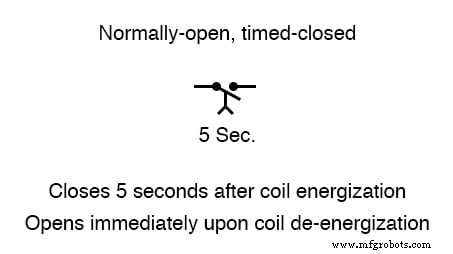
1. Normally‑Open, Timed‑Closed (NOTC) Contact
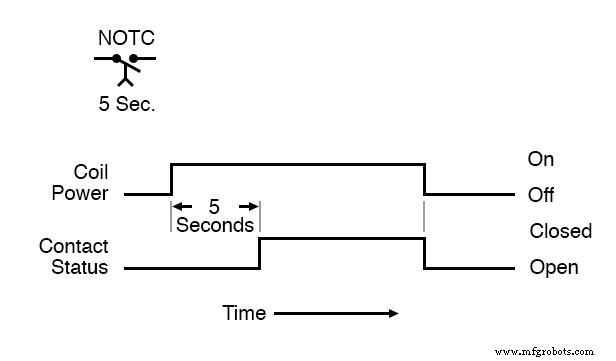
A NOTC contact is open when the coil is de‑energized. Upon energizing the coil, the contact closes only after the specified delay period. Because the delay occurs during coil energization, it is also called a normally‑open, on‑delay relay.
NOTC Timing Diagram
2. Normally‑Open, Timed‑Open (NOTO) Contact
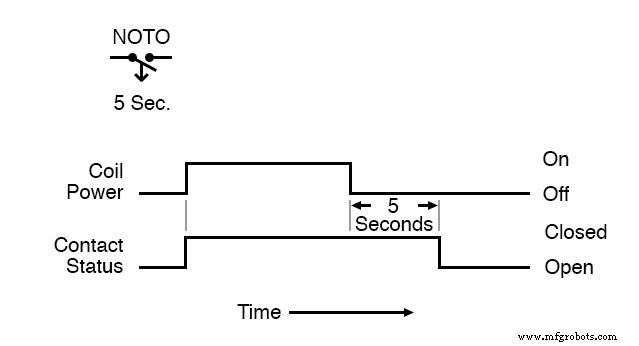
A NOTO contact is also open when the coil is de‑energized. The contact closes immediately upon coil energization, but opens only after the coil has been de‑energized for the set delay. This is referred to as a normally‑open, off‑delay relay.
NOTO Timing Diagram
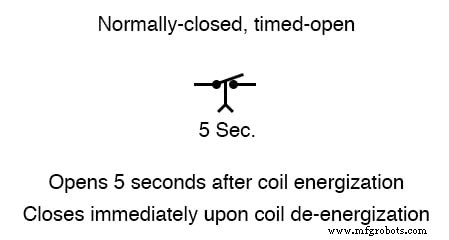
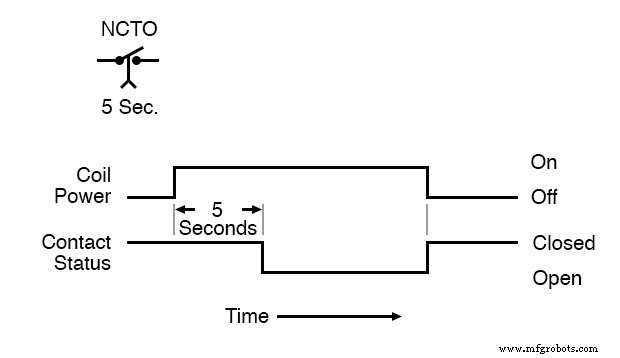
3. Normally‑Closed, Timed‑Open (NCTO) Contact
An NCTO contact is closed when the coil is de‑energized. When the coil is energized, the contact opens after the specified delay, making it a normally‑closed, on‑delay relay.
NCTO Timing Diagram
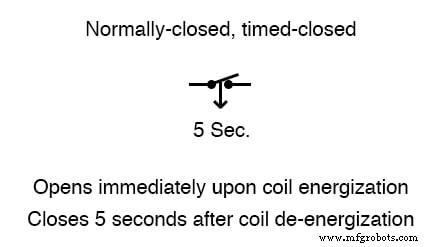
4. Normally‑Closed, Timed‑Closed (NCTC) Contact
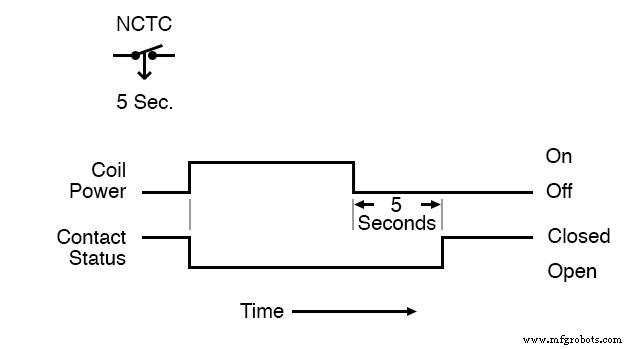
An NCTC contact is closed when the coil is de‑energized. Energizing the coil closes the contact immediately, but it opens only after the coil has been de‑energized for the set delay—an off‑delay configuration.
NCTC Timing Diagram
Industrial Control Applications
- Flashing Light Control – Two time‑delay relays can produce a constant‑frequency on/off pulse for lamps.
- Engine Auto‑Start – Sequentially start auxiliary systems (fuel pumps, oil pumps) before engaging the engine starter.
- Furnace Purge Control – Run the air fan for a prescribed time to remove hazardous vapors before ignition.
- Motor Soft‑Start – Apply a reduced voltage for a set delay, then switch to full power to limit inrush current.
- Conveyor Belt Sequencing – Delay each belt’s start until the previous belt has reached full speed, preventing material pile‑up.
Advanced Timer Features
Modern time‑delay relays use electronic RC networks rather than mechanical dashpots, offering greater reliability and versatility. Many models support:
- One‑Shot – A single output pulse per input transition from off to on.
- Recycle – Continuous on/off cycling while the input remains energized.
- Watchdog – Triggers if the input fails to cycle at a required frequency, ideal for monitoring critical computer systems.
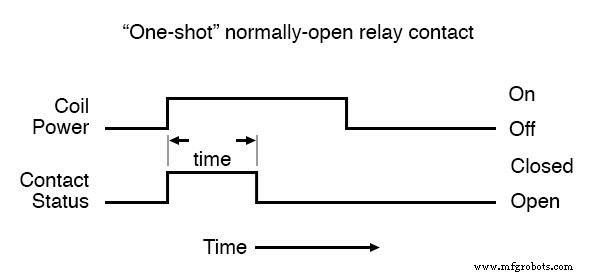
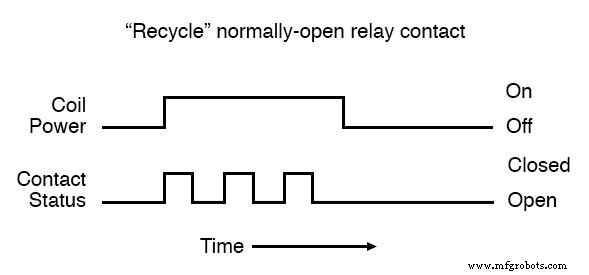
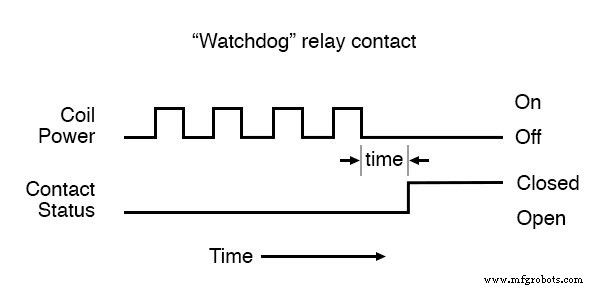
Watchdog Timer Relays in Practice
Watchdog timers are essential for detecting computer lock‑ups in safety‑critical processes. The system cycles the relay coil; if the computer halts, the relay “times out,” alerting operators.
Key Takeaways
- Four core contact types: NOTC, NOTO, NCTO, NCTC.
- One‑Shot, Recycle, and Watchdog modes extend functionality.
- Electronic designs are more reliable and versatile than older mechanical models.
- Time‑delay relays are indispensable for sequencing, soft‑starting, and safety in industrial controls.
For further technical guidance, refer to the Time‑Delay Electromechanical Relays Worksheet.
Industrial Technology
- Hands‑On Electromagnetism Experiment: Build and Test a Simple Electromagnet
- Detecting AC Magnetic Fields with a Coil and Audio Detector
- Build a Permanent Capacitor Split-Phase Induction Motor – Step‑by‑Step Guide
- Designing Reliable Switch Contacts: Materials, Types, and Protection Strategies
- Eliminating Contact Bounce in Mechanical Switches
- Protective Relays: Safeguarding Industrial Power Systems
- Solid‑State Relays: Advantages, Limitations, and Practical Insights
- Designing Wattmeters: Leveraging Dynamometer Movements for Accurate Power Measurement
- Understanding Mutual Inductance and Transformers: Principles, Applications, and Key Concepts
- Testing SSR and Coil Relays: A Step‑by‑Step Guide Using Multimeter and Battery