



Hands‑On Electromagnetism Experiment: Build and Test a Simple Electromagnet
PARTS AND MATERIALS
- 6‑volt battery
- Magnetic compass
- Small permanent magnet
- Spool of 28‑gauge magnet wire (enamel‑insulated copper)
- Large bolt, nail, or steel rod (preferably soft iron)
- Electrical tape
Magnet wire is a thin, enamel‑insulated copper wire that allows hundreds of turns to be wound into a compact coil. For an effective electromagnet, choose a magnetic core—soft iron or any readily available steel. Stainless steel is non‑magnetic and will not work.
CROSS‑REFERENCES
Lessons In Electric Circuits, Volume 1, Chapter 14: “Magnetism and Electromagnetism”
LEARNING OBJECTIVES
- Apply the left‑hand rule to determine magnetic field direction.
- Construct a functional electromagnet and observe its poles.
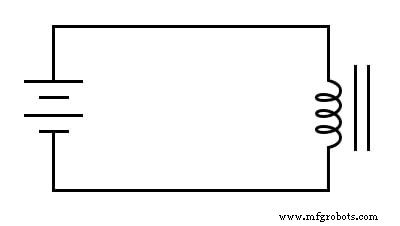
SCHEMATIC DIAGRAM
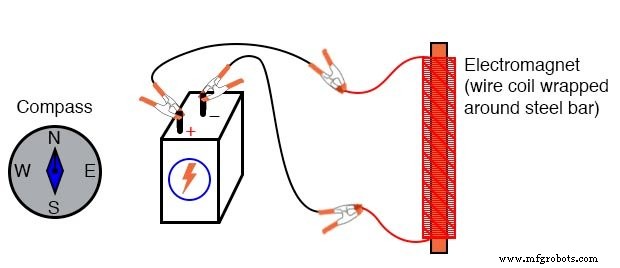
ILLUSTRATION
INSTRUCTIONS
- Wrap a single layer of electrical tape around the steel core to protect the wire from abrasion.
- Begin winding the magnet wire. Keep the coil even and maintain a consistent winding direction—never reverse from clockwise to counter‑clockwise.
- For precision, clamp the rod in a drill press chuck and run the drill at a slow speed to feed the wire steadily. This technique ensures uniform spacing and reduces tension.
- Continue winding until you have several hundred turns. Overlapping is acceptable; the key is uniformity.
- Secure the finished coil with one or two layers of electrical tape.
- Scrape the enamel insulation from both ends of the wire using a sharp knife or scissor to expose the copper for connection.
- Connect the coil to the 6‑volt battery using jumper leads.
- Once the current flows, the coil becomes a powerful magnet. Use the magnetic compass to identify the north and south poles at each end of the core.
- Place a permanent magnet near one pole to observe attraction or repulsion. Flip the permanent magnet to see how the force changes.
- To safely disconnect, never touch the coil with both hands. Use a single hand or insulated tools to avoid inductive kickback, a harmless but noticeable spark caused by the sudden interruption of current.
Electromagnets underpin many everyday devices: relays, electric motors, solenoids, doorbells, buzzers, and the magnetic heads of printers and disk drives. Understanding their operation and safety considerations is essential for any budding electrical engineer.
RELATED WORKSHEETS
- Basic Electromagnetism and Electromagnetic Induction Worksheet
Industrial Technology
- Construct a Basic Transformer: Step‑by‑Step Guide
- Detecting AC Magnetic Fields with a Coil and Audio Detector
- Build a Permanent Capacitor Split-Phase Induction Motor – Step‑by‑Step Guide
- Build a Large-Scale AC Permanent Split‑Capacitor Induction Motor
- Comprehensive Copper Wire Gauge Table – Sizes, Diameters, Areas & Weights
- Understanding Ladder Diagrams: Design, Wiring, and Safety in Industrial Control Systems
- Understanding Conductor Ampacity: How Wire Size, Insulation, and Standards Determine Current Capacity
- Electromagnetism: From Oersted’s Discovery to Modern Applications
- Real‑World Inductor Behavior: Skin Effect, Losses, and the Q Factor
- Barbed Wire Explained: History, Construction, and Modern Uses