



Electromagnetism: From Oersted’s Discovery to Modern Applications
In 1820, Danish physicist Hans Christian Oersted unintentionally revealed the intimate link between electricity and magnetism while lecturing on the topic. By passing an electric current through a wire suspended above a compass, he observed the needle’s unmistakable deflection—evidence that moving charges generate magnetic fields.
Oersted’s experiment marked the birth of electromagnetism, a field that now underpins countless technologies, from industrial machinery to medical imaging.
The relationship between current and magnetic field is succinctly expressed by the right‑hand rule: point your thumb in the direction of conventional current, and your fingers curl around the magnetic flux lines. This rule shows that the magnetic field circles the wire perpendicularly to the flow of charge.
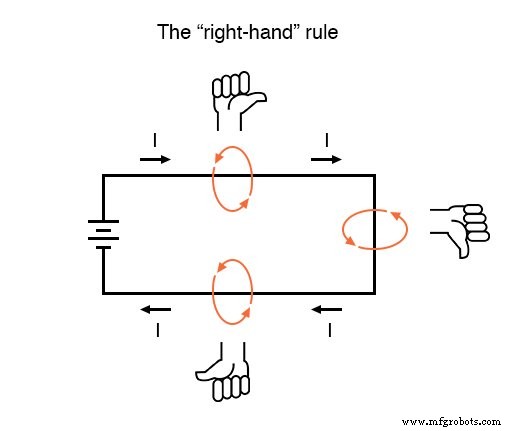
While a straight wire produces a weak magnetic field, winding the wire into a coil amplifies the effect dramatically. The magnetic flux from each turn adds constructively, yielding a field that aligns along the coil’s axis and exhibits distinct north and south poles.
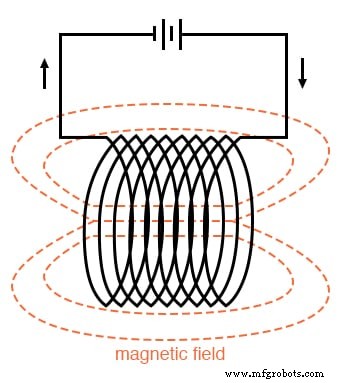
In a coil, the magnetic field strength—termed magnetomotive force (mmf)—is proportional to the product of the electric current and the number of turns. This relationship mirrors the way electromotive force drives current in circuits.
An electromagnet is a wire arrangement specifically designed to produce a strong, controllable magnetic field when energized. Electromagnets are integral to research, industry, medicine, and consumer electronics.
As an electrically controllable magnet, electromagnets enable a wide range of electromechanical devices. The most familiar example is the electric motor, which converts electrical energy into mechanical motion.
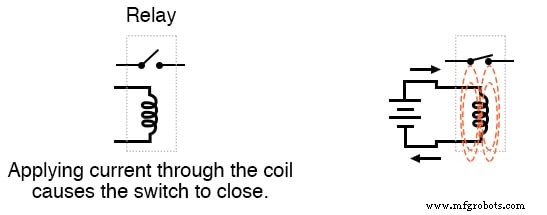
Another critical application is the relay, an electrically operated switch. By placing a coil near a movable contact, a small current can generate a magnetic field that opens or closes the switch, allowing one electrical circuit to control another.
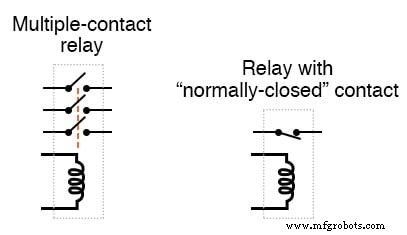
Relays can be configured to actuate multiple contacts or to reverse the default state (energizing the coil opens the contact, while de‑energizing allows it to close). This versatility makes relays indispensable in complex automation and safety systems.
Review
- Current flowing through a conductor generates a surrounding magnetic field.
- The right‑hand rule predicts the direction of this field relative to the current.
- Coiling a conductor amplifies the magnetic field and aligns it along the coil’s axis.
- The magnetomotive force of an electromagnet equals the current multiplied by the number of coil turns.
Related Worksheets
- Intermediate Electromagnetism and Electromagnetic Induction Worksheet
- Basic Electromagnetism and Electromagnetic Induction Worksheet
Industrial Technology
- Hands‑On Electromagnetism Experiment: Build and Test a Simple Electromagnet
- Detecting AC Magnetic Fields with a Coil and Audio Detector
- Understanding Relay Construction: From Solenoids to Industrial Applications
- Magnetic Units of Measurement Explained: Fundamentals, SI, and Practical Equivalents
- Understanding Magnetic Fields and Inductance: Principles, Applications, and Design
- Advanced Flexible Magnetic Field Sensor Using Ag Nanowires and Magnetic Nanoparticle-Infused PDMS
- Real-Time 3D Magnetic Field Mapping Using Diamond NV Centers
- Advanced Magnetic Field Detection with NASA’s Fiber Bragg Grating Technology
- Understanding Electromagnetism: Key Concepts and Definitions
- Magnetic Shielding Explained: Safeguarding Devices from Magnetic Interference