



Permanent Magnets: From Ancient Lodestone to Modern Ferromagnetism
For centuries, scholars have marveled at certain mineral rocks that naturally attract iron. The earliest recorded reference dates back roughly 2,500 years in Europe, with even older mentions in East Asia. This mineral—known as lodestone or magnetite—captured the imagination of ancient scientists and became the first documented permanent magnet.
In the 13th century, Peter Peregrinus conducted a pivotal experiment that demonstrated iron could be “charged” with magnetism by rubbing it against a lodestone’s pole. This discovery laid the groundwork for modern magnetic theory.
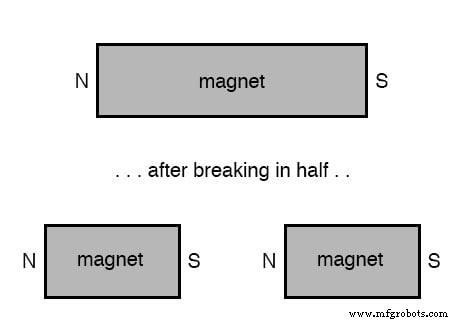
Unlike electric charges, magnets possess two opposing poles—north and south. When a magnet is cut in half, each fragment still contains both poles, illustrating that a single pole cannot exist in isolation.
Similar to electric charges, like poles repel and unlike poles attract. This force propagates invisibly through space, passing through paper and wood with minimal attenuation.
René Descartes famously visualized magnetic fields by placing a magnet under a sheet of cloth and sprinkling iron filings on top. The filings align along field lines, revealing the continuous path from one pole to the other.
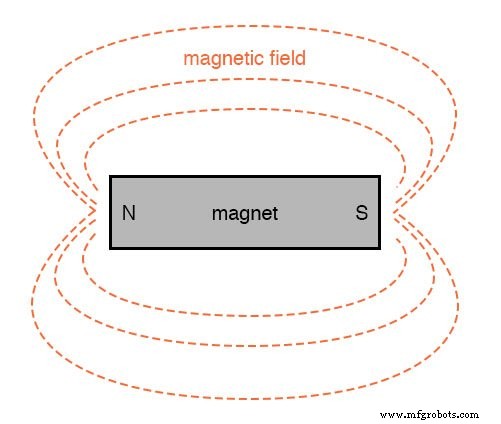
In magnetic terminology, the total influence of the field is called flux, while the force that creates it is simply force. Michael Faraday popularized the concept of a magnetic “tube,” now commonly referred to as a line of force. Although field lines are a convenient visual tool, they do not represent discrete, constant‑value entities.
Modern physics explains that a magnetic field arises from moving electric charges. In a permanent magnet, electrons within iron atoms spin in a coordinated manner, producing a steady magnetic field even without an external influence.
The ability of a material’s electrons to maintain this uniform spin depends on its atomic structure. Only a select group of substances can sustain a permanent magnetic field; these are classified as ferromagnetic.
When iron is brought near a permanent magnet, its internal electrons align with the magnet’s field, magnetizing the iron. Regardless of which pole the iron approaches, it will always be attracted, as the induced magnetization creates an opposite pole on the iron’s near side.
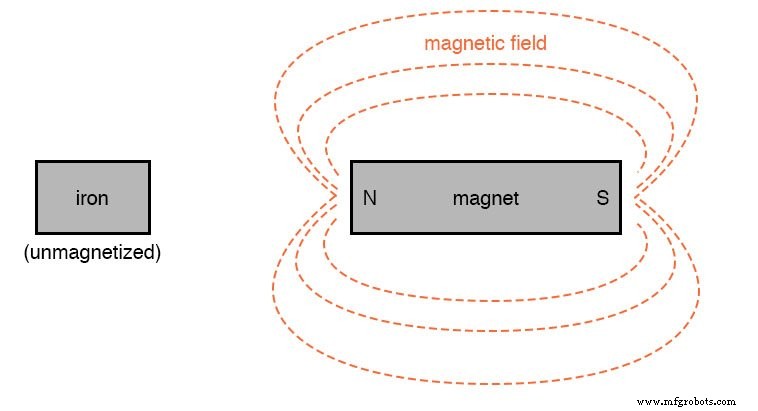
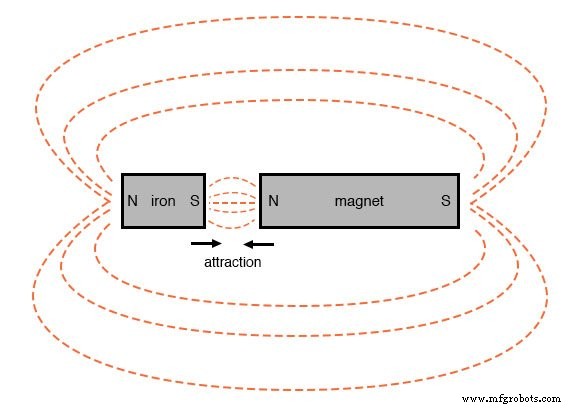
Materials that readily align their electron spins in response to an external field are termed ferromagnetic. Those that are only slightly responsive are paramagnetic, while diamagnetic materials actually oppose external fields, creating a weak repulsion.
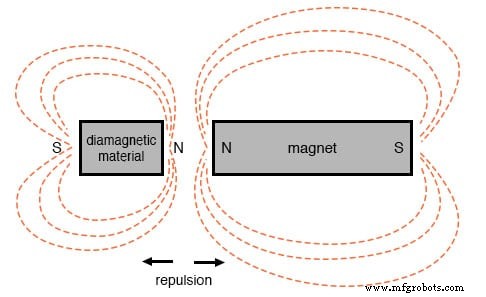
Retention of magnetization after removing an external field—known as retentivity—is essential for a permanent magnet’s performance.
Key Takeaways
- Lodestone (magnetite) is a naturally occurring permanent magnet that retains its magnetic field without external help.
- Ferromagnetic materials are easily magnetized and can maintain magnetization.
- Paramagnetic materials are magnetized only weakly and require an external field.
- Diamagnetic materials repel external magnetic fields by generating an opposing magnetic moment.
Related Worksheets
- Magnetism Worksheet
Industrial Technology
- Detecting AC Magnetic Fields with a Coil and Audio Detector
- Understanding Relay Construction: From Solenoids to Industrial Applications
- Electromagnetism: From Oersted’s Discovery to Modern Applications
- Magnetic Units of Measurement Explained: Fundamentals, SI, and Practical Equivalents
- Iron: Properties, History, and Everyday Applications
- Alliant Castings: Leading Foundry Solutions for Heavy‑Duty Industries
- Magnetic Separation & Iron Ore Beneficiation: Advanced Techniques for Efficient Iron Concentration
- Ductile Iron: High-Strength, Durable Castings for Industrial Applications
- Sustainable 3D‑Printed Magnets: Eco‑Friendly, Precision‑Shaped Solutions for Modern Electronics
- Magnetic Labels: Versatile, Durable Inventory Solutions