



Magnetic Units of Measurement Explained: Fundamentals, SI, and Practical Equivalents
If the coexistence of multiple measurement systems for common quantities has left you puzzled, you're not alone. In magnetism, a lack of early standardization has resulted in three distinct unit systems. This guide demystifies the key magnetic quantities and shows how they relate to their electrical counterparts.
Key Magnetic Quantities
Magnetomotive Force (MMF) – The magnetic “push” analogous to electric voltage (electromotive force).
Field Flux (Φ) – The total magnetic “substance” analogous to electric current.
Field Intensity (H) – MMF distributed over the length of the electromagnet; also called magnetizing force.
Flux Density (B) – Magnetic flux per unit area.
Reluctance (R) – Opposition to magnetic flux through a material, analogous to electrical resistance.
Permeability (μ) – Material’s ability to admit magnetic flux, the inverse of specific resistance.
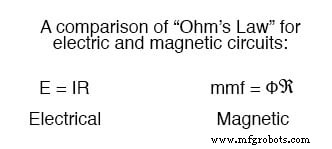
These relationships mirror the classic electrical equations E = IR, I = E/R, and R = E/I, and the power relations P = IE, P = I²R, P = E²/R.
Measurement Systems
English and metric systems coexist, but magnetism also employs two main metric frameworks:
- CGS (Centimeter–Gram–Second) – Built on centimeters, grams, and seconds.
- SI (International System of Units) – Derived from the earlier MKS (Meter–Kilogram–Second) and later RMKS (Rationalized MKS). SI is the global standard for magnetic units.
The Greek letter μ serves both as the symbol for magnetic permeability and the micro‑prefix in SI units, which can be confusing.
Just as Ohm’s law links voltage, current, and resistance, magnetic circuits obey an analogous relation:
Similarly, reluctance relates to permeability just as resistance relates to specific resistance:
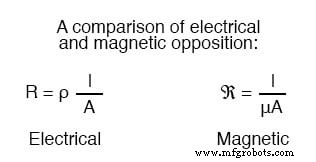
Longer magnetic paths increase reluctance, while larger cross‑sectional areas reduce it. However, reluctance is nonlinear because it varies with flux density, akin to a varistor whose resistance changes with current.
Related Worksheets
- Magnetic Units of Measurement Worksheet
Industrial Technology
- Understanding Relay Construction: From Solenoids to Industrial Applications
- pH Measurement: Fundamentals, Electrodes, and Best Practices
- Electromagnetism: From Oersted’s Discovery to Modern Applications
- Understanding Magnetic Fields and Inductance: Principles, Applications, and Design
- Accurate Power Measurement in AC Circuits: From Electrodynamometers to Hall‑Effect Sensors
- Measuring Power Quality: Understanding Harmonics and Their Impact on AC Systems
- Advanced Flexible Magnetic Field Sensor Using Ag Nanowires and Magnetic Nanoparticle-Infused PDMS
- Real-Time 3D Magnetic Field Mapping Using Diamond NV Centers
- Advanced Magnetic Field Detection with NASA’s Fiber Bragg Grating Technology
- Magnetic Shielding Explained: Safeguarding Devices from Magnetic Interference