



Understanding Magnetic Fields and Inductance: Principles, Applications, and Design
Whenever electrons flow through a conductor, a magnetic field is generated around it—this phenomenon is known as electromagnetism.
Magnetic fields influence the alignment of electrons within atoms and can exert forces across space, just as electric fields do between charged particles. Like electric fields, magnetic fields can permeate empty space and affect matter at a distance.
Field Force and Field Flux
Fields are quantified by two concepts: field force and field flux. Field force represents the “push” a field exerts over a distance, while field flux denotes the total influence a field has through space. These are analogous to voltage (push) and current (flow) in a conductor, though field flux can exist in vacuum whereas current requires mobile charge carriers.
Just as electrical resistance opposes current flow, material properties oppose magnetic flux. The magnitude of flux that develops in a region is proportional to the applied field force and inversely proportional to the material’s magnetic opposition. The nature of the medium—air, steel, or another ferromagnetic substance—determines this opposition.
While an electric field can accumulate free charge on conductors, a magnetic field produces a kind of “inertia” that resists changes in the electron flow within the conductor that creates the field.
Stronger Magnetic Fields With Inductors
Inductors harness this principle by winding conductive wire into coils, concentrating the magnetic field beyond what a straight wire can achieve. Some coils are self‑supporting, while others are wound around solid cores. The core may be straight or looped—square, rectangular, or circular—to fully contain the flux. These design choices significantly affect the inductor’s performance.
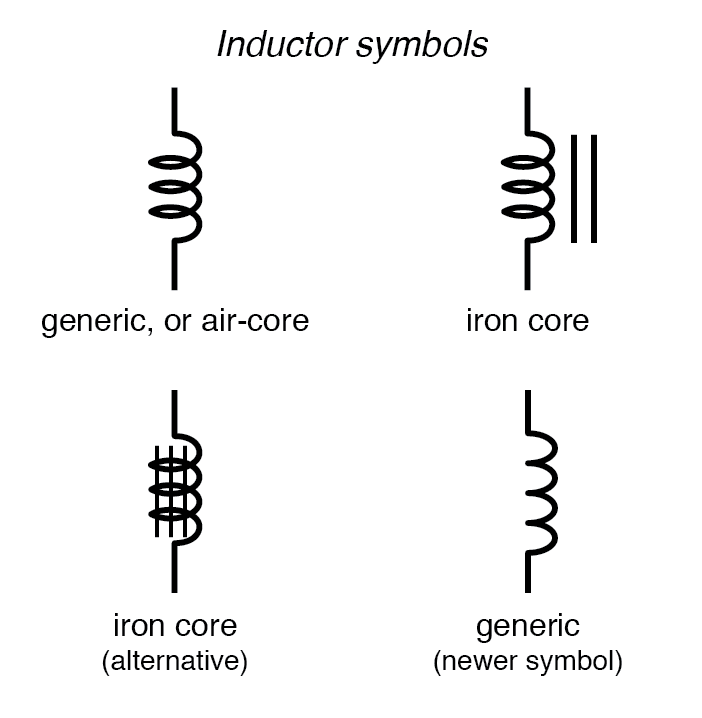
The schematic symbol for an inductor is a simple coil. Variants include parallel lines along the coil axis to denote a core, or a modern “hump” style that replaces the coil shape.
As current flows through the coil, it generates a concentrated magnetic field. The field flux represents stored energy tied to the kinetic motion of electrons. Greater current produces a stronger field and more stored energy.
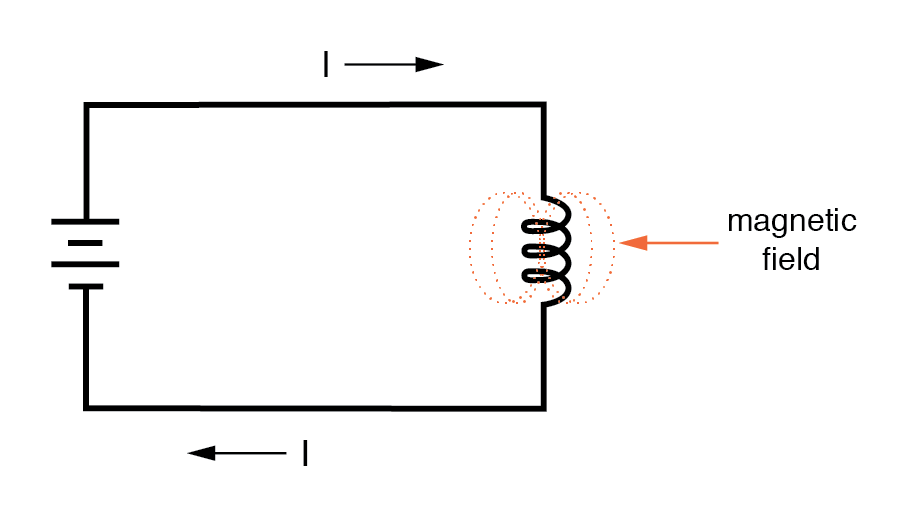
Because inductors store energy as a magnetic field, they behave differently from resistors, which merely dissipate energy as heat. The energy stored is directly proportional to the current.
Consequently, inductors resist changes in current. When the current rises or falls, the inductor generates a voltage of opposing polarity, thereby attempting to keep the current steady. This self‑induction is the cornerstone of inductor behavior.
Increasing current strengthens the magnetic field, and the resulting change induces a voltage that opposes further change. Decreasing current weakens the field, inducing a voltage of the opposite polarity that aids the remaining current.
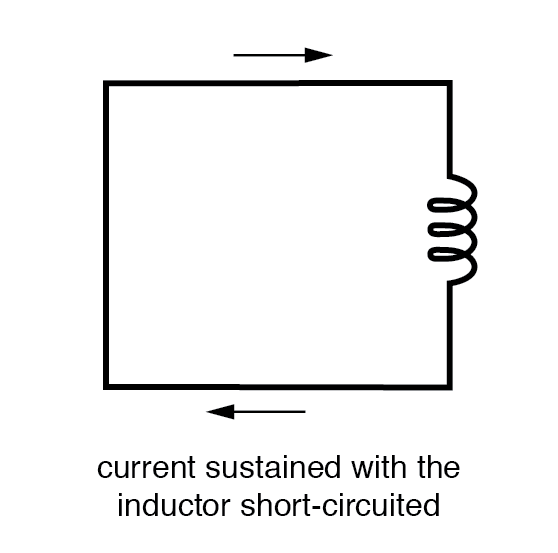
In theory, a perfectly insulated inductor could maintain a constant current if short‑circuited, but in practice resistance in ordinary wires causes the current to decay rapidly unless the wire is superconductive.
When the current increases, the inductor “charges” and behaves like a load, dropping a voltage opposite to the current direction. When the current decreases, the inductor “discharges” and behaves like a source, dropping a voltage in the same direction as the current.
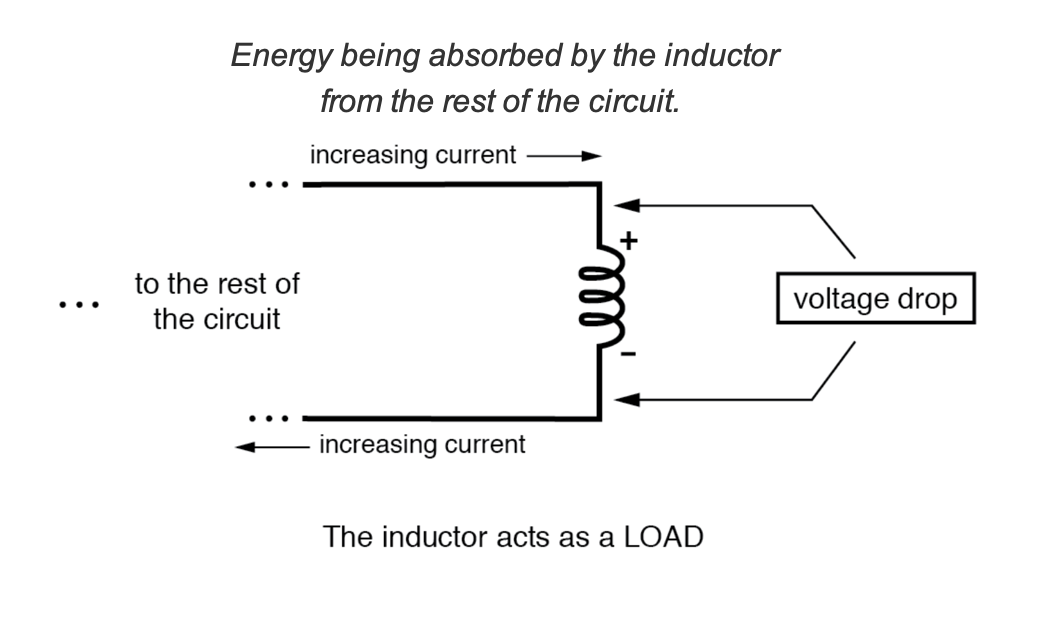
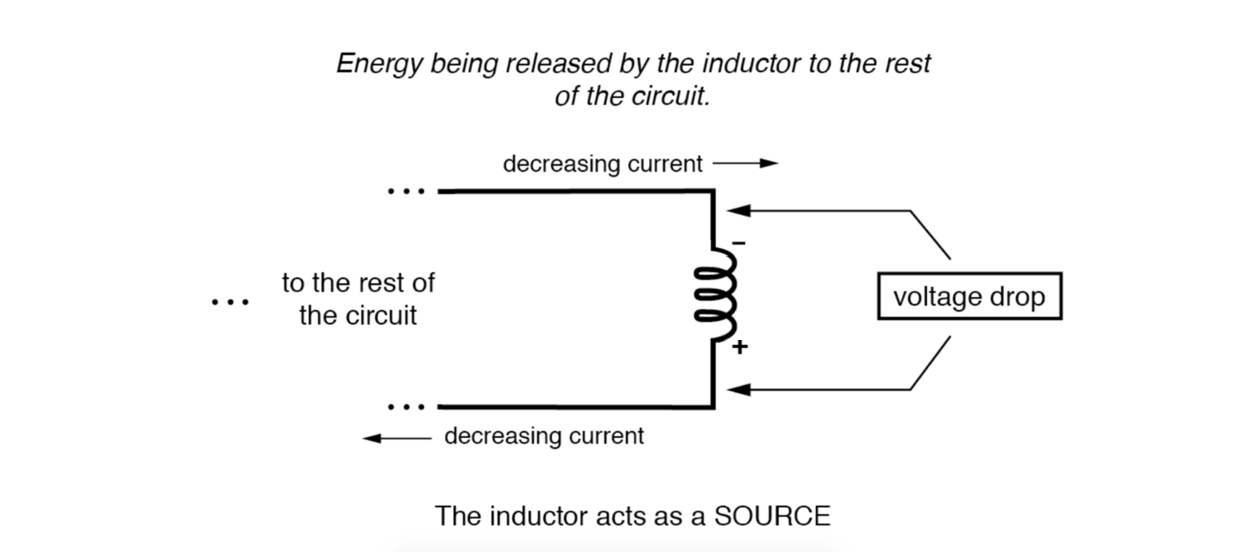
When power is first applied to an unmagnetized inductor, it initially resists current by presenting the full supply voltage. As current builds, the magnetic field grows, absorbing energy. Eventually the current reaches its maximum and the voltage drop across the inductor becomes minimal, even though the current stays high.
Thus, unlike capacitors—where stored energy raises the voltage across the device—inductors maintain energy storage by sustaining a steady current.
Core material also matters: ferromagnetic cores (e.g., soft iron) enhance flux for a given field force, whereas non‑magnetic materials like aluminum or air provide little reinforcement.
What Is Inductance?
Inductance quantifies an inductor’s ability to store energy for a given current and to resist changes in current. It is denoted by the capital letter “L” and measured in henries (H). The induced voltage equals the inductance multiplied by the rate of change of current (V = L di/dt).
Choke vs. Inductor
Historically, inductors used to block high‑frequency AC signals were called chokes. In large‑power applications they may also be referred to as reactors. Understanding these terms is essential when studying AC circuits and inductive reactance.
Review
- Inductors oppose current changes by generating opposing voltage.
- During increasing current, they act as loads; during decreasing current, they act as sources.
- Inductance, measured in henries, reflects this behavior.
- Chokes and reactors are historical or large‑scale names for inductors.
Related Worksheets
- Inductance Worksheet
Industrial Technology
- Detecting AC Magnetic Fields with a Coil and Audio Detector
- Electric Fields and Capacitors: Fundamentals, Functionality, and Design
- Electromagnetism: From Oersted’s Discovery to Modern Applications
- Magnetic Units of Measurement Explained: Fundamentals, SI, and Practical Equivalents
- Understanding Mutual Inductance and Transformer Fundamentals
- C++ Structures vs Classes: A Practical Guide for Embedded Developers
- Nanodiamonds: Ultra‑Precise Magnetic Sensors for Biomedical and Quantum Applications
- Real-Time 3D Magnetic Field Mapping Using Diamond NV Centers
- Advanced Magnetic Field Detection with NASA’s Fiber Bragg Grating Technology
- Magnetic Shielding Explained: Safeguarding Devices from Magnetic Interference