



Understanding Mutual Inductance and Transformers: Principles, Applications, and Key Concepts
When two conductive coils are positioned close together, the magnetic flux generated by one coil induces a voltage in the other. This phenomenon, known as mutual inductance, is the fundamental principle behind transformer operation.
A transformer is a purpose‑built device that harnesses mutual inductance between two or more windings to change voltage and current levels while keeping power nearly constant.
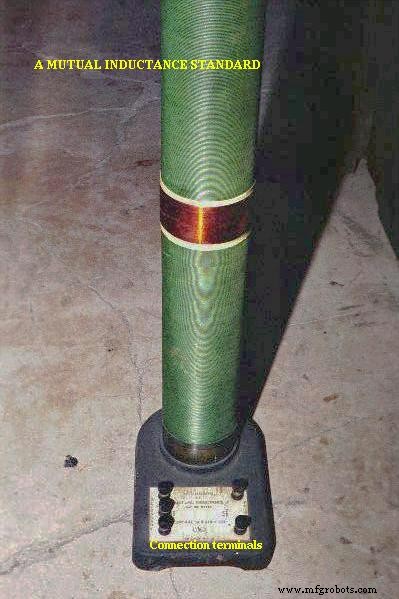
The photo above shows a precision mutual‑inductance standard: two concentric windings wrapped on a ceramic core. The outer coil is green‑insulated, the inner bronze‑insulated. In commercial transformers the windings are wound on a laminated core and are not exposed, but the physics remains identical.
Mutual inductance only operates when the magnetic flux is varying. Therefore it requires an alternating (AC) excitation; steady DC produces no induced voltage unless the current is pulsed, which effectively creates a changing field.
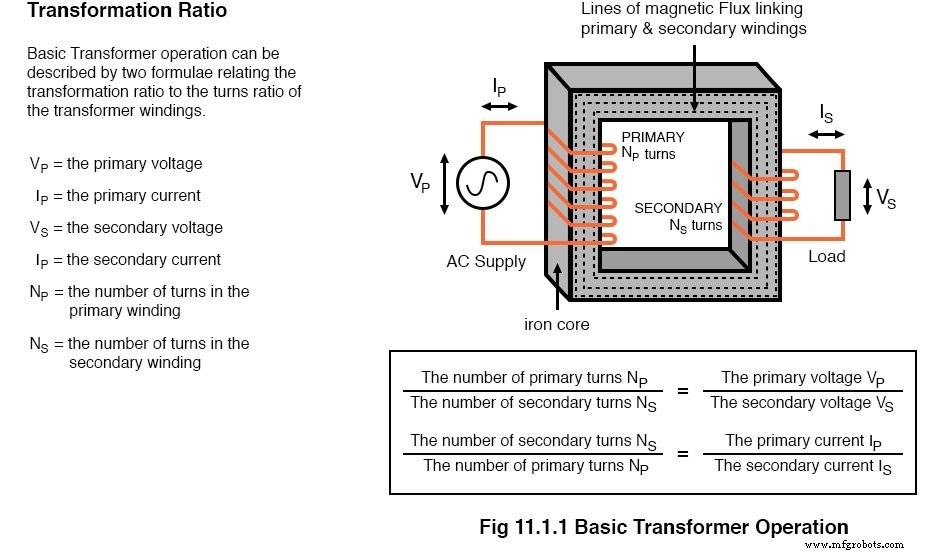
The induced voltage on the secondary winding is directly proportional to the turns ratio:
- Vsecondary = Vprimary × (Nsecondary / Nprimary)
- Isecondary = Iprimary × (Nprimary / Nsecondary)
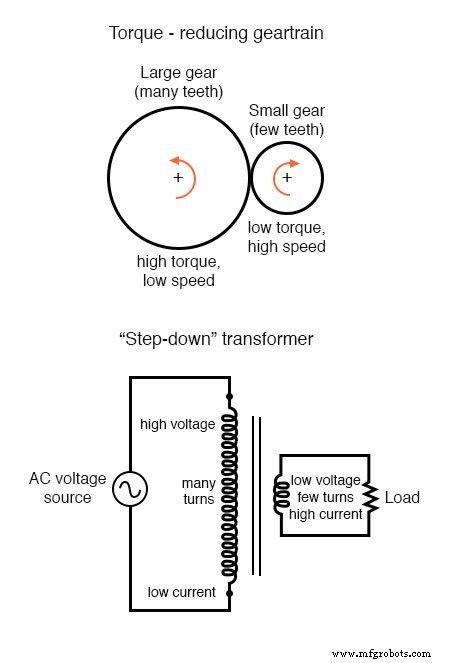
Thus a step‑up transformer increases voltage while decreasing current, and a step‑down transformer does the reverse.
This relationship is analogous to gear ratios in mechanical systems, where the speed of one component is scaled relative to another.
Key Takeaways
- Mutual inductance is the process by which the magnetic field of one coil induces voltage in a nearby coil.
- A transformer is a device that intentionally creates mutual inductance to step voltage up or down.
- Transformers operate exclusively on AC signals; they rely on changing magnetic flux.
Further Learning
Industrial Technology
- Exploring Voltage Addition with Series Battery Connections
- Voltage Divider Lab: Design, Measurement, and Kirchhoff’s Voltage Law Verification
- Understanding Mutual Inductors: Principles, Symbols, and Their Role in Transformers
- Using Commutating Diodes to Protect Inductive Loads
- Designing Wattmeters: Leveraging Dynamometer Movements for Accurate Power Measurement
- Tachogenerators: Precision Speed Measurement for Industrial Motors and Equipment
- Understanding Mutual Inductance and Transformers: Principles, Applications, and Key Concepts
- Key Factors Determining Inductance in Coil Design
- Understanding AC Waveforms: Sine Waves, Frequency, and Oscilloscope Basics
- Understanding Mutual Inductance and Transformer Fundamentals