



Understanding Mutual Inductors: Principles, Symbols, and Their Role in Transformers
Understanding Mutual Inductors
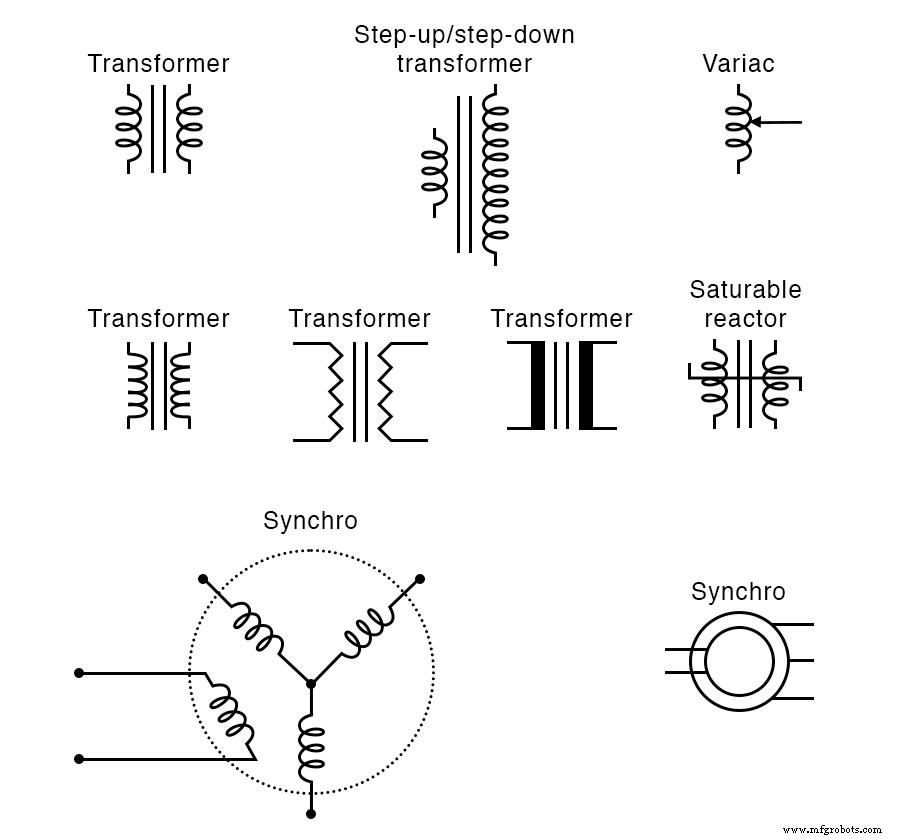
Mutual inductors leverage the phenomenon of mutual inductance—the induction of a magnetic field in one coil by the magnetic field of a neighboring coil. This coupling is the fundamental principle behind transformer operation.
Key Concepts
- Mutual Inductance (M): The ratio of the induced electromotive force (EMF) in one coil to the time‑rate change of current in the other coil.
- Coils must be physically close and share a common magnetic core to maximize M.
- Typical values range from a few microhenries in small circuits to several henries in power transformers.
Common Schematic Symbols
- Series Coupled Inductor (shared winding)
- Parallel Coupled Inductor (separate windings with common core)
- Tapped Inductor (secondary winding with a tap for voltage division)
- Isolated Inductor (no magnetic coupling)
Applications in Transformers
In a transformer, two or more windings are magnetically coupled via a core, converting voltage levels while preserving power. The same principles apply to isolation transformers, step‑up/down units, and coupled resonant circuits.
Further Learning
For hands‑on practice, try the Step‑up, Step‑down, and Isolation Transformers Worksheet, which covers design equations, efficiency calculations, and practical considerations.
These fundamentals are detailed in standard texts such as Hambley’s Electrical Engineering: Principles and Applications (2017) and the IEEE Transactions on Power Delivery.
Industrial Technology
- Electronics: A Hands‑On Science for All
- Inductors Explained: Types, Functions, and Applications
- Understanding Mutual Inductance and Transformers: Principles, Applications, and Key Concepts
- Inductors & Calculus: How Current Change Drives Voltage
- Series vs. Parallel Inductors: How Inductance Adds or Diminishes
- Practical Considerations for Selecting and Using Inductors
- Understanding Mutual Inductance and Transformer Fundamentals
- Powering V2X & Autonomous Driving: Inductors & RF Passives in Telematics Control Units
- Inductor Basics: Master AC Power and Signal Filtering
- Inductor Types Explained: A Comprehensive Guide