



Powering V2X & Autonomous Driving: Inductors & RF Passives in Telematics Control Units
The rapid evolution of sensing technology and next‑generation communication networks is driving the emergence of autonomous driving. Coupled with the global rollout of 5G, the spotlight has shifted to vehicle‑to‑vehicle (V2V) and vehicle‑to‑infrastructure (V2I) communication—collectively known as V2X—allowing cars to exchange real‑time data with each other and the surrounding infrastructure.
Telematics Control Units (TCUs)
TCUs are the nerve centers that enable autonomous vehicles to talk to the world. They combine GNSS receivers, cellular and Wi‑Fi radios, and Inertial Measurement Units (IMUs) into a compact module. IMUs leverage simultaneous localization and mapping (SLAM) and dead‑reckoning algorithms to keep the vehicle accurately positioned even when GPS signals are lost in tunnels, under bridges, or near high‑rise buildings.
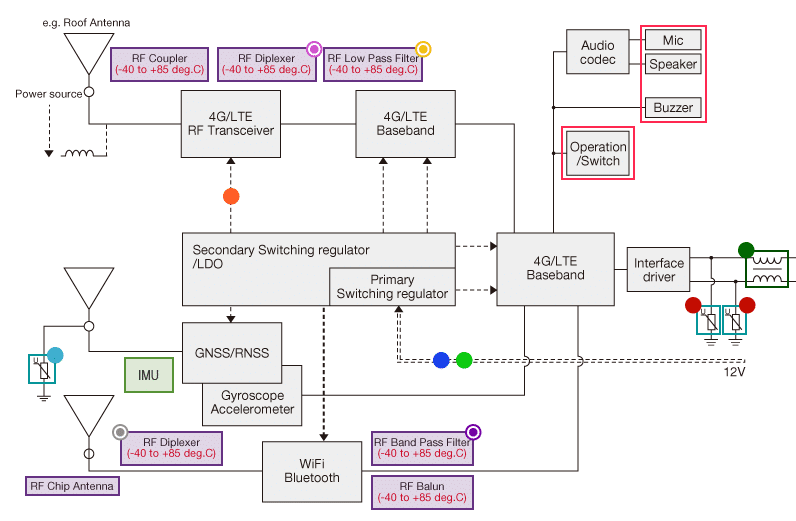
Figure 1. V2X‑Telematics Control Unit Block Diagram (Source: TDK Application Guide)
IMUs (Inertial Measurement Units)
Modern IMUs integrate 3‑axis gyroscopes and accelerometers on a single chip, delivering industry‑leading noise performance, temperature stability, and sensitivity. Their precision is essential for navigation, telematics, and location services. Many IMUs also support programmable multi‑interface configurations, allowing external sensors such as barometers or pressure gauges to be added seamlessly.
High‑Frequency RF Products – Automotive Chip Antennas, Filters, Baluns, Diplexers, and Directional Couplers
For V2X, cars must maintain robust wireless links via cellular or dedicated short‑range communications (DSRC). TDK’s ANT series of ceramic chip antennas, built with low‑temperature co‑fired ceramics (LTCC), offer a compact, low‑profile solution that delivers exceptional performance in the smallest footprint in the industry. These antennas simplify board revisions and enhance overall system reliability.
Complementary RF components—including filters, baluns, diplexers, and directional couplers—are also part of TDK’s portfolio. They are engineered to operate across wide temperature ranges and meet the stringent reliability standards required for automotive applications. For detailed specifications, consult the product catalogs or contact TDK directly.
Internet of Things Technology
- Driving Convergence and Interoperability in Industrial IoT and Industrie 4.0
- Cisco 1G Bidirectional Transceivers: Boosting Service Provider and IoT Network Efficiency
- Link Labs Introduces Low‑Power, Long‑Range M2M Network for Diverse Industries
- How Connected Sensors and Smart Processors Power Industry 4.0
- Renesas Expands RX24T & RX24U MCU Lineup with High‑Temperature G Versions for Motor Control
- GE Unveils Durus Plus: Enhanced Low‑End Controller for Reliable Industrial Control
- Choosing Controllers and Recorders for Food & Beverage Production
- Polyplastics Launches PBT & PPS Resins for Advanced Driver‑Assistance Applications
- Leveraging RTUs for Big‑Data Insights in Industrial Operations
- Unlocking Blockchain’s Potential in Industrial Automation: Opportunities and Obstacles