



Inductors Explained: Types, Functions, and Applications
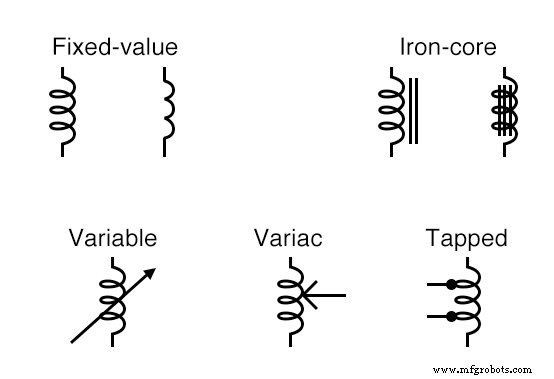
An inductor is a passive two‑terminal component that stores energy in a magnetic field when electric current flows through it.
Commonly called a choke, coil, or reactor, inductors come in two primary varieties: air‑core and iron‑core.
The image above shows several readily available types.
Air‑core inductors contain no ferromagnetic material; they use ceramic, plastic, or other non‑magnetic substrates. Iron‑core inductors, by contrast, incorporate an iron core to enhance magnetic flux and increase inductance.
Additional categories include variable inductors, which allow the inductance to be tuned to a desired value, and tapped inductors, where multiple electrical connections are available along the coil – a common feature in transformer windings.
RELATED WORKSHEETS:
- Inductors Worksheet
Industrial Technology
- Variable Inductor Lab: Exploring Magnetic Permeability and Inductive Reactance
- Understanding Mutual Inductors: Principles, Symbols, and Their Role in Transformers
- Inductors & Calculus: How Current Change Drives Voltage
- Practical Considerations for Selecting and Using Inductors
- Understanding AC Inductor Circuits: Reactance, Phase Shift, and Power Dynamics
- Real‑World Inductor Behavior: Skin Effect, Losses, and the Q Factor
- Advanced AC Position Transducers: From Potentiometers to Inductosyns & Capacitive Sensors
- Inductor Basics: Master AC Power and Signal Filtering
- Inductor Types Explained: A Comprehensive Guide
- Metal Core PCBs: Design, Materials, and High‑Temperature Applications