



Variable Inductor Lab: Exploring Magnetic Permeability and Inductive Reactance
Parts and Materials
- Paper tube (e.g., a toilet‑paper roll)
- Bar of iron or steel, large enough to almost fill the tube’s diameter
- 28 AWG “magnet” wire
- Low‑voltage AC power supply
- Incandescent lamp rated for the supply voltage
Cross‑References
- Lessons In Electric Circuits, Volume 1, chapter 14: “Magnetism and Electromagnetism”
- Lessons In Electric Circuits, Volume 1, chapter 15: “Inductors”
- Lessons In Electric Circuits, Volume 2, chapter 3: “Reactance and Impedance—Inductive”
Learning Objectives
- Understand how magnetic permeability influences inductance.
- Demonstrate how inductive reactance controls current in an AC circuit.
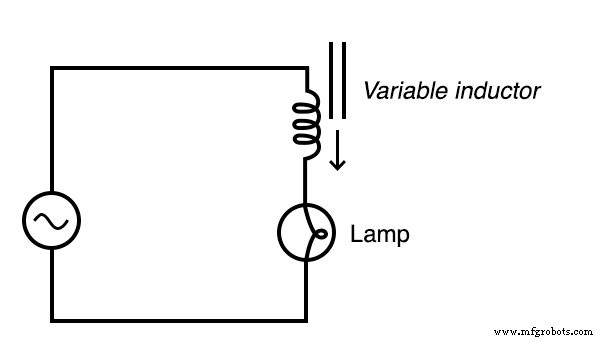
Schematic Diagram
Illustration
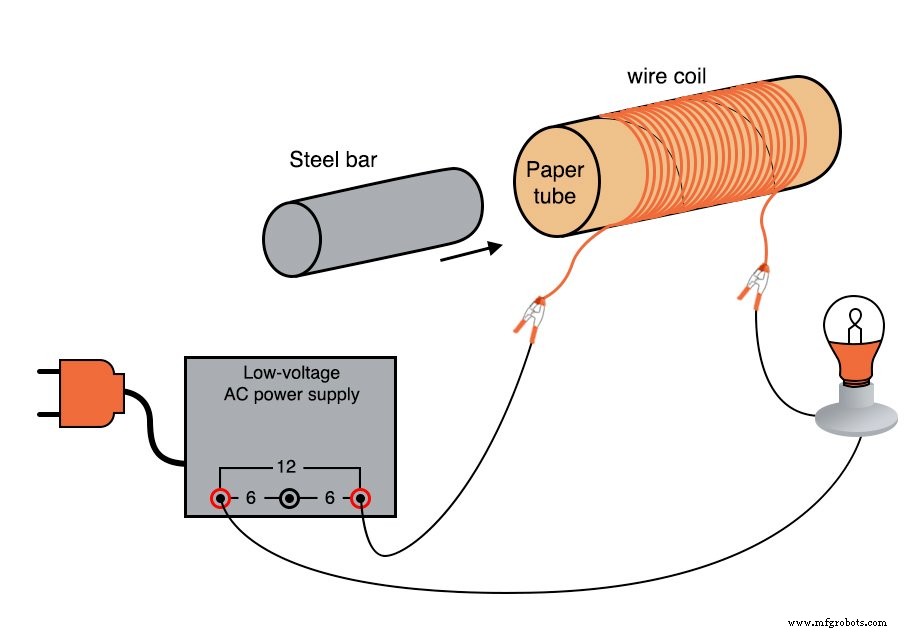
Instructions
Wrap hundreds of turns of magnet wire around the paper tube. Connect the homemade inductor in series with an AC supply and lamp. With the tube empty, the lamp should glow brightly. Inserting a steel bar increases the inductance (L) and consequently the inductive reactance (XL), dimming the lamp.
Experiment with bars made from different materials—copper, stainless steel, etc.—to observe variations in magnetic permeability.
Related Worksheets
- Mutual Inductance Worksheet
- Inductance Worksheet
- Inductive Reactance Worksheet
Construct a Basic Transformer: Step‑by‑Step Guide
High‑Sensitivity Audio Detector for Ultra‑Low Electrical Signals
Industrial Technology
- Building and Troubleshooting a Basic 6‑V Battery‑Lamp Circuit
- Exploring Nonlinear Resistance in Incandescent Lamps: A Practical Lab Guide
- Inductors Explained: Types, Functions, and Applications
- The Triode: A Cornerstone of Vacuum Tube Technology
- Pentodes: The Fifth Element for Enhanced Tube Performance
- Combination Tubes: Merging Multiple Functions into a Single Glass Envelope
- Key Performance Parameters of Electron Tubes
- Real‑World Inductor Behavior: Skin Effect, Losses, and the Q Factor
- Lava Lamp: History, Design, and Manufacturing Secrets
- Understanding Variables in C: Types, Naming Rules, and Memory Management