



From Edison’s Lamp to the Audion: The Early Evolution of Vacuum Tubes
Thomas Edison is often credited with inventing the incandescent lamp, but he was the pioneer who refined the design that would later power modern electronics.
In 1879, Edison’s successful lamp used a carbonized sewing thread filament inside a glass bulb from which air had been removed. The resulting vacuum allowed the filament to glow at white‑hot temperatures without combusting.
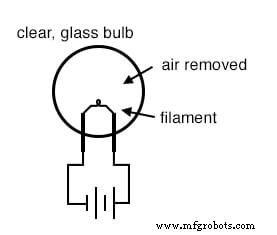
During experiments around 1883, Edison inserted a metal strip inside the evacuated bulb and connected it to a sensitive ammeter. He discovered that electrons flowed through the meter only when the filament was hot, ceasing once it cooled.
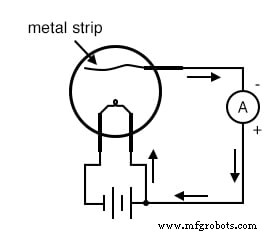
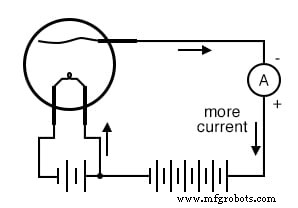
The glowing filament released free electrons into the vacuum, which were drawn to the metal strip and returned to the filament, creating a one‑way current. Edison amplified this effect by adding a high‑voltage battery to the circuit, which increased the current dramatically when connected in the correct orientation.
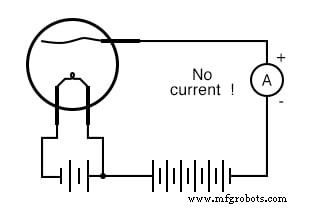
Reversing the battery produced almost no current, revealing a phenomenon that would later be called the Edison Effect—a natural diode.
Although Edison saw no immediate application for this one‑way electron flow, the discovery would lay the groundwork for future inventions.
In 1895, J. A. Fleming explored the Edison Effect and marketed his device as a “valve,” inaugurating a new field of vacuum‑tube technology. However, these early valves could not carry large currents, limiting their use to small signal applications.
Lee De Forest, in 1906, added a metal screen—or grid—between the filament and the metal plate. By applying a small voltage between the grid and the filament, he could regulate the electron flow from filament to plate.
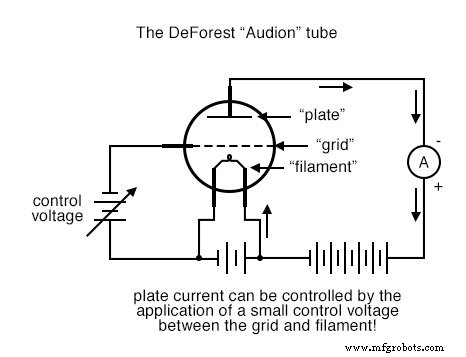
De Forest’s grid behaved as a voltage‑controlled resistor: a negative grid voltage suppressed electron flow, while a positive voltage enhanced it. Even though the grid current was tiny, its voltage had a large influence on the plate voltage and current, turning the device into an amplifier.
This adjustable vacuum tube, which De Forest named the Audion, became the first practical amplifying component for electronics. The Audion’s structure and operation closely resemble a modern n‑channel D‑type MOSFET, a voltage‑controlled device with high current gain.
De Forest’s Audion revolutionized communications. In 1912 he sold the rights to the Audion as a telephone signal amplifier to AT &T, enabling practical long‑distance telephone links. The following year, he demonstrated its use for generating radio‑frequency AC signals. By 1915, he broadcast voice signals from Arlington, Virginia to Paris, and in 1916 he launched the first radio news broadcast—earning him the title “Father of Radio” in the United States.
Industrial Technology
- From Lodestone to Neodymium: The Evolution of Magnetism
- The Triode: A Cornerstone of Vacuum Tube Technology
- Pentodes: The Fifth Element for Enhanced Tube Performance
- The Legacy of Vancouver Foundries: Industry & Development
- The Evolution of Printed Circuit Boards: From 1940s Origins to Modern High-Speed Design
- From Rivers to Industry: The Rise of Machining in the Rust Belt
- The Evolution of Industrial Robots: From Ancient Automation to Modern Marvels
- Fanuc Robot History: From 1956 to Global Industrial Leader
- The Evolution of Yaskawa Motoman Robotics
- From Navy Mechanic to Pioneer: Swanton Welding’s Founding Story