



Tracing the History of Chlorinated Polymers: The Rise of PVC, Neoprene, and PVDC
By the 1920s and early 1930s, the rapid evolution of synthetic polymers ushered in a new class of materials grounded in chlorine chemistry. The earliest evidence of PVC “synthesis” dates back to the mid‑1830s, when Justus von Liebig and his student, Henri Victor Regnault, first produced vinyl chloride—the monomer that would later become the backbone of PVC. Although neither chemist intended to create polymers, Regnault’s observation in 1838 of a white powder that had formed in a vessel containing vinyl chloride marked the accidental birth of PVC. The material was “discovered” again in 1872, underscoring its elusive nature.
Commercial attempts to exploit PVC in the early 20th century stalled because of its poor thermal stability. Waldo Semon of B.F. Goodrich solved this problem by inventing plasticizers that lowered PVC’s softening temperature, opening a narrow but viable window for melt processing. By varying the type and amount of plasticizer, manufacturers could tailor PVC from rigid to flexible, giving the polymer remarkable versatility.
In 1930, DuPont’s research director, Elmer Bolton, pivoted to acetylene chemistry, converting vinyl acetylene into chloroprene—Neoprene’s monomer—by reacting it with hydrogen chloride. By 1931, DuPont had acquired the patents from Dr. Julius Nieuwland of Notre Dame and polymerized chloroprene, producing the first truly synthetic rubber. Neoprene’s properties could also be fine‑tuned with plasticizers, leveraging the same chemistry that had revolutionized PVC.
Two years later, a lab worker at Dow Chemical inadvertently discovered polyvinylidene chloride (PVDC). Chemically similar to PVC but with a higher chlorine content, PVDC offered superior barrier, chemical, and flame‑retardant properties. Ralph Wiley first noted PVDC’s resistance to cleaning agents while working on perchloroethylene. Recognizing its potential as a moisture‑barrier coating, Wiley steered the company toward film applications. After six years of refinement—including removal of a green tint and unpleasant odor—PVDC was adopted in 1942 as a protective film for military gear. Although Dow’s president, Willard Dow, considered abandoning PVDC in 1943, Wiley’s patents persuaded the company to continue, leading to the creation of the iconic Saran bubble film. Saran became the go‑to wrap for military equipment, and post‑war, a small company’s food‑wrap product eventually brought the brand back under Dow’s umbrella in 1948.
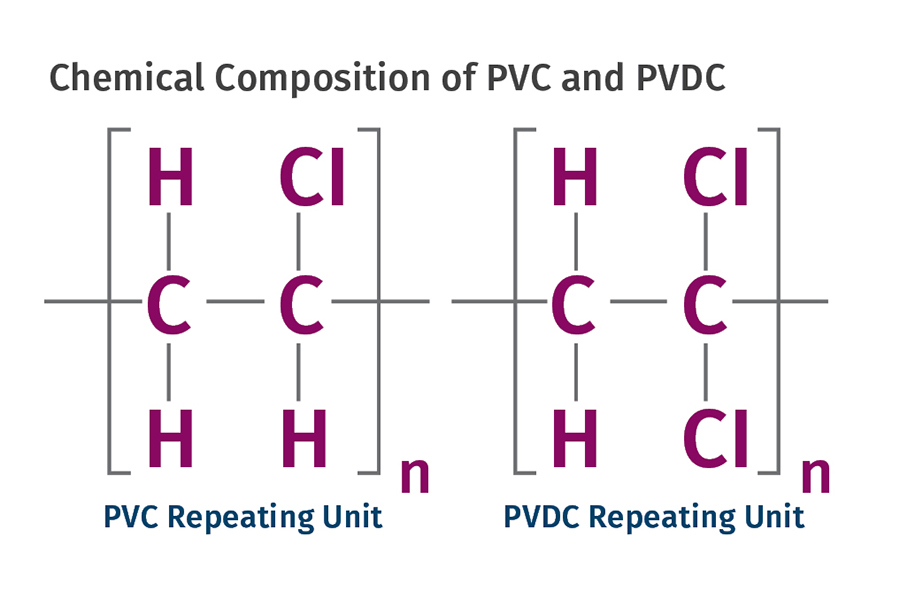
Following PVC, Neoprene, and PVDC, chlorinated polyethylene (CPE) emerged. Unlike the others, CPE is produced by chlorinating pre‑polymerized polyethylene, replacing hydrogen atoms with chlorine along the backbone. Depending on the base polyethylene (LDPE vs. HDPE) and chlorine content, CPE can behave as a thermoplastic, thermoplastic elastomer, or rigid polymer. The 1939 patent by Eric Fawcett—who also helped invent polyethylene—laid the groundwork for chlorinated polyolefins, including chlorinated polypropylene. When chlorinated post‑polymerization, PVC itself becomes chlorinated PVC (CPVC), raising its glass‑transition temperature from ~80 °C to 110 °C and enhancing heat resistance.
Chlorine imparts several desirable attributes across these materials: exceptional barrier properties (e.g., Saran’s oxygen barrier exceeds LDPE by over 3,000 ×), high chemical resistance, and inherent flame retardancy. For instance, Neoprene can filter 99.9 % of particles larger than 0.1 µm—surpassing the size of an average coronavirus (≈0.125 µm). However, chlorine also introduces challenges: narrow processing windows, corrosive by‑products that demand protective tooling, and environmental concerns such as dioxin formation when PVC is incinerated.
In 2004, S.C. Johnson shifted Saran Wrap’s composition from PVDC to polyethylene to mitigate environmental impact. The new material is lighter, cheaper, and easier to produce but lacks the self‑cling adhesion and superior barrier performance of the original PVDC. Regulatory scrutiny now extends to halogenated flame retardants, yet Neoprene remains in wide use—from laptop sleeves to high‑fashion apparel—illustrating the complex public perception of plastics.
Despite controversies, chlorine‑containing polymers have endured for nearly a century. PVC remains the world’s third most consumed polymer, thanks largely to the properties chlorine confers. As the industry continues to explore alternatives, fluorinated polymers will be the next focus.
ABOUT THE AUTHOR: Michael Sepe is an independent materials and processing consultant based in Sedona, Ariz., with clients across North America, Europe, and Asia. With over 45 years of experience in the plastics industry, he advises on material selection, manufacturability, process optimization, troubleshooting, and failure analysis. Contact: (928) 203‑0408 • mike@thematerialanalyst.com
Resin
- Tracing the History of Polymeric Materials, Part 13: How Nylon and Polyesters Rewrote Textile Innovation
- Tracing the Evolution of Polymeric Materials: The Pioneering Innovations of the 19th Century (Part 2)
- Tracing the Evolution of Polymeric Materials: Part 1 – From Natural Rubber to Celluloid
- Tracing the History of Polymeric Materials, Part 4: Leo Baekeland and the Birth of Bakelite
- From Baekeland to Swinburne: The Evolution of Phenolic Polymers
- The Evolution of Polymer Materials: Part 6 – From Thermosets to Thermoplastics
- Tracing the Evolution of Polymeric Materials: The Rise of Cellulose‑Based Innovations
- The Legacy of PTFE: From Serendipity to Global Impact – Part 10
- Polycarbonate’s Rise: How a 1950s Innovation Shaped Modern Materials (Part 11)
- Predictive Maintenance Evolution: From Reactive Failures to Proactive Success