



Combination Tubes: Merging Multiple Functions into a Single Glass Envelope
Combination Tubes: Merging Multiple Functions into a Single Glass Envelope
In the same spirit that the integrated circuit revolutionized electronics, tube designers sought to condense multiple tube functions into a single glass envelope. By doing so, they reduced space requirements and improved reliability in modern tube‑based equipment.
Compactrons – Four or More Elements in One Shell
While a single tube cannot rival the transistor density of silicon, engineers still pushed the limits of miniaturization. These ambitious efforts gave rise to the so‑called compactrons, which housed four or more complete tube elements within one envelope.
Diode and Triode Pairing
A common pairing inside one glass body was two diodes or two triodes. The dual‑diode arrangement is especially useful in full‑wave rectifiers, where two diodes are always required to convert AC to DC efficiently.
Pentagrid Converters (Heptodes)
One of the most elegant examples of functional integration is the pentagrid converter, a type of heptode used in superheterodyne radio receivers. It contains seven elements: five grids, a cathode, and a plate. Two grids serve as signal inputs, while the remaining three provide screening and suppression. By combining the oscillator and mixer stages into a single tube, the signal coupling becomes intrinsic, eliminating the need for separate oscillator and mixer circuits.
Variable‑Mu Operation
Applying a DC voltage to one control grid changes the tube’s amplification factor (µ). This variable‑mu capability allows dynamic adjustment of gain for signals impressed on another grid, providing versatile signal processing options.
Ultra‑Linear Audio Power Amplifiers
Engineers David Hafler and Herb Keroes pioneered the ultra‑linear amplifier concept, which uses a tetrode tube in conjunction with a tapped output transformer. The screen grid, tapped on the transformer, receives a feedback voltage proportional to the rate of change of magnetic flux (dΦ/dt). This feedback improves linearity and reduces distortion, all while keeping the circuit compact.
Illustrative circuit diagram:
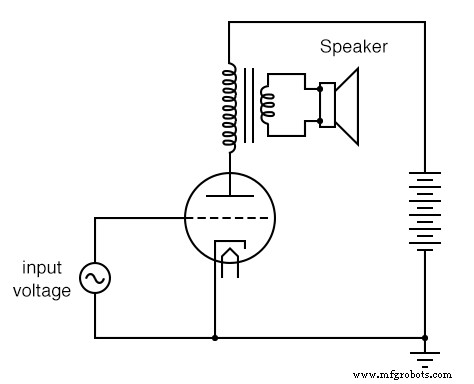
Replacing the triode with a tetrode and tapping the screen for feedback yields a noticeable gain improvement and reduced unwanted plate‑grid coupling.
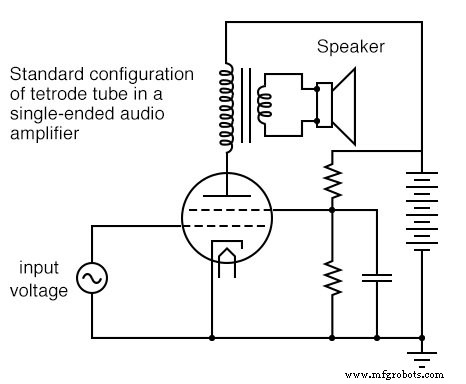
Key to success is ensuring the screen is not overloaded with excessive positive voltage relative to the cathode.
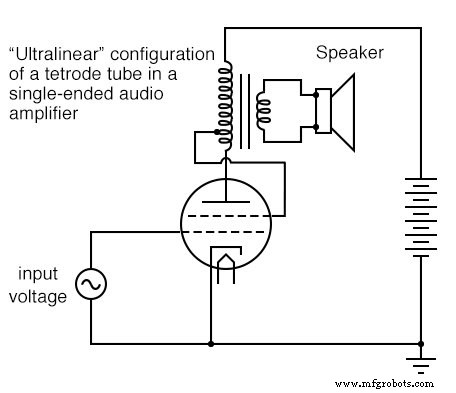
Dual‑Plate Tubes
Some designs employ dual plates sharing a single cathode, with separate control grids for each plate. Common variants include the triode‑heptode and triode‑hexode, the latter featuring four grids, one cathode, and one plate.
Separate Structures Inside One Envelope
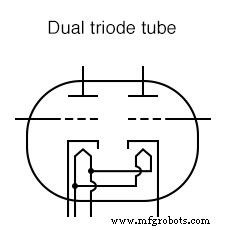
Economy often drove designers to combine distinct tube structures within a single glass envelope. Dual‑diode rectifiers and dual‑triode tubes are classic examples, especially when each device operates at modest power levels.
Typical dual‑triode models include the 12AX7 and 12AU7, both low‑power tubes. The 12AX7 is renowned as a preamplifier tube in electric guitar amplifiers.
Industrial Technology
- Titanium Tubes Explained: 9 Types & Their Industrial Applications
- Variable Inductor Lab: Exploring Magnetic Permeability and Inductive Reactance
- Signal Coupling: Understanding AC Noise in Telephone Cables
- Combination Tubes: Merging Multiple Functions into a Single Glass Envelope
- Key Performance Parameters of Electron Tubes
- Display Tubes: From CRTs to Cat‑Eye Indicators
- Microwave Tube Technology: From Klystrons to Magnetrons
- Current Signal Systems: The 4‑20 mA Loop Explained
- Combination Lock: Design, Manufacturing, and Historical Evolution
- Ensuring Signal Integrity in High-Speed PCB Design