



Display Tubes: From CRTs to Cat‑Eye Indicators
Display tubes have evolved from simple amplification devices to sophisticated visual instruments. Their applications range from oscilloscopes to television monitors, and from voltage meters to signal strength indicators.
The most iconic example is the cathode ray tube (CRT). Originally devised to study electron behavior in vacuum, CRTs became the backbone of oscilloscopes and later the centerpiece of television sets. The distinction lies in the deflection method: oscilloscope CRTs employ electrostatic (plate) deflection, ideal for high‑frequency signal rendering, whereas television CRTs use electromagnetic (coil) deflection. Coils avoid glass penetration, reduce manufacturing costs, and improve reliability—critical for the fixed sweep rates of TV displays.
A lesser‑known but fascinating relative is the Cat‑Eye or Magic‑Eye indicator tube. This device functions as a voltage‑sensitive display, emitting a glowing green ring on a fluorescent screen. The width of the illuminated band directly reflects the potential difference between the control electrode (a narrow rod) and the screen.
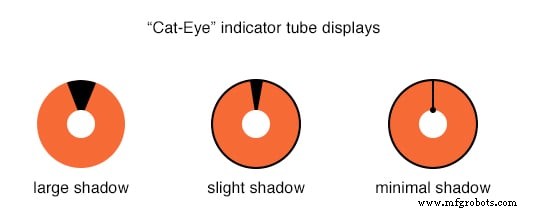
When the control electrode is more negative than the screen, it deflects electrons away, creating a darker shadow that widens with increasing voltage disparity. At zero voltage difference, the screen lights evenly.
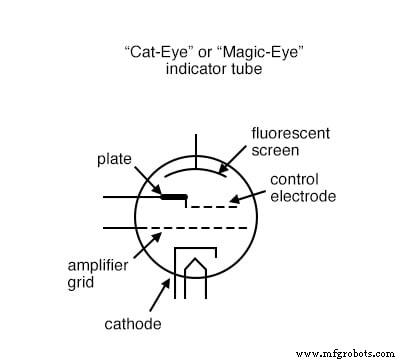
Below is the schematic symbol for a Cat‑Eye tube:
And a real‑world photo showing its circular display, glass envelope, socket, and internal layout:
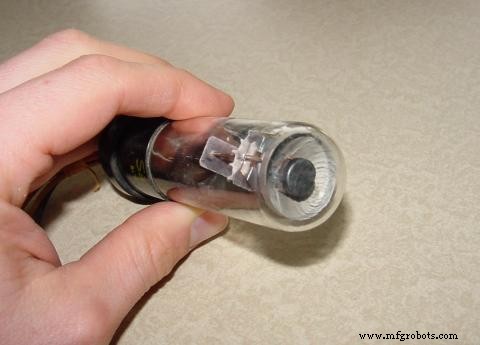
Typically, only the tube’s front is visible on an instrument panel, allowing users to read the display directly.
While a Cat‑Eye tube can operate without an amplifier grid, incorporating a triode arrangement (cathode, amplifier grid, plate) enhances sensitivity. In this configuration, the grid’s small voltage changes produce large plate‑to‑cathode voltage swings, which in turn dramatically alter the shadow width on the screen.
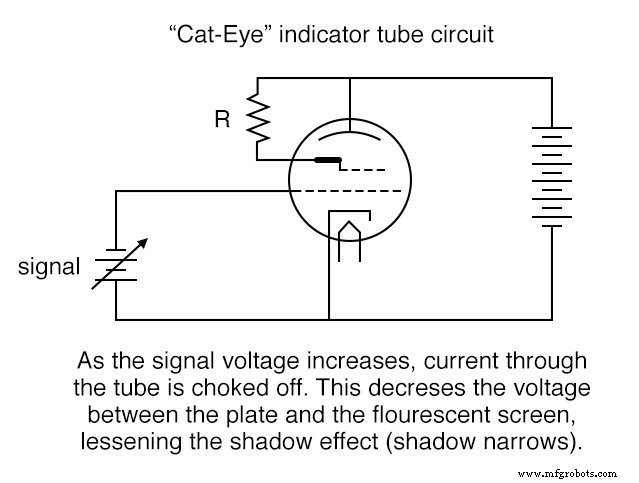
Because of its sensitivity, the Cat‑Eye tube excelled as a null detector in bridge circuits and as a signal‑strength gauge in radio tuning, though it lacked the precision of a graduated CRT scale and could not directly display voltage polarity.
Industrial Technology
- Titanium Tubes Explained: 9 Types & Their Industrial Applications
- Exploring Voltage Addition with Series Battery Connections
- Voltage Divider Lab: Design, Measurement, and Kirchhoff’s Voltage Law Verification
- DIY 12AX7 Vacuum Tube Audio Amplifier – Classic Sound Build
- Understanding Gas Discharge Tubes: From Lightning to Modern Thyristors
- Combination Tubes: Merging Multiple Functions into a Single Glass Envelope
- Gas‑Filled Ionization Tubes: Principles, Types, and Applications
- Microwave Tube Technology: From Klystrons to Magnetrons
- Tachogenerators: Precision Speed Measurement for Industrial Motors and Equipment
- Understanding AC Waveforms: Sine Waves, Frequency, and Oscilloscope Basics